
Exploring the Meaning of Apator in Greek
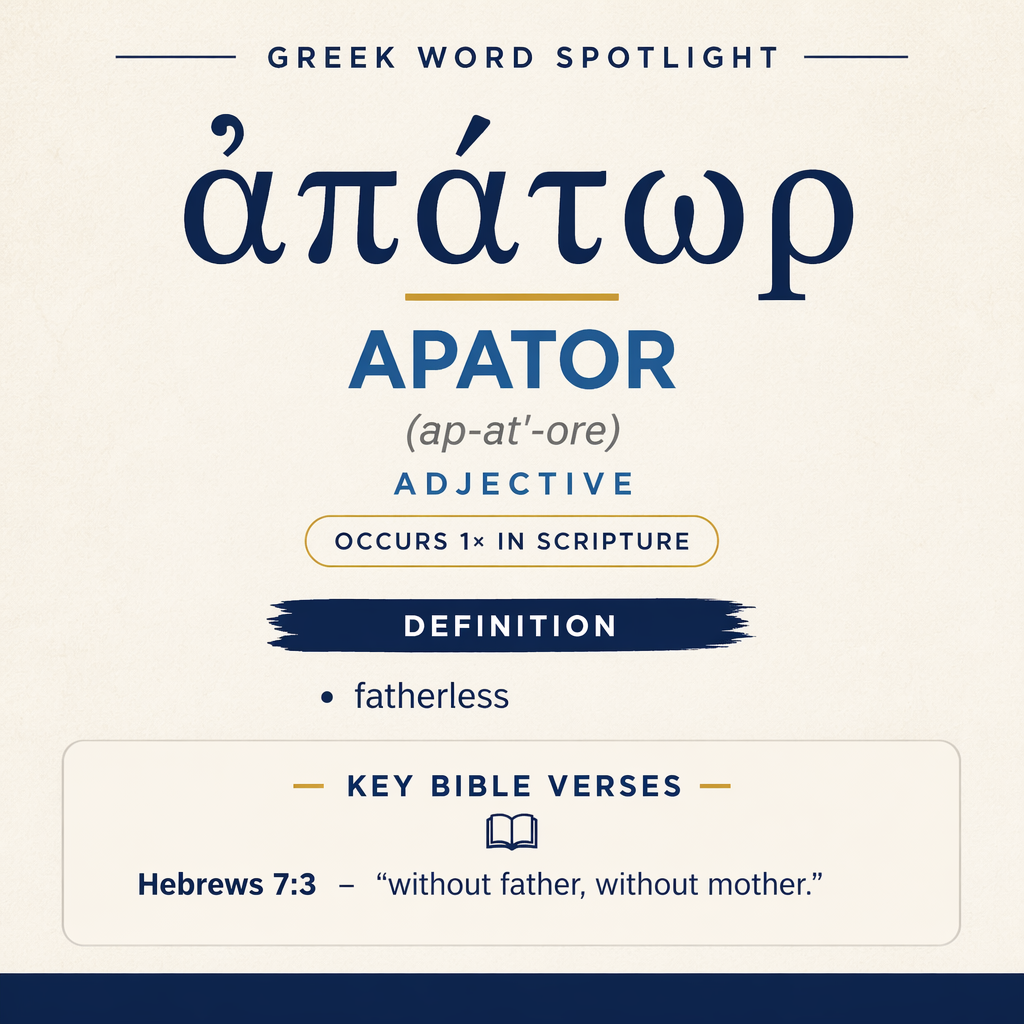
ἀπάτωρ means “fatherless” and appears once in Scripture, in Hebrews 7:3.
Verse Context
Hebrews 7:3 uses it in the description “without father, without mother, without genealogy.”
Learn More →ἀπάτωρ describes someone as “fatherless” and appears once in the New Testament, in Hebrews 7:3. In that verse it belongs to a tightly packed series of descriptions used to portray a priestly figure in a way that supports an argument about continuing priesthood.
Root and Related Words
ἀπάτωρ (Apator) is connected with the noun πατήρ (pater), “father” (Strong’s G3962). Strong’s also links it with Α (Alpha), “Alpha” (Strong’s G1).

Occurrences
“without father, without mother, without genealogy, having neither beginning of days nor end of life, but made like the Son of God), remains a priest continually.” (Hebrews 7:3)
In Hebrews 7:3, ἀπάτωρ stands at the head of a chain of negative descriptions: “without father, without mother, without genealogy….” The word functions as the first stroke in a portrait that deliberately withholds ordinary family anchoring. In the flow of the line, “without father” is not presented as an isolated detail but as part of a coordinated cluster: fatherlessness is paired with being “without mother” and “without genealogy,” then broadened into language about “neither beginning of days nor end of life.” The sequence moves from family relations (father, mother) to record and descent (“genealogy”), and then to temporal framing (“beginning… end”). Within that progression, ἀπάτωρ contributes the initial denial of paternal identification, setting the tone for the rest of the descriptors that follow.
The verse’s syntax also places this description in service of a comparison: the figure so described is “made like the Son of God” and, on that basis, “remains a priest continually.” In this setting, fatherlessness helps create a literary and conceptual distance from standard hereditary lines, preparing for the statement about continual priesthood. The effect in the quoted line is cumulative: “without father” is one element among several that together present a figure whose priestly status is not introduced through ordinary familial or genealogical markers but is instead aligned with an ongoing priestly role.
Sense and Usage
The single attested use of ἀπάτωρ places the idea of being “fatherless” within a structured series of negations. The word is not employed here as a free-standing characterization meant to evoke social vulnerability or personal biography; rather, it operates as a deliberate descriptor within a formal argument that emphasizes the absence of identifying ancestry. Its immediate neighbors—“without mother” and “without genealogy”—clarify how fatherlessness is being used: it belongs to the domain of lineage and descent, the typical ways a person is located within a family line and thereby within a history.
Because the verse arranges its phrases in a rising pattern (from parentage, to genealogical record, to beginnings and endings of life), ἀπάτωρ participates in a rhetorical movement that begins with what is most basic in human identification: a father. The force of the adjective is sharpened by this placement. It is not merely one missing piece of information; it is the first in a sequence of missing coordinates, and the first denial sets up the logic that follows. Read within the quoted sentence, fatherlessness signals that the figure’s identity—at least as it matters for the sentence’s conclusion—is not presented in terms of paternal descent.
In the same breath, the line moves to priesthood: “remains a priest continually.” The adjective therefore serves a priestly argument in context. It contributes to a portrayal in which the continuing nature of priesthood is connected with the absence of the ordinary markers that would establish a beginning through ancestry or an ending through succession. Within the verse’s own wording, fatherlessness is one of the features that supports the depiction of an uninterrupted priestly standing, especially as the figure is “made like the Son of God.”
Even in a single occurrence, the usage shows how ἀπάτωρ can function precisely: it does not need additional narrative explanation in the line itself, because the surrounding phrases interpret its relevance. “Without father” is immediately balanced by “without mother,” and both are then interpreted through “without genealogy.” In other words, the verse itself frames fatherlessness as an ancestry-related absence, not as a detached label. That framing helps the final clause land with its intended weight: the figure described by these absences “remains a priest continually.”
Imagery
The imagery of ἀπάτωρ in Hebrews 7:3 is spare and formal: the reader is asked to picture a priestly figure whose paternal line is not traced. The word contributes to an image of identity without the usual family reference points—an identity presented without the normal introduction through fatherhood, and therefore suited, within the verse’s own logic, to a description of continuing priesthood.
Sources: Lexical data from Strong’s Exhaustive Concordance and the Translators Brief Lexicon of Extended Strongs for Greek (STEPBible, CC BY). Occurrence data from the Translators Amalgamated Greek New Testament (STEPBible, CC BY). Scripture quotations from the World English Bible (public domain).




