Exploring the Meaning of Apatao in Greek
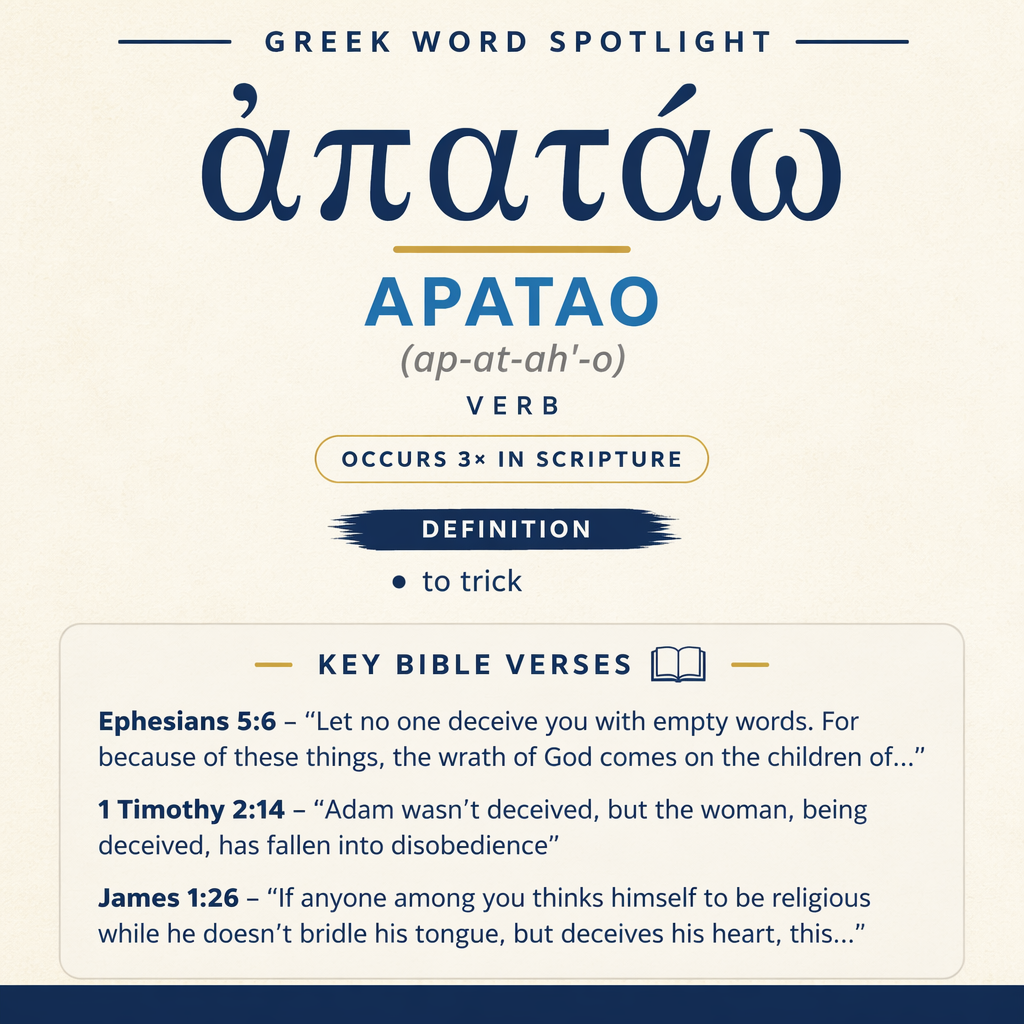
ἀπατάω means “to trick” and appears three times in Scripture: Ephesians 5:6, 1 Timothy 2:14, and James 1:26.
Core Meaning
ἀπατάω is defined as “to trick.” In its listed verses, it describes deceiving someone.
Learn More →Where It Appears
This word occurs 3 times in Scripture. The references are Ephesians 5:6, 1 Timothy 2:14, and James 1:26.
Learn More →Verse Snapshots
Ephesians 5:6 warns, “Let no one deceive you with empty words.” 1 Timothy 2:14 and James 1:26 speak of being deceived and deceiving one’s heart.
Learn More →ἀπατάω means “to trick,” describing the act of leading someone by words or impressions that are empty, misleading, or internally persuasive. In the New Testament it appears in moral warning (Ephesians), an account of being led astray (1 Timothy), and self-deception at the level of the heart (James).
Occurrences
Ephesians 5:6 — “Let no one deceive you with empty words. For because of these things, the wrath of God comes on the children of disobedience.”
Here ἀπατάω is framed as something done to the readers by “no one,” and its chief instrument is “empty words.” The warning assumes that trickery can arrive clothed in speech that sounds meaningful while lacking substance; it is not a mere mistake but an attempt to mislead. The immediate stakes are ethical and communal: the verse links such misleading speech with the peril of becoming aligned with “the children of disobedience,” on whom “the wrath of God comes.” Within this sentence, tricking is not treated as a private mental event but as a social act—someone speaks, others may be swayed, and the result is a shift toward disobedience.

The phrase “because of these things” ties the warning to a broader moral context in the surrounding exhortation, but even within this single verse the logic is clear: empty words can blunt moral seriousness and soften the perceived consequences of disobedience. Thus ἀπατάω functions as a guardrail term: it names the threat of being verbally manipulated into a false sense of safety, as though disobedience carries no weight.
1 Timothy 2:14 — “Adam wasn’t deceived, but the woman, being deceived, has fallen into disobedience;”
In this line ἀπατάω appears in a contrast: “Adam wasn’t deceived, but the woman, being deceived….” Trickery is presented not as an abstract possibility but as an explanatory factor for “fallen into disobedience.” The construction “being deceived” portrays the action as something that happened to her—she was the object of the tricking—and the stated outcome is not confusion alone but a concrete moral descent into disobedience.
Because the sentence distinguishes between two people with different relations to deception, ἀπατάω is treated as a decisive turning point: one party is described as not having undergone it, while the other is marked by it, with disobedience named as the consequent state. The verse therefore places trickery in a causal chain (deceived → fallen into disobedience), highlighting the potency of deception to redirect conduct.
James 1:26 — “If anyone among you thinks himself to be religious while he doesn’t bridle his tongue, but deceives his heart, this man’s religion is worthless.”
James uses ἀπατάω reflexively in effect: the person “deceives his heart.” The setting is self-assessment—someone “thinks himself to be religious”—and the problem is a mismatch between that self-perception and the unchecked speech that follows (“doesn’t bridle his tongue”). Trickery here is internalized; the agent and the victim are closely bound (“he” deceives “his heart”), so the deception is not simply outside misinformation but a form of self-misleading that lodges at the core of evaluation and desire.
The verse also specifies a practical trigger: unrestrained speech correlates with a heart that is being tricked. In this scene, ἀπατάω names the way a person can maintain a religious self-image while their own inner life is being misled, resulting in an assessment that is blunt and final: “this man’s religion is worthless.” The verb therefore serves to expose the mechanism by which outward claims persist even when the inner center has been turned by false impressions.

Sense and Usage
Across these passages, “to trick” operates in three closely related directions: tricking by others through persuasive speech, being tricked as a gateway into disobedience, and tricking one’s own heart in the maintenance of a religious identity. The unifying thread is that ἀπατάω is not mere ignorance; it is the successful planting of a misleading impression that alters orientation and conduct.
Ephesians 5:6 emphasizes the medium: “empty words.” This locates trickery in language that sounds plausible but lacks the weight of truthfulness and moral consequence. The verse does not analyze the content of such words; it evaluates them by their emptiness and their effect. The command “Let no one deceive you” treats deception as a recognizable pressure that must be resisted, and it places responsibility on the audience to refuse the influence. Trickery, then, is depicted as an external force that seeks entrance through speech.
1 Timothy 2:14 emphasizes the result: “has fallen into disobedience.” Deception is not portrayed as morally neutral, as though it merely changes an opinion; it is tied to a fall—an actual movement into disobedience. In the logic of the statement, being tricked provides a pathway whereby disobedience becomes the settled outcome. The verse’s contrastive structure also shows that deception can be absent in one case and present in another, underscoring that ἀπατάω is a distinct event or condition with tangible consequences.
James 1:26 emphasizes the locus: “his heart.” Here trickery is internal and self-sustained, interacting with speech (“tongue”) and self-concept (“thinks himself to be religious”). The heart is the seat of the deception’s effect: it is where the misleading impression is received and maintained. The verb therefore covers a range from interpersonal manipulation to self-induced misdirection, yet in each case the action of tricking produces a false assessment—either about moral safety (Ephesians), about the path into disobedience (1 Timothy), or about the worth of one’s religion (James).
The three scenes also show how ἀπατάω intersects with responsibility. Ephesians issues a direct prohibition against being deceived, portraying vigilance as necessary when faced with empty speech. James holds the person accountable for deceiving his own heart, linking that self-deception to an unbridled tongue and a verdict of worthlessness. Even in 1 Timothy, where the grammatical focus is on being deceived, the outcome is described in moral terms (“fallen into disobedience”), indicating that deception is significant precisely because of what it brings about in behavior and allegiance.
Imagery and Emphasis
The passages cluster around the image of words and inner judgment. In Ephesians 5:6, trickery rides on “empty words” and aims at shifting a community toward the pattern of “disobedience.” In James 1:26, the unbridled tongue becomes part of the machinery by which the heart is tricked, allowing a person to keep thinking himself religious even as his religion is judged “worthless.” In 1 Timothy 2:14, deception stands at the doorway to a fall into disobedience. Taken together, ἀπατάω carries the weight of misdirection that is not harmless: it reorients people—by speech, by inward persuasion, or by a decisive misled turn—toward disobedience and away from truthful self-understanding.
Sources: Lexical data from Strong’s Exhaustive Concordance and the Translators Brief Lexicon of Extended Strongs for Greek (STEPBible, CC BY). Occurrence data from the Translators Amalgamated Greek New Testament (STEPBible, CC BY). Scripture quotations from the World English Bible (public domain).