
Exploring the Meaning of Anistemi in Greek
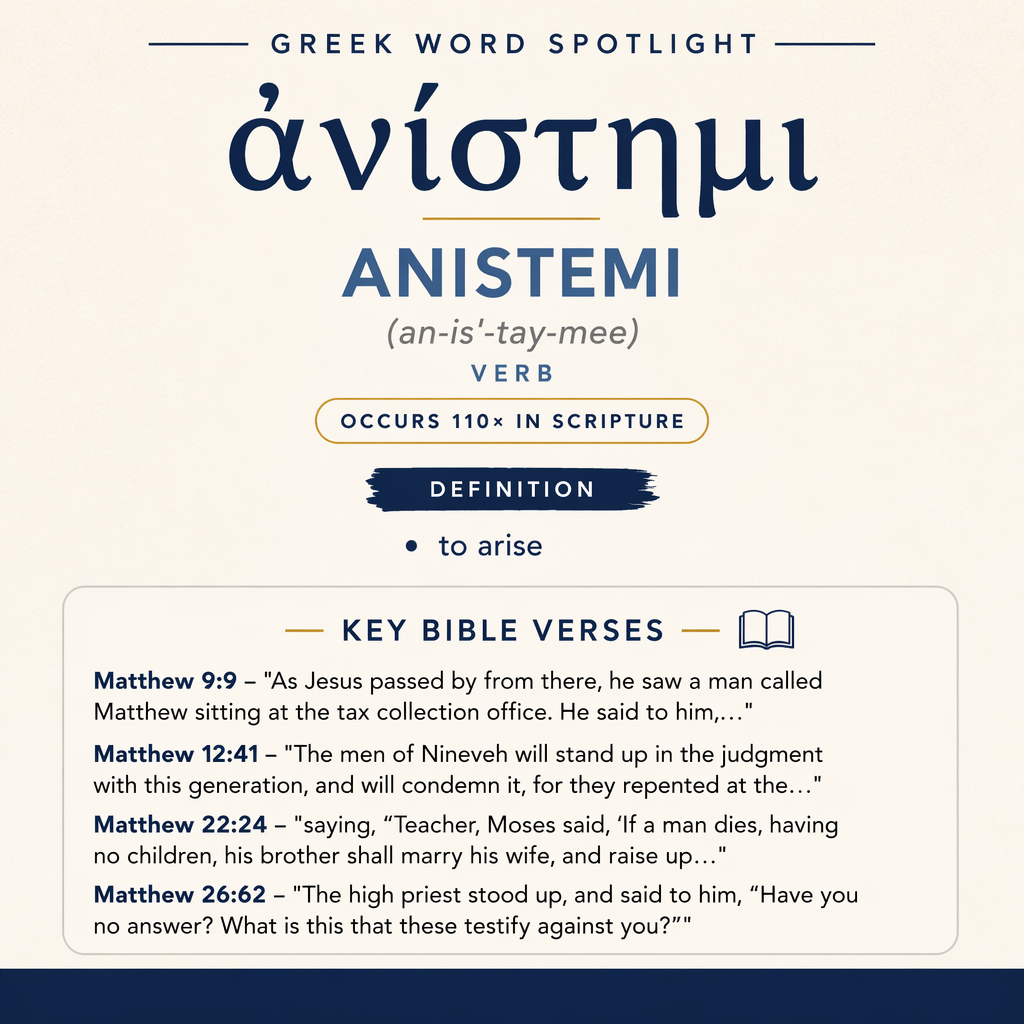
ἀνίστημι means “to arise” and occurs 110 times in Scripture, including in Matthew (e.g., 9:9; 12:41; 26:62) and Mark (e.g., 1:35; 5:42).
Core Meaning
ἀνίστημι is defined as “to arise.” In the cited verses, it is used for rising up or standing up.
Learn More →Gospel Examples
In Matthew 26:62 the high priest “stood up,” and in Mark 1:35 Jesus “rose up.” In Mark 5:42 a girl “rose up and walked.”
Learn More →Scripture Footprint
This verb occurs 110 times in Scripture. The provided examples include multiple occurrences in Matthew and Mark.
Learn More →ἀνίστημι expresses the act of arising, a movement from a prior position into an upright or newly active stance. In the passages below it appears in scenes of physical getting up, formal standing in public speech, and the narrated “rising” that marks both opposition and vindication.
Occurrences
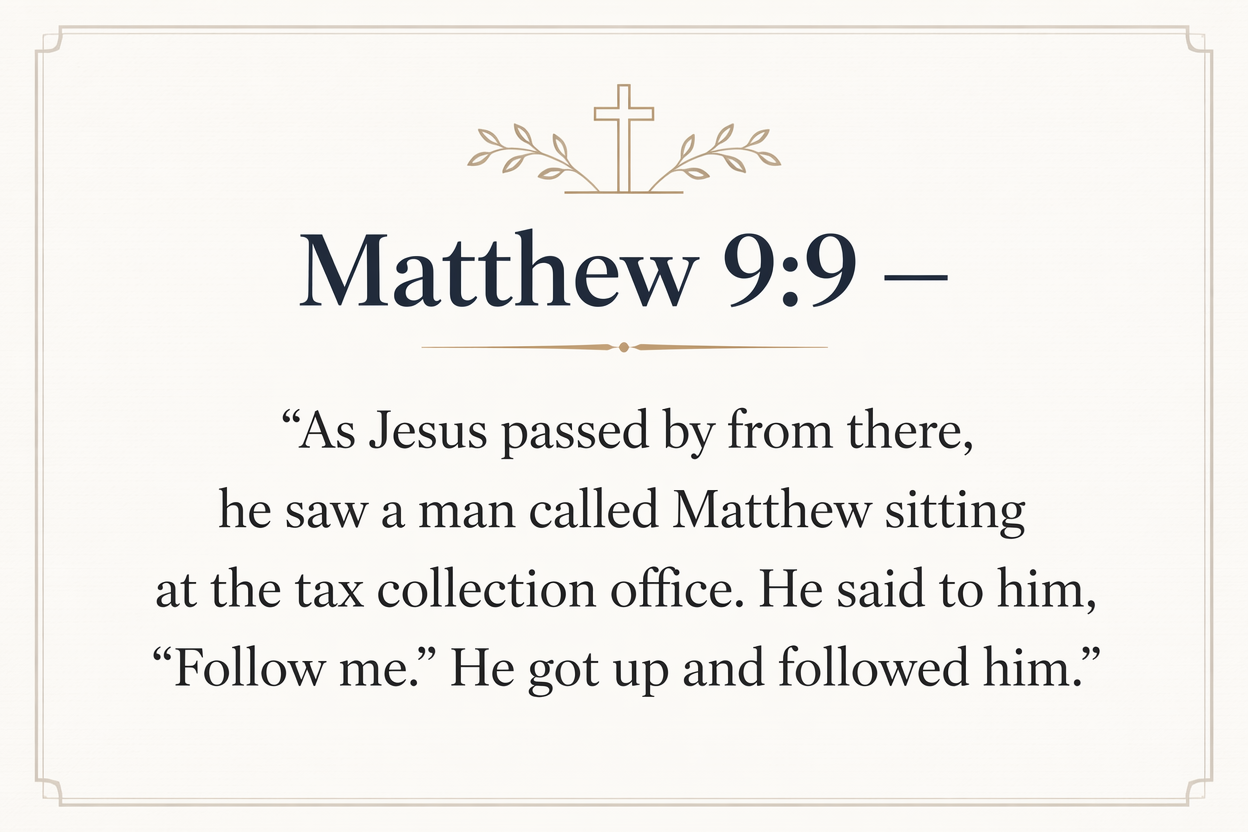
Matthew 9:9 — “As Jesus passed by from there, he saw a man called Matthew sitting at the tax collection office. He said to him, “Follow me.” He got up and followed him.”
Here ἀνίστημι marks the immediate bodily response to a summons. Matthew is first pictured “sitting,” then, on hearing “Follow me,” he “got up,” and that rising is joined directly to the next action: “and followed him.” The verb therefore carries the hinge-moment that turns a stationary posture into enacted discipleship within the same sentence.
Matthew 12:41 — “The men of Nineveh will stand up in the judgment with this generation, and will condemn it, for they repented at the preaching of Jonah; and behold, someone greater than Jonah is here.”
In this saying, ἀνίστημι is projected into a courtroom-like future scene: “will stand up in the judgment.” The rising is not about walking away or beginning travel, but about taking a posture that signals presence and active participation. Their standing places them “with this generation” and is paired with a decisive outcome—“and will condemn it”—so the verb contributes the image of persons rising to take a position in judgment.
Matthew 22:24 — “saying, “Teacher, Moses said, ‘If a man dies, having no children, his brother shall marry his wife, and raise up offspring for his brother.’”
In the citation of Moses, ἀνίστημι is used for “raise up offspring.” The action is not a simple change of posture but the bringing about of a new standing within a family line—offspring who “stand up” as the brother’s continuation. Within the quoted rule, this “raising up” is tied to the situation “If a man dies, having no children,” so the verb frames a remedy that counters the finality of death by establishing descendants.
Matthew 26:62 — “The high priest stood up, and said to him, “Have you no answer? What is this that these testify against you?””
Here ἀνίστημι describes a formal, public movement in a judicial interrogation. The high priest “stood up” and then immediately speaks; the standing functions like a procedural step that underscores the gravity and authority of the questions that follow. The verb contributes a visible shift in the room: from hearing testimony to demanding an answer.
Mark 1:35 — “Early in the morning, while it was still dark, he rose up and went out, and departed into a deserted place, and prayed there.”
In Mark’s narrative, ἀνίστημι marks the start of a sequence of purposeful actions. Jesus “rose up” in darkness and then “went out” and “departed into a deserted place,” ending with prayer. The rising is the initiating movement that sets the entire chain in motion, highlighting readiness and intention rather than mere waking.
Mark 2:14 — “As he passed by, he saw Levi, the son of Alphaeus, sitting at the tax office, and he said to him, “Follow me.” And he arose and followed him.”
This scene parallels the earlier call narrative: Levi is “sitting,” is addressed with “Follow me,” and “arose and followed him.” ἀνίστημι again functions as the decisive transition from seated work at the tax office to accompanying Jesus. The verb’s contribution is the immediate outward change that matches the inward decision implied by following.
Mark 3:26 — “If Satan has risen up against himself, and is divided, he can’t stand, but has an end.”
Here ἀνίστημι is used figuratively for internal opposition: “has risen up against himself.” The rising is not described as physical standing from a chair, but as the initiation of conflict within a single entity. The result is instability—“is divided”—and an inability “to stand,” leading to “an end.” In this argument, the verb supplies the image of an uprising that begins division and collapse.
Mark 5:42 — “Immediately the girl rose up and walked, for she was twelve years old. They were amazed with great amazement.”
In the healing account, ἀνίστημι denotes a concrete reversal of the girl’s prior condition: she “rose up and walked.” The immediacy (“Immediately”) and the added detail (“for she was twelve years old”) keep the focus on the reality of the act. The verb’s force is seen in the astonished reaction—“They were amazed with great amazement”—as her rising becomes the visible proof of restored life and ability.
Mark 7:24 — “From there he arose, and went away into the borders of Tyre and Sidon. He entered into a house, and didn’t want anyone to know it, but he couldn’t escape notice.”
ἀνίστημι here is the narrative marker that precedes travel. Jesus “arose” and “went away” into a new region, then enters a house seeking privacy. The rising is the first step in relocation, introducing a transition in geography and in the story’s setting, even as his desire for concealment is frustrated.
Mark 8:31 — “He began to teach them that the Son of Man must suffer many things, and be rejected by the elders, the chief priests, and the scribes, and be killed, and after three days rise again.”
In this teaching, ἀνίστημι names the culminating movement after suffering, rejection, and death: “after three days rise again.” The verb stands as the counterpart to being “killed,” expressing the change from death to new standing. It is presented as part of what “must” happen, embedded in a sequence that moves from hostility to death and then to rising.
Mark 9:9 — “As they were coming down from the mountain, he commanded them that they should tell no one what things they had seen, until after the Son of Man had risen from the dead.”
Here ἀνίστημι is placed as a temporal boundary for speech: silence is required “until after” the Son of Man “had risen from the dead.” The verb anchors the command in a future event that will change what can properly be told. The phrase “from the dead” specifies the sphere from which the rising occurs, intensifying the sense of a decisive transition.
Mark 9:10 — “They kept this saying to themselves, questioning what the “rising from the dead” meant.”
In this response, ἀνίστημι appears as a noun-like concept within quotation marks: “the ‘rising from the dead.’” The disciples’ questioning shows that the rising is not treated as a vague metaphor in their hearing, but as a specific idea needing interpretation. The verb’s contribution in the narrative is therefore also cognitive: it becomes the focal term around which their private discussion turns.

Sense and Usage
Across these passages, ἀνίστημι consistently marks a transition into an upright or newly active state, and the narratives use that transition to signal decisive turns. In the call scenes (Matthew 9:9; Mark 2:14), the verb sits between “sitting” and “followed,” making the bodily act of getting up the outward pivot that expresses the acceptance of Jesus’ directive. The same basic motion appears in Mark 1:35 and Mark 7:24, where rising is the first step that initiates movement away—either into solitude for prayer or into a new region.
In public or judicial contexts, the act of rising carries social weight. The high priest’s standing (Matthew 26:62) introduces authoritative speech, while the men of Nineveh “stand up in the judgment” (Matthew 12:41), where rising is bound to testimony-like participation and the act of condemnation. In such scenes, ἀνίστημι depicts more than posture; it marks the moment a figure takes a position before others.
Several occurrences expand the scope of “arising” beyond ordinary movement. Mark 3:26 uses the verb for an internal uprising—an action that begins opposition and division. Matthew 22:24 applies it to “raise up offspring,” where the idea of arising is mapped onto the establishment of descendants in the face of death. Mark 5:42 portrays rising as the observable sign of restoration, immediately linked with walking and communal amazement. Finally, Mark 8:31; 9:9; and 9:10 concentrate the term in the claim and concept of rising “from the dead,” treating ἀνίστημι as the decisive transition that follows being “killed” and as the event that structures both Jesus’ instructions and the disciples’ perplexed discussion.
Imagery in Context
The word’s imagery in these texts is consistently kinetic: someone who was seated stands and follows; someone who was silent stands and speaks; a journey begins with getting up; conflict begins with “rising up”; and the starkest boundary—death itself—is followed by “rising from the dead.” Whether the scene is a tax office, a hearing, early darkness before prayer, or a discussion on the way down a mountain, ἀνίστημι supplies the narrative’s visible turning point: the moment when a new stance is taken and what follows is set into motion.
Sources: Lexical data from Strong’s Exhaustive Concordance and the Translators Brief Lexicon of Extended Strongs for Greek (STEPBible, CC BY). Occurrence data from the Translators Amalgamated Greek New Testament (STEPBible, CC BY). Scripture quotations from the World English Bible (public domain).





