Exploring the Meaning of Aneu in Greek
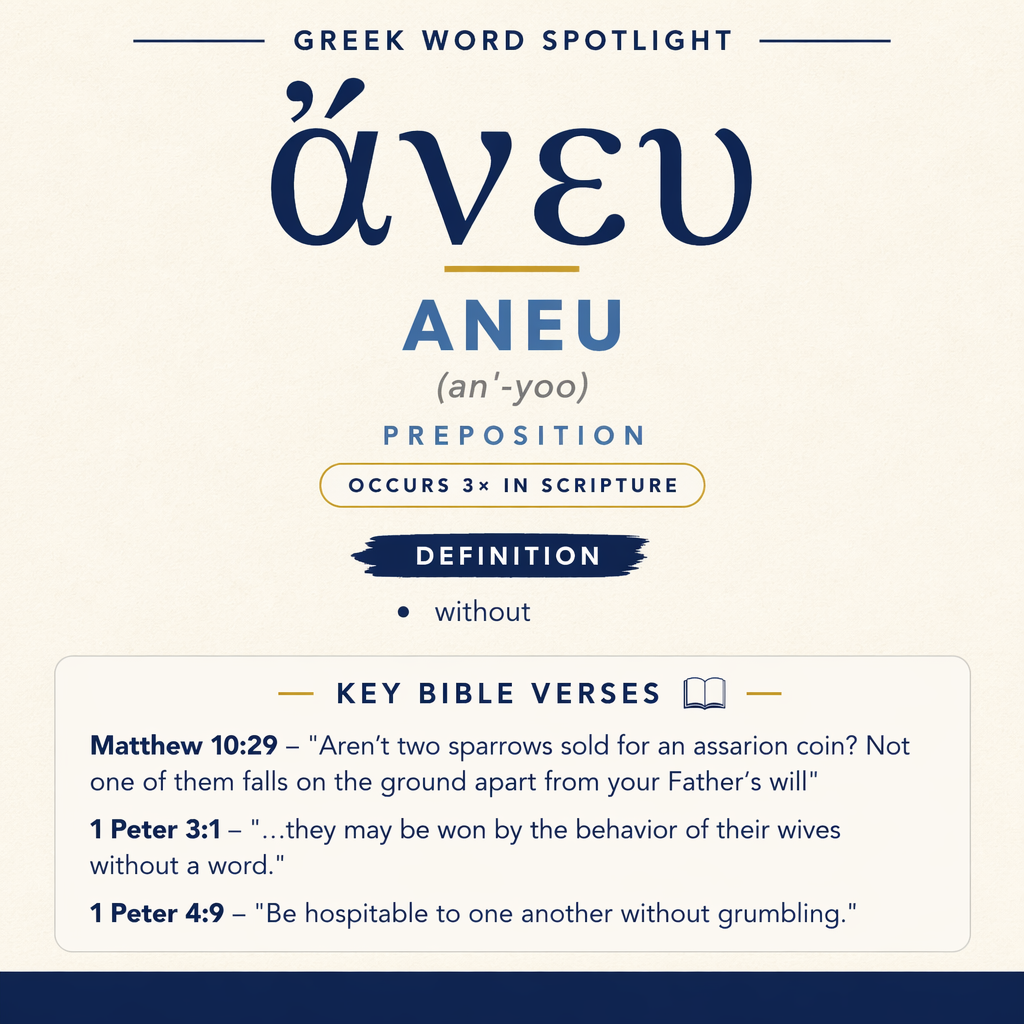
ἄνευ means “without” and occurs three times in Scripture: Matthew 10:29; 1 Peter 3:1; 1 Peter 4:9.
Where It Appears
It occurs 3 times in Scripture: Matthew 10:29; 1 Peter 3:1; 1 Peter 4:9.
Learn More →Scripture Examples
In Matthew 10:29 it appears in “apart from your Father’s will,” and in 1 Peter 4:9 in “without grumbling.”
Learn More →ἄνευ expresses the idea of something occurring “without.” It appears in Matthew 10:29 and twice in 1 Peter, shaping how the reader understands agency, speech, and attitude in the situations described.
Occurrences
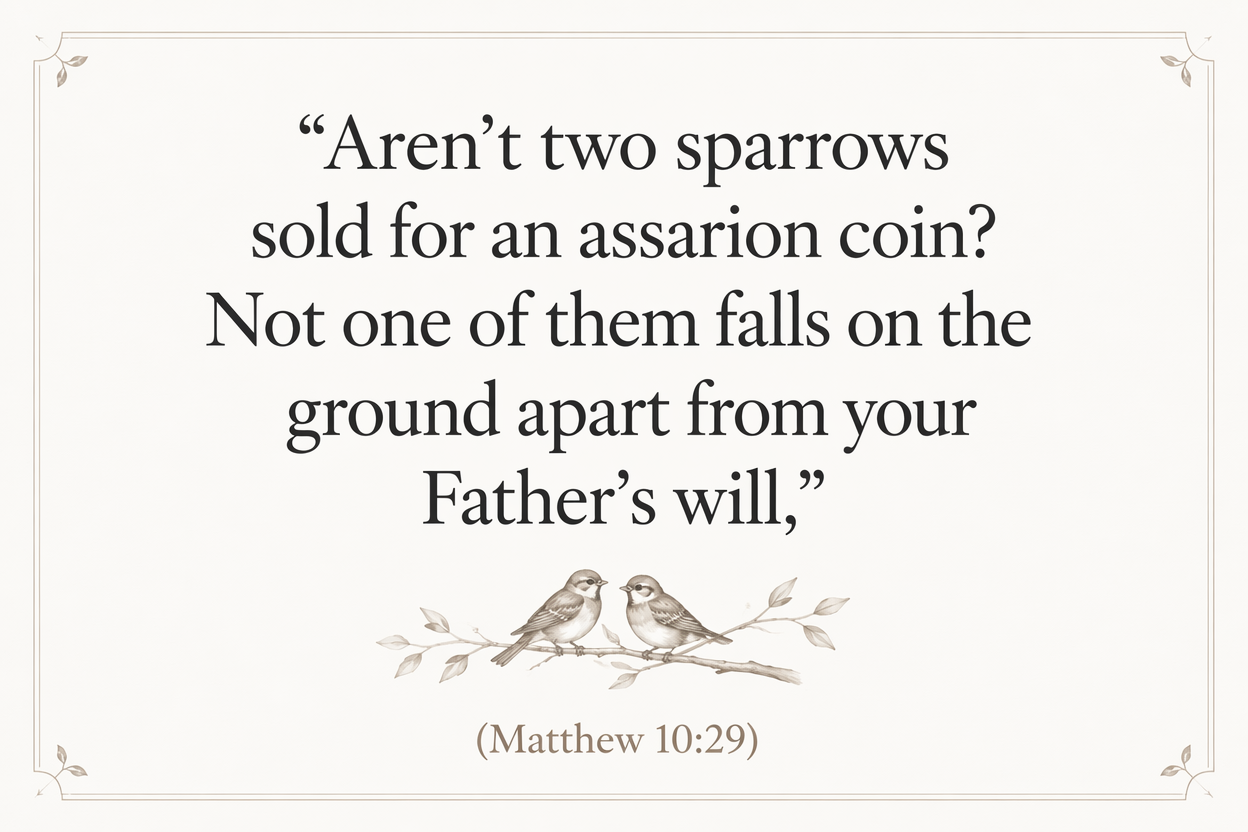
“Aren’t two sparrows sold for an assarion coin? Not one of them falls on the ground apart from your Father’s will,” (Matthew 10:29)
Here ἄνευ frames a claim about events that seem ordinary and easily overlooked. The scene is deliberately small in scale: inexpensive sparrows, sold for a tiny coin, and the simple fact of one “falls on the ground.” By adding “apart from your Father’s will,” the statement sets a boundary around what can be imagined as happening on its own. The wording does not describe the mechanics of the Father’s will; it uses ἄνευ to deny the possibility of the sparrow’s fall occurring in separation from that will. In this sentence, “without” is not about lacking an object or resource, but about excluding independence: the fall of even the least valued creature is not depicted as detached from divine intention.
In the same way, wives, be in subjection to your own husbands; so that, even if any don’t obey the Word, they may be won by the behavior of their wives without a word, (1 Peter 3:1)
In 1 Peter 3:1, ἄνευ is tied to communication and persuasion. The instruction anticipates a difficult domestic setting: some husbands “don’t obey the Word.” The hoped-for outcome is strikingly specific: “they may be won by the behavior of their wives.” The phrase “without a word” uses ἄνευ to describe a manner of influence that does not rely on verbal argument or speech. The verse sets “behavior” and “a word” in a purposeful contrast: conduct is presented as the means of winning, while words are explicitly set aside as unnecessary to that effect. ἄνευ therefore functions rhetorically to clear space for a kind of witness expressed in actions rather than in spoken persuasion, emphasizing the sufficiency of the wives’ visible manner of life for the intended result.
Be hospitable to one another without grumbling. (1 Peter 4:9)
In 1 Peter 4:9, ἄνευ qualifies a communal command with an inner posture. The directive “Be hospitable to one another” already requires tangible action: opening one’s home, resources, and time. The added phrase “without grumbling” uses ἄνευ to prohibit the accompaniment of that hospitality by complaint. The instruction is not merely about performing hospitality, but about how it is performed—what is excluded from it. ἄνευ makes “grumbling” an inadmissible partner to the practice, as though hospitality is meant to be whole and undivided, not outwardly generous while inwardly resentful or vocal in dissatisfaction.

Sense and Usage
Across these three passages, ἄνευ consistently marks absence, but it does so in different kinds of relationships. In Matthew 10:29, the absence is relational and conceptual: an event is denied the possibility of occurring in separation from “your Father’s will.” The word signals that a boundary has been drawn around reality as the speaker presents it; what happens is not pictured as standing alone, detached from the Father’s governance. Here “without” points to the excluded condition of independence, not to a missing material item.
In 1 Peter, the same term is applied to human conduct, twice functioning as a kind of moral and practical qualifier. In 1 Peter 3:1, “without a word” defines the mode by which a result may occur—being “won” by “behavior.” The phrase gives shape to the author’s pastoral strategy: the desired change is linked to observable life rather than verbal insistence. ἄνευ therefore helps distinguish between two possible instruments of influence in the home: speech and conduct. By specifying “without a word,” the verse does not merely praise silence; it directly attaches the prospect of persuasion to behavior as the operative factor while excluding reliance on spoken words within that sentence’s logic.
In 1 Peter 4:9, “without grumbling” operates similarly but with a different object. Here the command concerns a practice that can easily be burdened by reluctance. ἄνευ functions to separate the act of hospitality from the attitude of complaint, aiming for congruence between action and disposition. The term thus serves to regulate not only what believers do to one another, but what they are not to add to it. The preposition creates a clean line: hospitality is commanded; grumbling is barred from accompanying it.
Seen together, these uses show ἄνευ at work in both theological assertion and ethical instruction. In Matthew it strengthens a claim about divine oversight by denying the “without” scenario—no sparrow’s fall is pictured as occurring apart from the Father’s will. In 1 Peter it strengthens community norms by denying certain accompaniments—speech in one setting, complaint in another. The word’s force is therefore often felt less in what it introduces than in what it excludes: it removes imagined alternatives (independent occurrence; persuasion by words; hospitality accompanied by grumbling) so the reader focuses on the intended frame (the Father’s will; persuasive behavior; uncomplaining hospitality).
Because ἄνευ is a preposition, its contribution is often compact but decisive. It does not add a new action to the sentence; it modifies the conditions under which the action is understood. In these verses, it works as a boundary-marker: what is happening is defined partly by what is absent from it. That boundary can fall in different domains—between an event and a claimed divine relation (Matthew), between a hoped-for outcome and the means by which it is pursued (1 Peter 3), or between a commanded practice and the spirit that might otherwise sour it (1 Peter 4). In each case, the reader is guided to imagine the scene with a particular subtraction: the event is not detached; the influence is not verbal; the hospitality is not resentful.
Imagery in Context
The imagery shaped by ἄνευ is concrete in Matthew and practical in 1 Peter. In Matthew 10:29, the picture of a sparrow falling “on the ground” is given weight by the denial that such a fall occurs “apart from your Father’s will,” turning a small moment into an occasion for considering how closely life is held within divine purpose. In 1 Peter 3:1, the phrase “without a word” draws attention to visible conduct as a quiet, steady presence within a strained household dynamic. In 1 Peter 4:9, “without grumbling” evokes the everyday setting of hospitality and presses for a kind of generosity that is not undercut by complaint, so that the act offered to “one another” is not accompanied by a sour voice or spirit.
Sources: Lexical data from Strong’s Exhaustive Concordance and the Translators Brief Lexicon of Extended Strongs for Greek (STEPBible, CC BY). Occurrence data from the Translators Amalgamated Greek New Testament (STEPBible, CC BY). Scripture quotations from the World English Bible (public domain).