Exploring the Meaning of Aneleemon in Greek
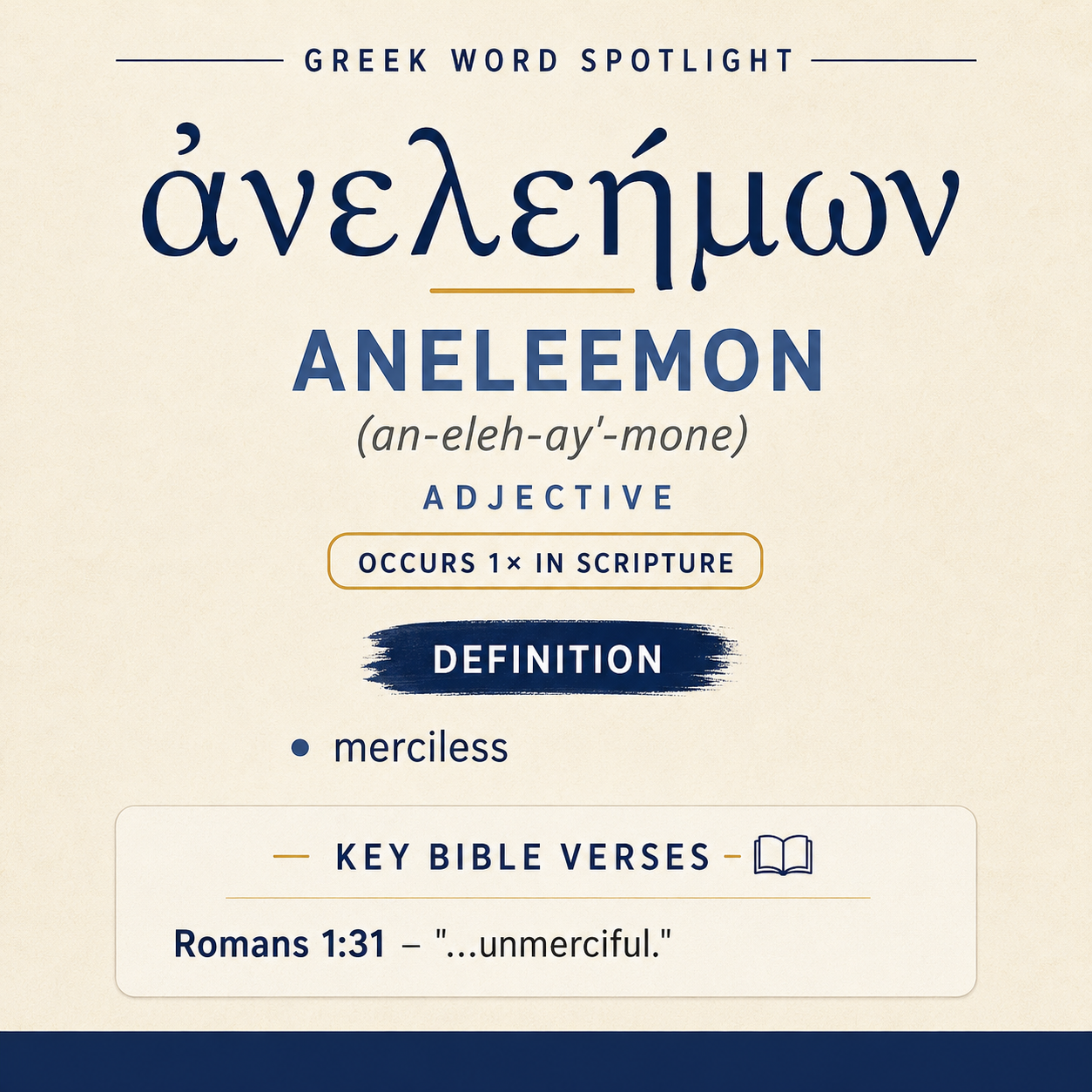
ἀνελεήμων means “merciless” and appears once in Scripture, in Romans 1:31.
Verse Context
In Romans 1:31, ἀνελεήμων is rendered “unmerciful.” It appears in a list including “without understanding” and “covenant breakers.”
Learn More →ἀνελεήμων means “merciless” and appears in Paul’s vice list in Romans, where it characterizes a hardened moral posture within a broader catalogue of relational and covenantal breakdown.
Root and Related Words
ἀνελεήμων (Aneleemon) is connected, in Strong’s derivation, to the letter-name Alpha, α (A, “Alpha,” Strong’s G1), and to ἐλεήμων (eleemon, “merciful,” Strong’s G1655). The form and spelling set it in deliberate contrast to eleemon, presenting a negated or opposite quality to what “merciful” names.

Occurrences
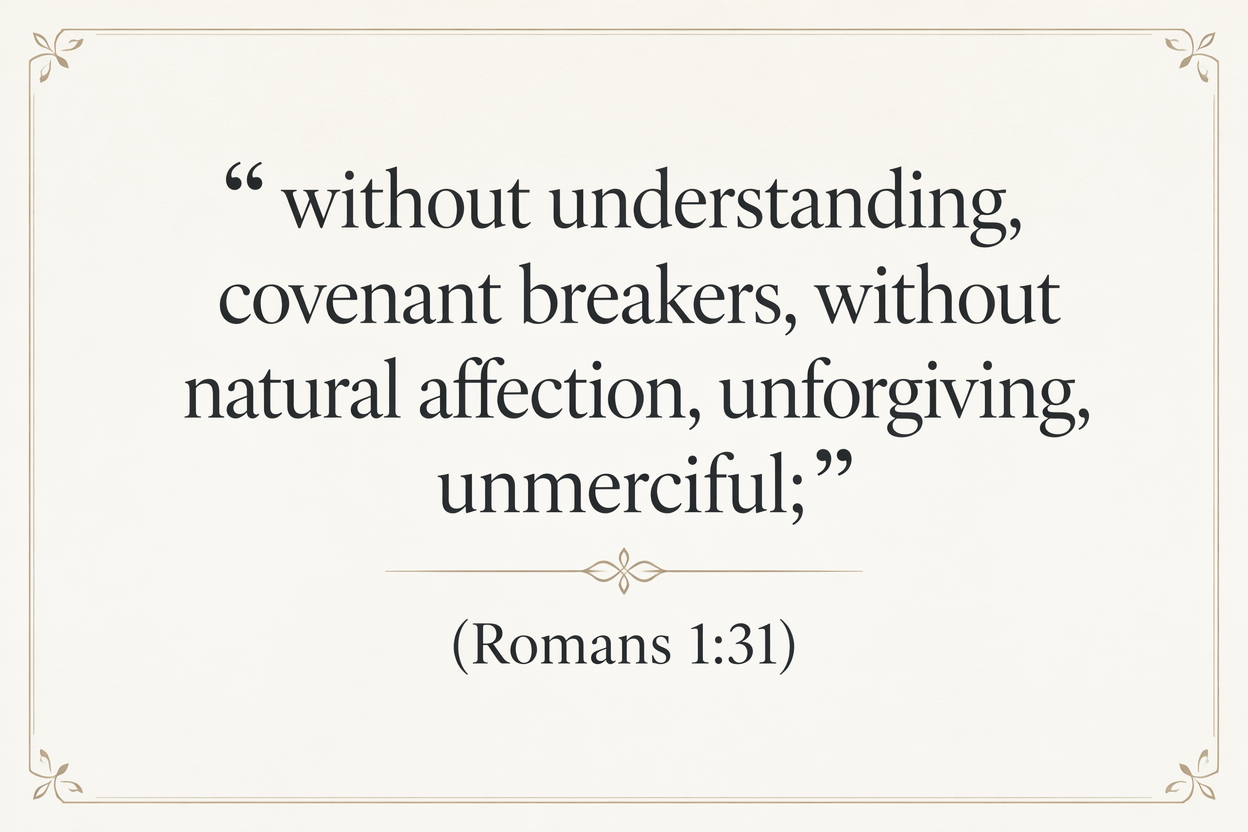
“without understanding, covenant breakers, without natural affection, unforgiving, unmerciful;” (Romans 1:31)
In Romans 1:31, ἀνελεήμων stands at the end of a tightly packed series of descriptors, each one sketching a collapse of moral and relational integrity. The immediate neighbors in the list are not abstract in tone: they are social and covenantal fractures—“covenant breakers,” failures of “natural affection,” and the settled refusal to release offense (“unforgiving”). Within that progression, “unmerciful” functions as a culminating relational verdict: a person described this way does not act with the kind of compassionate restraint that would mitigate harm or answer need. The term’s placement after “unforgiving” sharpens the portrait, as both words point to an inward posture that withholds a favorable response toward others. The surrounding items give the reader the frame for how “unmerciful” operates here: it is not merely an isolated trait but part of a cluster of attitudes that damage human bonds and erode trust—especially when paired with “covenant breakers,” which evokes the breaking of pledged commitments.
Because the verse is a list, ἀνελεήμων contributes by naming the moral temperature of the whole: the set of qualities moves from intellectual/moral dullness (“without understanding”) to the betrayal of formal obligations (“covenant breakers”), then to the disintegration of close human loyalties (“without natural affection”), and finally to the refusal to pardon (“unforgiving”) and the refusal to show mercy (“unmerciful”). Read within this sequence, “unmerciful” is not an accidental add-on; it is an endpoint that exposes the absence of pity or compassionate action as part of the same pattern of relational failure.
Sense and Usage
The single New Testament occurrence of ἀνελεήμων uses “merciless” as a moral descriptor in a plural catalogue, where a person or people can be marked out by recognizable patterns of conduct. In Romans 1:31, the word’s sense is shaped by adjacency: it appears where interpersonal duties are already being violated. “Covenant breakers” and “without natural affection” set the context in the realm of obligations and attachments; “unforgiving” sets the context in the realm of offense and response. Against that backdrop, “unmerciful” describes a further refusal: not simply failing in justice or truthfulness (ideas not stated in the verse), but failing in merciful regard toward others.
The list format also gives the term a diagnostic role. Paul’s string of adjectives is meant to be read cumulatively—each item reinforcing the next—so “unmerciful” participates in a portrait of moral life when it has become closed in on itself. In that portrait, mercy is not treated as a minor social grace but as a defining feature of humane life whose absence is noteworthy alongside broken covenants and fractured affections. The word therefore functions as a negative moral identifier: it labels the absence of mercy as one of the characteristic marks of the behavior being condemned.
Because ἀνελεήμων is set alongside other terms of relational failure, its usage here highlights that mercy belongs to the sphere of concrete human dealings. The vice list does not speak about inner feelings in isolation; it depicts behaviors and stances that spill into community. “Unmerciful” fits that practical cast. It describes a stance toward others that withholds the humane inclination to treat another’s weakness, need, or fault with lenience or pity. In the verse, it is paired with “unforgiving,” suggesting a hardened persistence rather than a momentary lapse.
Imagery and Tone
Romans 1:31 carries the tone of a moral inventory, and ἀνελεήμων contributes a stark relational image: a community atmosphere in which people meet obligation-breaking with more coldness than care, and offense with refusal rather than release. In a list that moves through broken commitments and broken affections, “unmerciful” suggests a world where help is withheld and compassion has been shut down.
Sources: Lexical data from Strong’s Exhaustive Concordance and the Translators Brief Lexicon of Extended Strongs for Greek (STEPBible, CC BY). Occurrence data from the Translators Amalgamated Greek New Testament (STEPBible, CC BY). Scripture quotations from the World English Bible (public domain).