Exploring the Meaning of Amometos in Greek
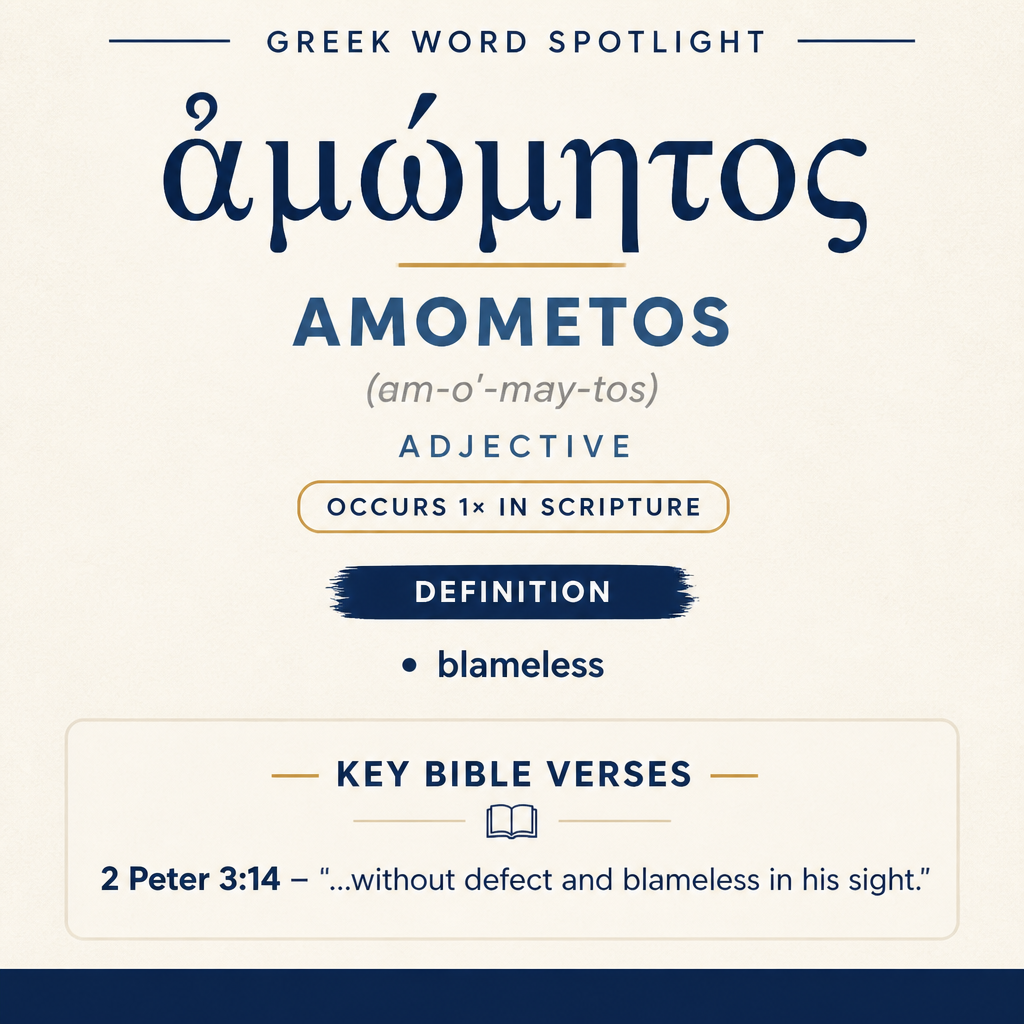
ἀμώμητος means “blameless” and appears once in Scripture, in 2 Peter 3:14.
Scripture Occurrence
This adjective occurs one time in Scripture. Its single occurrence is in 2 Peter 3:14.
Learn More →Verse Context
In 2 Peter 3:14 it appears alongside being “without defect” and connected with being found in peace.
Learn More →ἀμώμητος means “blameless” and appears once in the New Testament, in an exhortation that looks toward being found acceptable “in his sight.” In its lone occurrence it stands alongside the idea of being “without defect,” forming a paired description of the believer’s hoped-for condition.
Root and Related Words
ἀμώμητος is connected with the letter-name Ἄλφα (Alpha, “Alpha”; Strong’s G1) and with the verb μωμάομαι (mōmaomai, “to criticize”; Strong’s G3469).

Occurrences
“Therefore, beloved, seeing that you look for these things, be diligent to be found in peace, without defect and blameless in his sight.” (2 Peter 3:14)
Here ἀμώμητος belongs to a call for diligence: “be diligent to be found…” The wording presents the desired outcome as something discovered or recognized at the decisive moment implied by “be found,” rather than merely asserted. Within that aim, the adjective functions as one of two closely linked descriptors—“without defect and blameless”—that portray the kind of standing envisioned “in his sight.” The immediate frame is relational and evaluative: the state described is not primarily about self-perception but about what holds up under God’s seeing. The placement at the end of the sentence gives it weight; the exhortation culminates in a condition that is both peaceful (“to be found in peace”) and morally unassailable (“blameless”), set within the sphere of divine observation.

The coordination with “without defect” also shapes how ἀμώμητος lands in the verse. The phrase pairs two evaluative terms, suggesting a thoroughness to the envisioned integrity: peace is not detached from character, and diligence is not mere activity but an earnest pursuit of a condition that will stand as whole before God. In this single use, ἀμώμητος does not operate as a general compliment but as a concrete target of moral and spiritual readiness, tied to watchful expectation (“seeing that you look for these things”).
Sense and Usage
The sense “blameless” in 2 Peter 3:14 functions as an assessment term: it describes a person as free from blame when evaluated “in his sight.” Because the verse places it in an imperative framework (“be diligent”), the word carries an ethical demand rather than a detached description. It is the kind of condition one is to be “found” in—language that implies scrutiny, exposure, and a verdict rendered by the observer named in the text.
The collocation “without defect and blameless” helps define the practical force of “blameless.” In this context it is not merely the absence of public accusation; it is a quality that aligns with completeness and soundness. The verse’s movement is from expectation (“you look for these things”) to effort (“be diligent”) to outcome (“to be found in peace… blameless”). Thus ἀμώμητος marks the moral dimension of Christian hope: what is anticipated is not only an external change in circumstances but a state of life that can be presented as acceptable under God’s gaze.
Even in a single attestation, the word’s usage is clear in its orientation. It is inseparable from the phrase “in his sight,” which anchors “blameless” in the arena of divine judgment and approval. The term therefore evokes the imagery of appearing before an examiner: the one who “sees” is the one before whom peace, integrity, and freedom from blame must hold together.
Imagery
The verse’s imagery is judicial and observational rather than ceremonial: to be “found” a certain way “in his sight” suggests standing in a searching light. ἀμώμητος contributes the idea of emerging from that sight without any blame attaching—an inward and outward integrity that matches the peace the verse also urges.
Sources: Lexical data from Strong’s Exhaustive Concordance and the Translators Brief Lexicon of Extended Strongs for Greek (STEPBible, CC BY). Occurrence data from the Translators Amalgamated Greek New Testament (STEPBible, CC BY). Scripture quotations from the World English Bible (public domain).