
Exploring the Meaning of Halusis in Greek
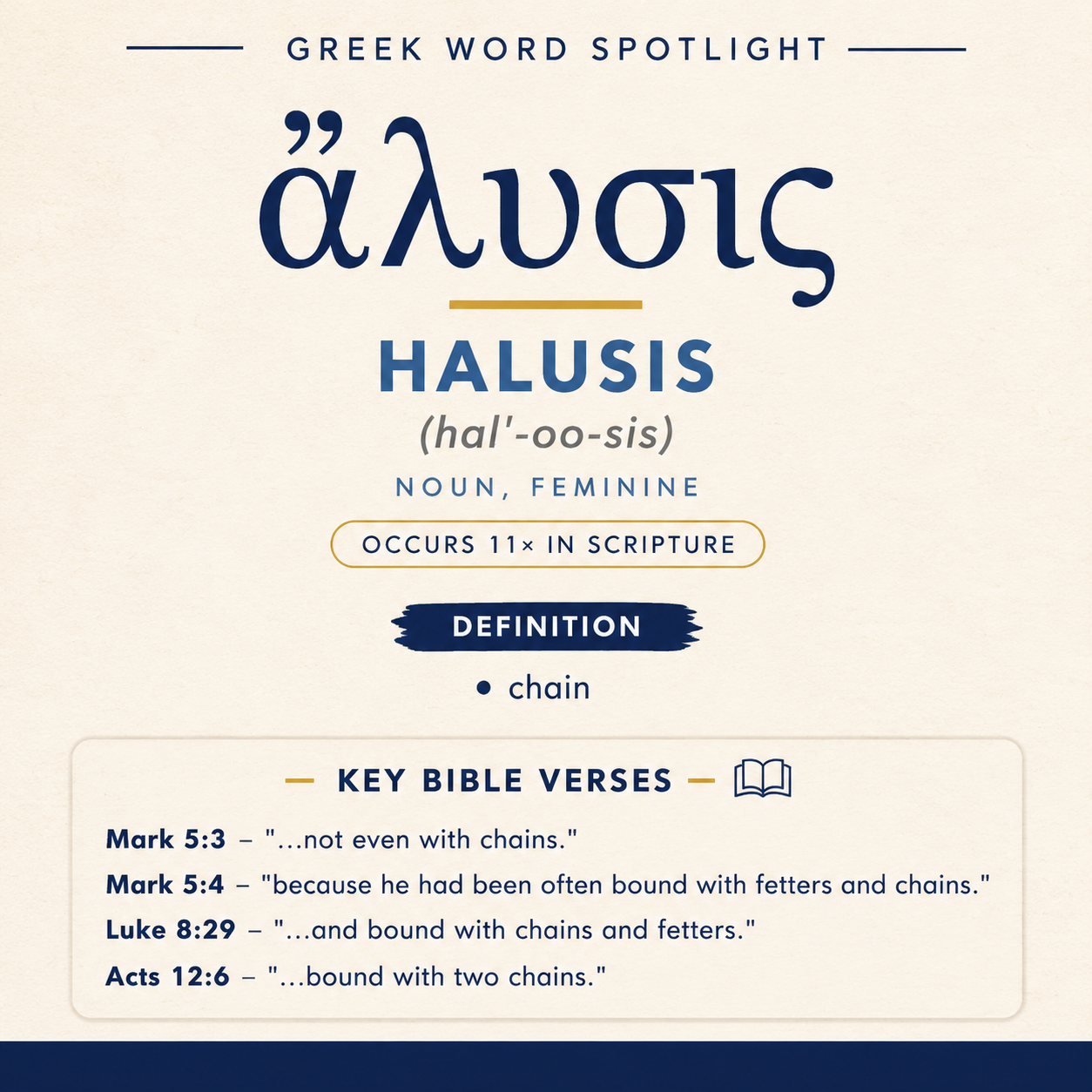
ἅλυσις means “chain” and occurs 11 times in Scripture, including Mark 5:3–4, Luke 8:29, Acts 12:6–7, Acts 21:33, Acts 28:20, and Ephesians 6:20.
Core Meaning
ἅλυσις is the Greek word for “chain.” It describes physical chains used to bind a person.
Learn More →Gospel Scenes
In Mark 5:3–4, the man among the tombs could not be bound even with chains. Luke 8:29 also describes him being restrained as the unclean spirit seized him.
Learn More →Acts and Letters
In Acts, chains bind Peter in prison (12:6–7) and Paul during arrest and custody (21:33; 28:20). Paul calls himself “an ambassador in chains” in Ephesians 6:20.
Learn More →ἅλυσις refers to a “chain,” appearing in narratives of physical restraint, imprisonment, and guarded custody, as well as in a visionary scene where a chain is carried as an implement. In these passages it functions as a concrete object that binds a person or is held ready for use.
Occurrences
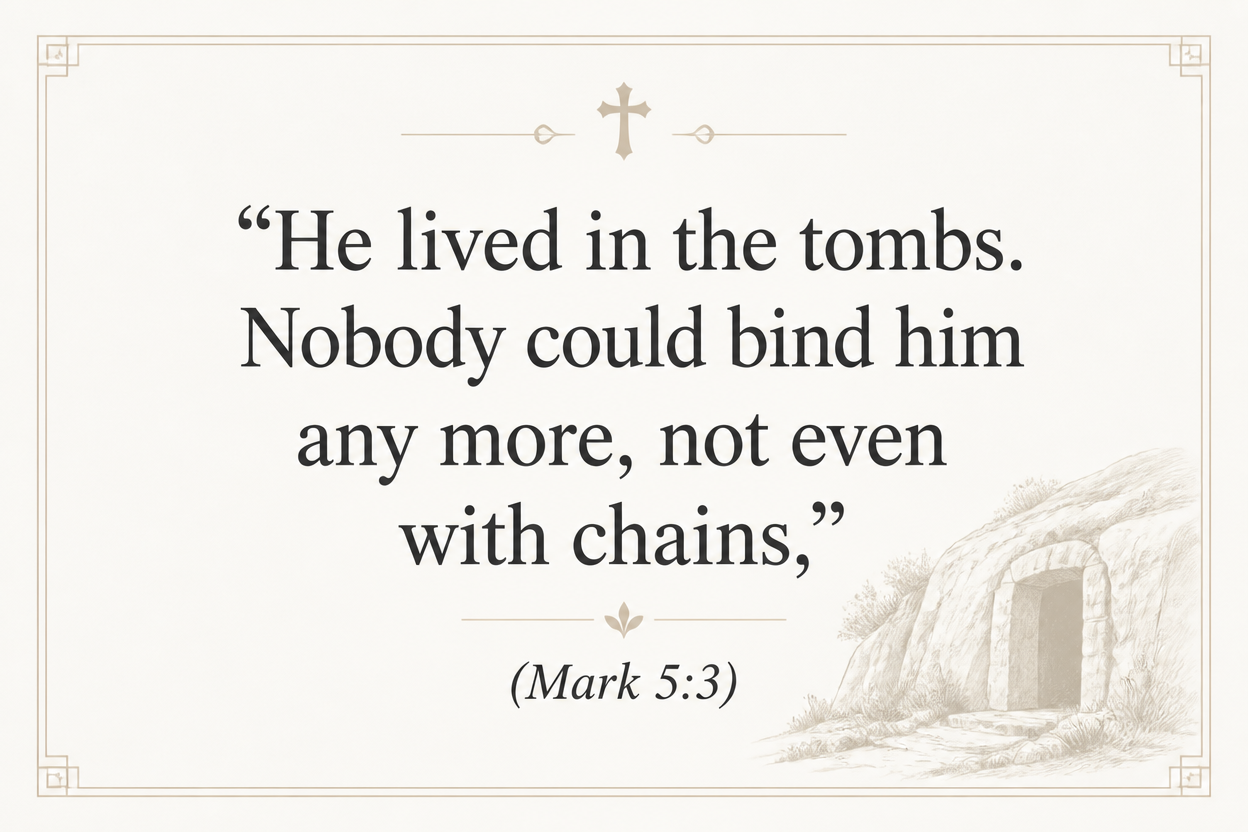
“He lived in the tombs. Nobody could bind him any more, not even with chains,” (Mark 5:3)
Here ἅλυσις marks an attempted means of restraint. The line stresses failure—“Nobody could bind him any more”—and “not even with chains” places the chain among the strongest ordinary tools people would use to control someone living in the tombs.
“because he had been often bound with fetters and chains, and the chains had been torn apart by him, and the fetters broken in pieces. Nobody had the strength to tame him.” (Mark 5:4)
In this continuation, ἅλυσις appears twice: first as the instrument used to bind (“bound with fetters and chains”), then as the object overcome (“the chains had been torn apart by him”). The repeated mention underscores both the intensity of the restraint and the violent force with which it is defeated, reinforcing the closing assessment that “Nobody had the strength to tame him.”
“For Jesus was commanding the unclean spirit to come out of the man. For the unclean spirit had often seized the man. He was kept under guard, and bound with chains and fetters. Breaking the bonds apart, he was driven by the demon into the desert.” (Luke 8:29)
ἅλυσις again belongs to a cluster of control measures: the man is “kept under guard,” and “bound with chains and fetters.” The chain stands within a larger picture of confinement that fails when the man is able to break restraints (“Breaking the bonds apart”) and is driven away “into the desert.” Within the sentence, the chain is a visible sign of the community’s attempt to contain what is overtaking him.
“The same night when Herod was about to bring him out, Peter was sleeping between two soldiers, bound with two chains. Guards in front of the door kept the prison.” (Acts 12:6)
Here ἅλυσις belongs to the tight security of a prison setting. Peter is not merely detained; he is “sleeping between two soldiers” and “bound with two chains,” while “Guards in front of the door kept the prison.” The mention of “two chains” emphasizes controlled custody and the layered measures used to prevent escape.
“And behold, an angel of the Lord stood by him, and a light shone in the cell. He struck Peter on the side, and woke him up, saying, “Stand up quickly!” His chains fell off his hands.” (Acts 12:7)
In the same imprisonment scene, ἅλυσις becomes the object that gives way. The statement “His chains fell off his hands” describes a sudden release that contrasts with the previous verse’s careful restraints. The chain, previously a sign of Herod’s control, becomes a marker of deliverance when it drops away without human effort.
“Then the commanding officer came near, arrested him, commanded him to be bound with two chains, and inquired who he was and what he had done.” (Acts 21:33)
Here ἅλυσις is attached to formal arrest procedures. The commanding officer both “arrested him” and “commanded him to be bound with two chains” before beginning his inquiry. The chain functions as the immediate, tangible act of custody that precedes legal questioning.
“For this cause therefore I asked to see you and to speak with you. For because of the hope of Israel I am bound with this chain.” (Acts 28:20)
In this spoken explanation, ἅλυσις is singled out—“this chain”—as something the speaker is presently wearing. The chain anchors the conversation in the reality of confinement even as the speaker gives a reason for his situation (“because of the hope of Israel”). It becomes a visible, personal emblem of being held while still seeking to “see you and to speak with you.”
“for which I am an ambassador in chains; that in it I may speak boldly, as I ought to speak.” (Ephesians 6:20)
Here ἅλυσις is linked with a role and a responsibility: “an ambassador in chains.” The chain is not described in detail, but it frames the speaker’s situation as constrained while he still aims to “speak boldly.” The word keeps the image concrete: the ambassadorial task is carried out under actual restraint.
“May the Lord grant mercy to the house of Onesiphorus, for he often refreshed me, and was not ashamed of my chain,” (2 Timothy 1:16)
In this commendation, ἅλυσις is personal—“my chain”—and it is tied to social response. Onesiphorus “was not ashamed” of the chain, treating the imprisoned person with refreshment rather than avoidance. The chain thus marks a stigma or risk that could prompt shame, and the sentence highlights the refusal to let that restraint define the relationship.
“I saw an angel coming down out of heaven, having the key of the abyss and a great chain in his hand.” (Revelation 20:1)
Here ἅλυσις appears as an object carried, not worn: “a great chain in his hand.” The chain is paired with “the key of the abyss,” and together they present equipment suited to secure and confine. The adjective “great” intensifies the physical impression of the chain as a formidable instrument.

Sense and Usage
Across these passages ἅλυσις functions as a material device of restraint, most often attached to the body as a means of binding. In the accounts of the tormented man (Mark 5:3–4; Luke 8:29), chains appear alongside “fetters,” and the repeated failure of binding—chains torn apart, bonds broken—makes the chain a measure of how extreme the situation is: if even chains cannot hold, ordinary control has collapsed. The chain is still a real, heavy tool, but its narrative role is to highlight the futility of human restraint in that circumstance.
In Acts, ἅλυσις belongs to the world of arrest and incarceration. The word is specific enough to convey method: “bound with two chains” (Acts 12:6; 21:33) suggests enforced immobility and guarded custody, while “His chains fell off his hands” (Acts 12:7) uses the chain as the most immediate sign that confinement has ended. Later, “I am bound with this chain” (Acts 28:20) shifts from describing procedure to pointing at the chain as an experienced condition—an object that is present on the speaker and that stands in the room as he speaks.
In the epistolary statements (Ephesians 6:20; 2 Timothy 1:16), chain language compresses a larger circumstance into a single concrete image: “in chains” and “my chain” keep the reader anchored in physical captivity while themes of speech (“speak boldly”) and loyalty (“not ashamed”) are in view. The chain is neither mere metaphor nor decoration; it is the bodily fact that makes bold speech and faithful companionship more striking in context.
Revelation 20:1 presents ἅλυσις not as something fastening a prisoner yet, but as an implement held in readiness. The “great chain” is part of a set with “the key of the abyss,” and the pairing presents containment as something that can be enacted with tangible tools. Even in a visionary description, the chain remains concrete—something seen, sized (“great”), and carried “in his hand.”
Imagery
In these texts, the chain consistently evokes custody—either the attempt to control a dangerous situation or the enforced limitation of a detained person. Whether torn apart in the tombs (Mark 5:4), falling from hands in a lit cell (Acts 12:7), worn as “this chain” while speaking (Acts 28:20), or held as a “great chain” alongside a key (Revelation 20:1), ἅλυσις supplies a vivid, physical image of restraint that can be imposed, endured, broken, or removed.
Sources: Lexical data from Strong’s Exhaustive Concordance and the Translators Brief Lexicon of Extended Strongs for Greek (STEPBible, CC BY). Occurrence data from the Translators Amalgamated Greek New Testament (STEPBible, CC BY). Scripture quotations from the World English Bible (public domain).





