
Exploring the Meaning of Halukos in Greek
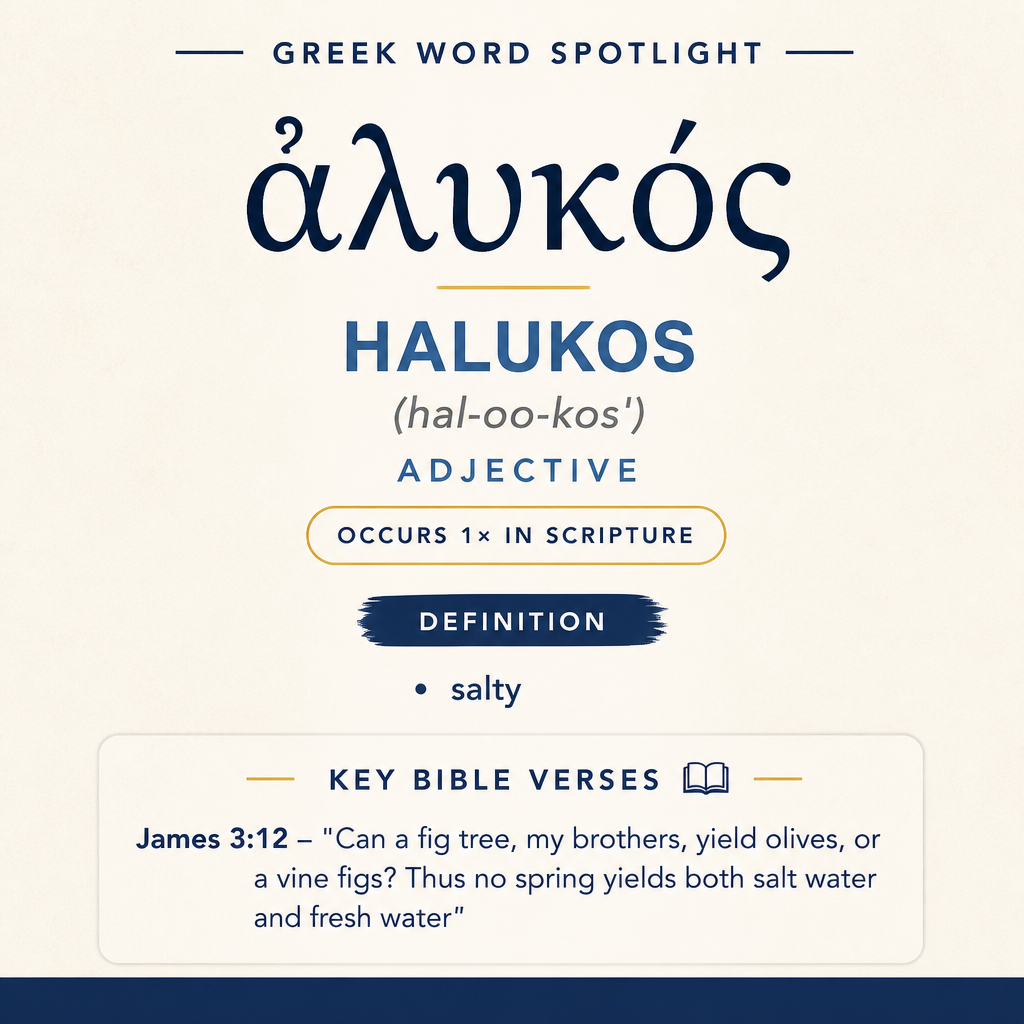
ἁλυκός (Halukos) means “salty” and appears once in Scripture in James 3:12.
James Context
In James 3:12, it describes salt water contrasted with fresh water from a spring.
Learn More →ἁλυκός means “salty” and appears in the imagery of James’s teaching about what sources can and cannot produce. In its lone New Testament setting, it serves to sharpen a contrast between different kinds of water issuing from a spring.
Root and Related Words
ἁλυκός derives from the noun ἅλς (hals), “salt” (Strong’s G251). The adjectival form expresses the quality associated with that noun, placing the idea of saltiness directly onto whatever it describes.

Occurrences
“Can a fig tree, my brothers, yield olives, or a vine figs? Thus no spring yields both salt water and fresh water.” (James 3:12)
Here ἁλυκός functions inside a set of tightly linked comparisons. James begins with the natural world: a fig tree produces figs, not olives; a vine produces grapes, not figs. He then extends the same logic to a spring, concluding with an either/or contrast: a spring does not yield both “salt water and fresh water.” The adjective ἁλυκός attaches the notion of saltiness to “water,” marking one kind of output from a spring, set opposite “fresh.”
In the verse’s reasoning, the adjective does more than label a taste; it helps establish a clear category distinction that fits the argument’s chain of examples. The fig tree and vine images are about recognizable, stable outcomes in nature. When the illustration shifts to water, ἁλυκός provides the descriptive feature that makes one output plainly different from the other: water characterized as “salt” is not the same as water characterized as “fresh.” The conclusion (“Thus no spring yields both…”) depends on those descriptions remaining distinct, and ἁλυκός supplies one side of that contrast with a concrete, sensory qualifier.
The placement of ἁλυκός is also rhetorically pointed. James does not speak in general terms about “different waters” but names two sharply contrasted kinds. By qualifying “water” with ἁλυκός, he makes the contrast vivid and immediate: the reader can readily picture a spring and recognize that “salt water” and “fresh water” are not interchangeable outcomes. Within the verse, then, the adjective strengthens the plausibility of the illustration and reinforces the underlying logic: what a source yields is consistent with what it is.
Sense and Usage
The sense “salty” in James 3:12 is carried by its straightforward descriptive force: it is a quality-term applied to “water.” The verse sets up a pattern of natural correspondence—plants correspond to their fruits, and a spring corresponds to its kind of water. Within that pattern, “salty” is not presented as an incidental detail but as the defining qualifier that distinguishes one stream of output from another.
Because the adjective appears paired with “fresh,” its meaning is heard relationally. The verse does not define saltiness; it relies on the reader’s ordinary grasp of the difference between water that is characterized by salt and water that is characterized as fresh. In this rhetorical frame, ἁλυκός operates as a boundary-marker: it helps establish that the two waters named are categorically different results, not merely variations along a single continuum.
The imagery also puts “salty” into the domain of what a spring “yields.” In James’s comparison, the spring is a source with a recognizable output. The adjective therefore participates in the broader claim that sources are known by what they produce. By describing one possible yield as “salt water,” ἁλυκός becomes a concrete descriptor that supports the argument’s emphasis on consistency: a spring does not generate mutually opposed outputs at once. The word’s contribution is thus to make the illustration crisp and empirically intuitive—saltiness is a tangible property that, when attached to water, immediately evokes a specific kind of spring-output.
Imagery
James 3:12 employs ἁλυκός in a scene drawn from everyday observation: a spring and its waters. The adjective helps the verse paint the spring’s output in a way that can be pictured and almost tasted, so that the final statement lands with the firmness of a natural fact: “Thus no spring yields both salt water and fresh water.” In that closing image, “salty” gives one side of the contrast a definite, concrete character, making the spring illustration as memorable as the fig tree and vine that precede it.
Sources: Lexical data from Strong’s Exhaustive Concordance and the Translators Brief Lexicon of Extended Strongs for Greek (STEPBible, CC BY). Occurrence data from the Translators Amalgamated Greek New Testament (STEPBible, CC BY). Scripture quotations from the World English Bible (public domain).





