
Exploring the Meaning of Allos in Greek
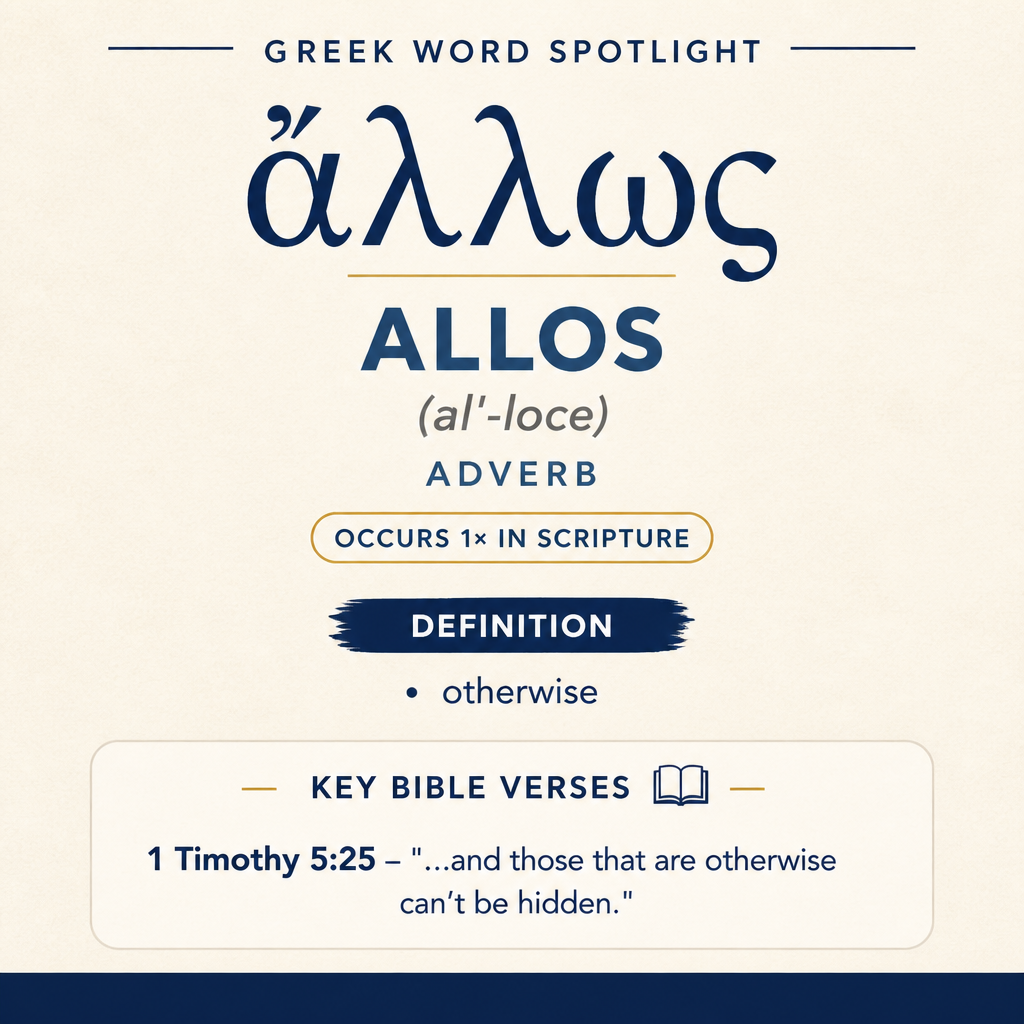
ἄλλως means “otherwise” and appears once in Scripture, in 1 Timothy 5:25.
Verse Context
In 1 Timothy 5:25, it describes good works that are “otherwise” and can’t be hidden.
Learn More →ἄλλως expresses the idea of something being the case “otherwise,” marking a contrast with what is “obvious” in a given situation. It appears once, in a concluding reflection on how visible and hidden realities relate to one another.
Root and Related Words
ἄλλως is related to allos (ἄλλος), “another” (Strong’s G243). The connection supplies a natural basis for its contrastive force: the term stands in relation to an “other” case or alternative state of affairs.

Occurrences
“In the same way also there are good works that are obvious, and those that are otherwise can’t be hidden.” (1 Timothy 5:25)
Here ἄλλως sets up a second category alongside what is “obvious.” The sentence first states that certain “good works” are plainly visible; then it turns to “those that are otherwise,” meaning works that belong to a different condition than the obvious ones. The adverb functions as a hinge between two assessments of visibility: (1) deeds whose character is immediately apparent, and (2) deeds whose character is not immediately apparent. By using “otherwise,” the statement does not abandon the category of “good works,” but distinguishes how they appear—some openly, some in another way.

The final clause—“can’t be hidden”—interprets the practical outcome of that distinction. Even when good works are “otherwise” than “obvious,” they do not remain permanently concealed. ἄλλως therefore contributes the contrast necessary for the logic of the sentence: the author can affirm both that some good works are self-evident and that the less evident ones still come to light. Without the “otherwise,” the second half would merely repeat the first; with it, the line addresses the common perception that what is not immediately seen might remain unseen.
Sense and Usage
The force of ἄλλως in this passage is contrastive: it marks an alternative mode of being in relation to what has just been named. In 1 Timothy 5:25 that contrast is explicitly anchored to perception—what is “obvious” versus what stands in a different condition. The word does not introduce a new subject but qualifies the same subject (“good works”) by acknowledging variety in how they present themselves.
Because the verse pairs “obvious” with “otherwise,” the adverb operates within a simple twofold framework. First, it presumes a baseline case: there are good works that can be recognized readily. Then it allows for an alternate case: there are good works that do not share that immediate obviousness. This is not merely stylistic variety; it makes the statement realistic about moral visibility. Some acts have outward clarity, while others do not display themselves in the same way—yet the author’s concluding claim is that even the second kind “can’t be hidden.” In that argument, ἄλλως is crucial because it keeps the second category from being mistaken as the opposite of “good works.” It is not “bad works” that cannot be hidden, but good works that are “otherwise” than obvious.
Within the single sentence, ἄλλως also has a balancing role. It prevents “obvious” from being treated as the only meaningful way for good works to exist publicly. The adverb implicitly recognizes that evaluation based solely on what is immediately apparent would be incomplete. By marking an “otherwise” condition, the verse can affirm that the moral weight of deeds does not depend on instant visibility, even while it maintains that concealment will not have the last word. The term therefore serves the verse’s movement from observation (“there are good works that are obvious”) to assurance (“those that are otherwise can’t be hidden”).
Imagery
The imagery carried by ἄλλως in 1 Timothy 5:25 is the contrast between what can be seen at once and what lies out of sight for a time. The verse pictures two kinds of “good works”: those that stand in the open as “obvious,” and those present in an “otherwise” condition—less immediately visible—yet destined not to remain hidden. The adverb helps the line hold together these two vantage points, making room for both immediate clarity and eventual disclosure.
Sources: Lexical data from Strong’s Exhaustive Concordance and the Translators Brief Lexicon of Extended Strongs for Greek (STEPBible, CC BY). Occurrence data from the Translators Amalgamated Greek New Testament (STEPBible, CC BY). Scripture quotations from the World English Bible (public domain).




