
Exploring the Meaning of Allelouia in Greek
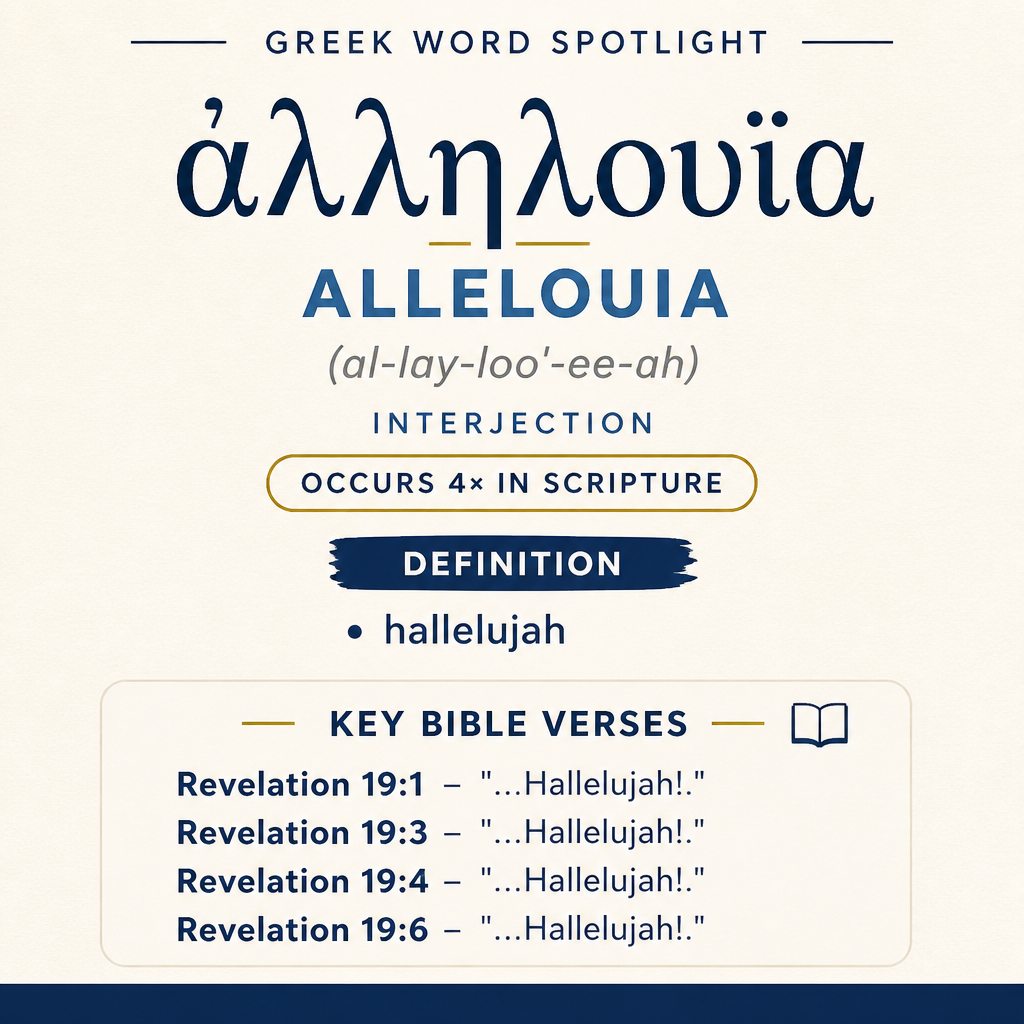
ἀλληλουϊα means “hallelujah” and appears four times in Scripture, all in Revelation 19:1, 19:3, 19:4, and 19:6.
Context in Revelation
In Revelation 19 it is spoken by a great multitude in heaven and by worshipers before God on the throne.
Learn More →ἀλληλουϊα means “hallelujah.” It appears in a tightly clustered series of heavenly acclamations in Revelation 19, where it punctuates worship, proclamation, and communal assent in response to God’s saving power and reigning authority.
Occurrences
“After these things I heard something like a loud voice of a great multitude in heaven, saying, “Hallelujah! Salvation, power, and glory belong to our God;” (Revelation 19:1)
Here ἀλληλουϊα functions as the opening cry of a “great multitude in heaven,” introduced as a “loud voice.” The interjection stands at the head of a threefold ascription—“Salvation, power, and glory”—directed to “our God.” In this scene, “Hallelujah!” does not merely decorate the sentence; it signals a shift into praise-language and frames what follows as worshipful proclamation. The content that immediately follows gives the cry its occasion: the multitude’s declaration that these realities “belong to our God.”
“A second said, “Hallelujah! Her smoke goes up forever and ever.”” (Revelation 19:3)
In the second occurrence, ἀλληλουϊα introduces a concise, responsive utterance: “A second said.” The cry again comes first, but the accompanying statement is now a vivid image—“Her smoke goes up forever and ever.” The interjection marks this as praise in the context of an irreversible outcome described in the following clause. The effect is to present “Hallelujah!” as the fitting communal response to the enduring visibility of judgment’s result, expressed through the continuing ascent of “smoke.”
“The twenty-four elders and the four living creatures fell down and worshiped God who sits on the throne, saying, “Amen! Hallelujah!”” (Revelation 19:4)
This use of ἀλληλουϊα occurs within a physical posture of worship: the elders and living creatures “fell down and worshiped God who sits on the throne.” The words placed on their lips are brief—“Amen! Hallelujah!”—but the narrative setting supplies their weight. “Amen!” functions as assent, and “Hallelujah!” follows as the worshipful acclamation that completes that assent in the presence of the enthroned God. Positioned after “Amen!” the interjection reads as the voiced act of praise that corresponds to the described act of bowing and worship.
“I heard something like the voice of a great multitude, and like the voice of many waters, and like the voice of mighty thunders, saying, “Hallelujah! For the Lord our God, the Almighty, reigns!”” (Revelation 19:6)
In the fourth occurrence, ἀλληλουϊα is carried by an overwhelming soundscape: “like the voice of a great multitude,” “many waters,” and “mighty thunders.” The interjection again leads, but it is immediately grounded by a reason clause: “For the Lord our God, the Almighty, reigns!” In this scene the cry operates as the communal shout that introduces a royal proclamation. The title-rich confession—“the Lord our God, the Almighty”—and the declaration of reigning give ἀλληλουϊα a triumphant tone befitting the auditory imagery of waters and thunder.

Sense and Usage
Across these passages ἀλληλουϊα operates as a self-contained exclamation of praise (“hallelujah”) that can stand alone or attach to a stated cause. Its placement is consistently initial within the spoken lines, marking what follows as the content of worship rather than ordinary narration. Revelation 19:1 shows it introducing a theological ascription (“Salvation, power, and glory belong to our God”), so the cry functions as the gateway into attributing honor to God. Revelation 19:6 pairs it with an explicit rationale (“For the Lord our God, the Almighty, reigns!”), demonstrating that the exclamation can also introduce a reasoned proclamation within worship.
The word’s use is also distinctly communal in these verses. It is voiced by “a great multitude,” then echoed by “a second,” then taken up by “the twenty-four elders and the four living creatures,” and then heard again as a vast, thunderous chorus. This progression places ἀλληλουϊα within a call-and-response atmosphere: praise is initiated, answered, affirmed in worship, and then amplified. Even when the speaker group changes, the interjection provides continuity, binding the scenes together with a shared acclamation.
In addition, the surrounding imagery shapes how the exclamation is heard. In Revelation 19:3, the accompanying line about smoke rising “forever and ever” gives the cry a judicial backdrop; in Revelation 19:4, the posture of falling down before the enthroned God gives it a liturgical seriousness; in Revelation 19:6, the comparison to “many waters” and “mighty thunders” gives it sonic force and public magnitude. In each case, ἀλληλουϊα serves as the verbal crest of worship—brief in form, but capable of carrying substantial theological and narrative weight through its context.
Imagery and Sound
Revelation 19 frames ἀλληλουϊα as an audible marker of heaven’s worship: it is heard as “a loud voice,” then as successive voices, and finally as a roar likened to waters and thunders. The word’s repetition across the scene creates a cadence—praise spoken, answered, affirmed, and intensified—so that “Hallelujah!” becomes the refrain through which salvation, enthroned worship, irreversible judgment imagery, and the proclamation of God’s reign are voiced in a single sustained chorus.
Sources: Lexical data from Strong’s Exhaustive Concordance and the Translators Brief Lexicon of Extended Strongs for Greek (STEPBible, CC BY). Occurrence data from the Translators Amalgamated Greek New Testament (STEPBible, CC BY). Scripture quotations from the World English Bible (public domain).





