Understanding the Meaning of Allophulos in Greek
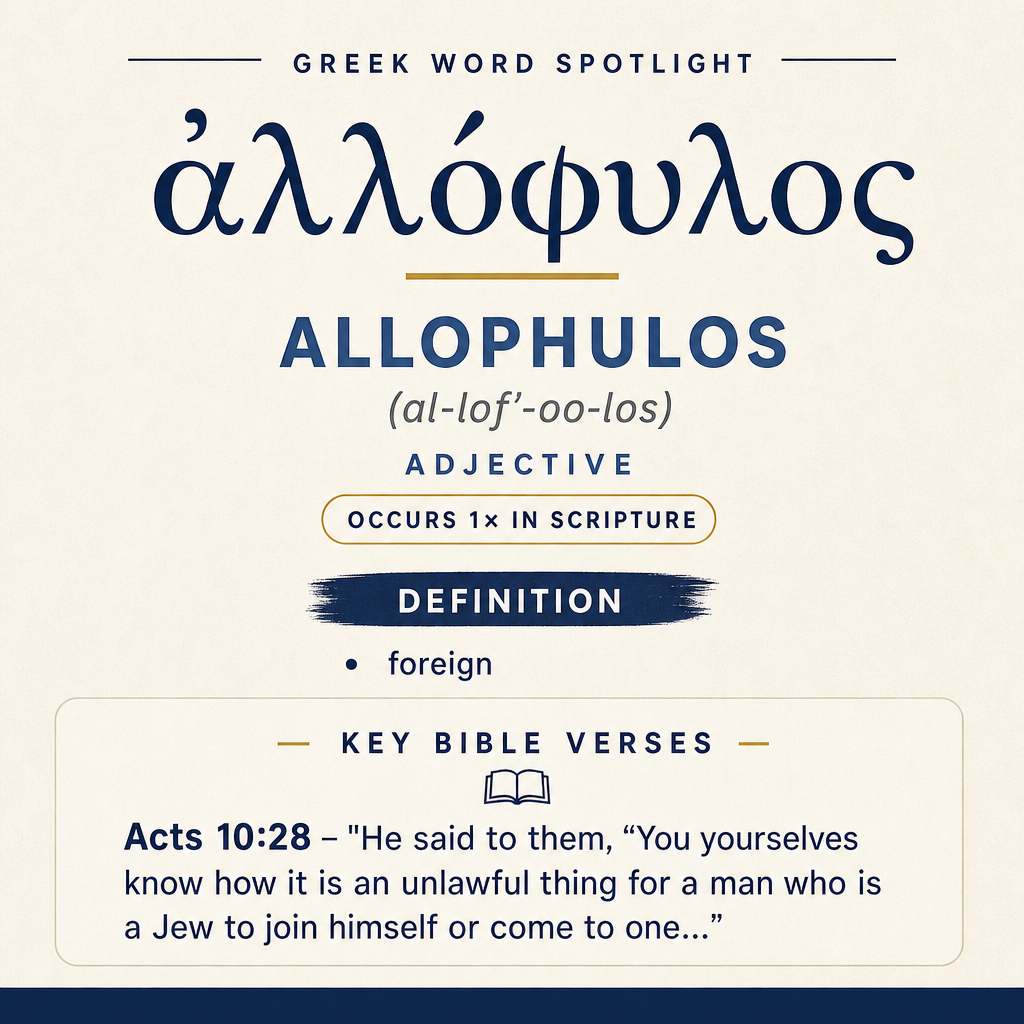
ἀλλόφυλος means “foreign” and appears once in Scripture, in Acts 10:28.
Scripture Occurrence
This word occurs 1 time in Scripture. Its occurrence is in Acts 10:28.
Learn More →Context Note
In Acts 10:28, it appears within a statement about what is unlawful for a Jew regarding association or visitation.
Learn More →ἀλλόφυλος means “foreign” and appears once in the New Testament, in Peter’s speech to a gathered audience in Caesarea (Acts 10:28). In that setting it serves as a key descriptor in a discussion of how Jews customarily relate to people from other nations.
Root and Related Words
ἀλλόφυλος is connected with two Greek words: ἄλλος (allos), “another” (Strong’s G243), and φυλή (phylē), “tribe” (Strong’s G5443). As a compound, it brings together the idea of “another” with the idea of “tribe,” forming a descriptor that characterizes someone in relation to a group boundary.

Occurrences
“He said to them, “You yourselves know how it is an unlawful thing for a man who is a Jew to join himself or come to one of another nation, but God has shown me that I shouldn’t call any man unholy or unclean.”” (Acts 10:28)
In Acts 10:28, ἀλλόφυλος (“foreign”) functions within Peter’s explanation of a social and religious barrier: “an unlawful thing for a man who is a Jew to join himself or come to one of another nation.” The word marks the person approached as belonging to a different people-group, and that difference is presented as the usual reason a Jewish man would not “join himself” to such a person or even “come” to them. The sentence sets up a contrast between established custom (“You yourselves know how it is…”) and a new divine instruction (“but God has shown me…”). In that contrast, “foreign” is not a casual observation about travel or geography; it is the descriptor that names the dividing line that normally governs contact.
The immediate context of the quotation shows how the idea of “foreign” interacts with the rest of Peter’s language. He moves from the boundary (“one of another nation”) to an interpretive conclusion about people: “I shouldn’t call any man unholy or unclean.” The movement of the thought is important: the category of being “foreign” is the kind of category that would typically shape behavior (“join himself or come”), yet Peter says God has instructed him to adjust the way he speaks and judges (“shouldn’t call any man unholy or unclean”). In this scene, ἀλλόφυλος belongs to the first half of that movement—the naming of the boundary that is being crossed—so that the second half can clarify what is being corrected: not merely a travel habit, but a moral or purity assessment attached to group difference.
Because this occurrence is embedded in direct speech, the word also carries rhetorical weight. Peter assumes shared knowledge (“You yourselves know”), indicating that the social meaning of “foreign” is recognized by both speaker and hearers. The descriptor therefore works as common ground at the start of the statement, before Peter presents the new lesson he has received. In other words, the word helps Peter begin from what his audience understands about Jewish practice, then show how God has reoriented his response to persons outside that familiar boundary.
Sense and Usage
The single attestation in Acts 10:28 places ἀλλόφυλος in a setting where group identity affects access, association, and the expectations surrounding purity. The word’s force comes from its relational nature: it identifies someone as “foreign” not in isolation, but specifically in relation to a defined in-group—here, “a man who is a Jew.” In the quoted sentence, “foreign” is the hinge between two spheres: the sphere of customary restriction (“an unlawful thing… to join himself or come”) and the sphere of divine correction (“God has shown me…”).
Within this verse, “foreign” is closely paired with the phrasing “of another nation,” so the sense is tied to national or people-group belonging. That is why the word can underwrite the kind of social distance Peter describes: joining oneself to someone, or visiting them, is treated as problematic precisely because that person is designated by difference of nation. The term therefore participates in the practical outworking of boundary language—who may approach whom, and on what terms.
Yet Acts 10:28 also shows that calling someone “foreign” is not the final word. Peter does not deny the reality of difference; he acknowledges it as something his hearers “know.” The shift comes in what the category is allowed to imply. Peter draws a clear line between identifying someone as outside one’s own people and labeling them with religiously loaded judgments: “I shouldn’t call any man unholy or unclean.” In this usage, the descriptor “foreign” provides the background for a correction of interpretive habits. The category remains a category, but it is no longer permitted to control the evaluation of a person as morally or ritually defiled.
Because the occurrence is singular, the word’s usage here is especially concentrated: it does not spread across diverse contexts, but appears at the climactic moment of explanation in a single narrative exchange. That concentration gives the term a sharply defined role—naming the outsider status that makes Peter’s visit notable, and framing the theological lesson he articulates in the same breath. In Acts 10:28, ἀλλόφυλος thus serves the narrative by making explicit the ordinary boundary, so that the meaning of crossing it can be stated plainly.
Imagery
The imagery evoked by Acts 10:28 is the concrete act of crossing a social threshold: a Jewish man “join[ing] himself” to someone “of another nation,” or “com[ing]” into their space. The word “foreign” gathers that threshold into a single descriptor and lets the scene focus on the meeting itself, where speech about purity (“unholy or unclean”) is corrected at the moment of contact.
Sources: Lexical data from Strong’s Exhaustive Concordance and the Translators Brief Lexicon of Extended Strongs for Greek (STEPBible, CC BY). Occurrence data from the Translators Amalgamated Greek New Testament (STEPBible, CC BY). Scripture quotations from the World English Bible (public domain).