Understanding the Meaning of Allegoreo in Greek
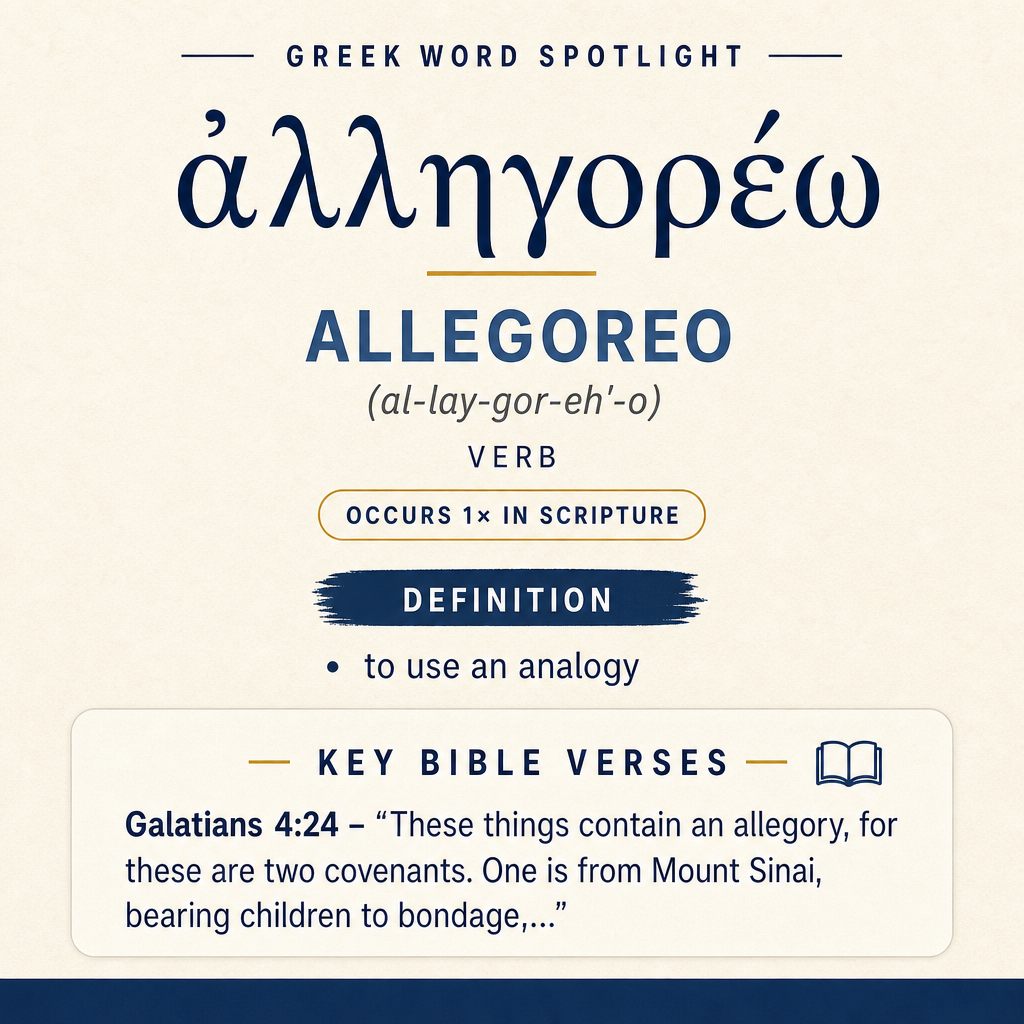
ἀλληγορέω means “to use an analogy” and appears once in Scripture, in Galatians 4:24.
Scripture Occurrence
This verb occurs 1 time in Scripture. Its single occurrence is in Galatians 4:24.
Learn More →Galatians Context
In Galatians 4:24, Paul says, “These things contain an allegory.” He connects the allegory to “two covenants.”
Learn More →ἀλληγορέω means “to use an analogy,” and it appears in the apostle’s argument about “two covenants” in Galatians 4:24. In that setting, the verb marks a move from narrated particulars to an analogical reading that carries the discussion forward.
Root and Related Words
ἀλληγορέω (Allegoreo) is connected, per Strong’s, with ἄλλος (allos, “another,” Strong’s G243) and ἀγορά (agora, “marketplace,” Strong’s G58). The relationship of these components frames the verb as language that “speaks” in a way that sets one thing alongside another.

Occurrences
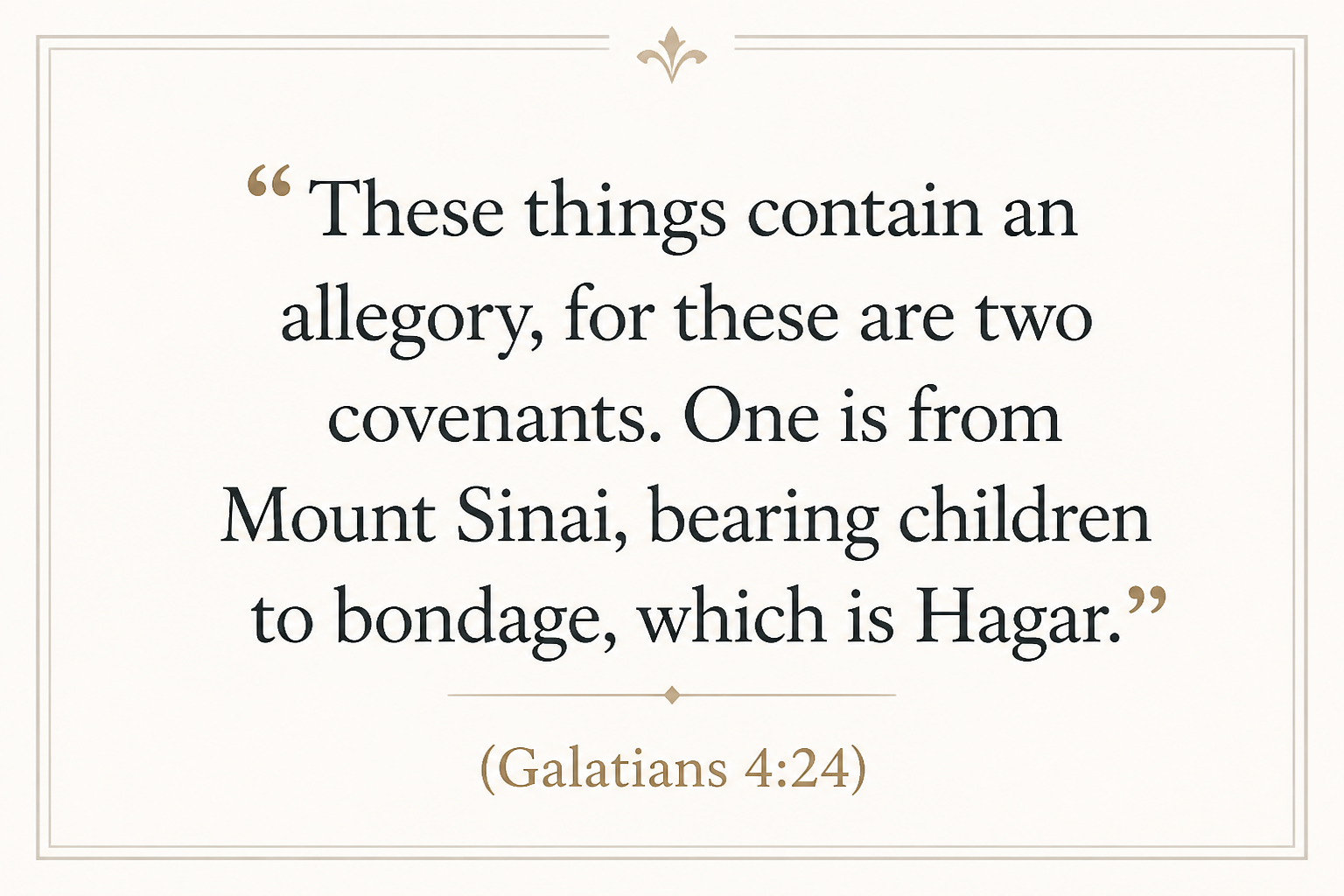
“These things contain an allegory, for these are two covenants. One is from Mount Sinai, bearing children to bondage, which is Hagar.” (Galatians 4:24)
In Galatians 4:24, ἀλληγορέω introduces a stated interpretive stance: “These things contain an allegory.” The immediate effect is to signal that what has been under discussion is now being handled as an analogy—material that can be read as corresponding to something else. Paul then immediately specifies what the analogical correspondence is meant to highlight: “for these are two covenants.” The verb thus functions as the hinge between “these things” and the conceptual pair that governs the explanation, “two covenants.”
The remainder of the verse shows the analogy’s direction and stakes. Paul identifies one of the two covenants as having an origin (“from Mount Sinai”) and a resulting condition (“bearing children to bondage”), and then pins that covenant to a named figure (“which is Hagar”). Within the sentence’s logic, ἀλληγορέω authorizes this kind of mapping: an account or set of “things” can be treated as carrying an analogical meaning that yields covenantal categories, geographic anchoring (“Mount Sinai”), and social consequence (“bondage”). By marking the discourse as analogical, the verb clarifies that Paul is not merely listing historical details; he is presenting an interpretive reading that organizes those details into a structured comparison.
Sense and Usage
The sense “to use an analogy” is expressed here as an explicit declaration that a set of elements “contain an allegory.” The language does not simply imply analogy; it announces that an analogical method is being used, and then supplies the interpretive target (“two covenants”). This makes the verb a meta-level marker: it frames how the reader should understand the relation between “these things” and the conclusions drawn from them.
Within Galatians 4:24, the analogical use is not left abstract. It results in a set of correspondences that are stated in compact form. One covenant is characterized by origin and outcome—“from Mount Sinai” and “bearing children to bondage”—and the final clause, “which is Hagar,” anchors the analogy to a particular referent named in the text. The verb therefore supports a kind of reasoning in which narrative or named realities can be read as standing for, or pointing to, other realities within an argument. In practical terms, it enables Paul to speak about covenants by drawing on “these things” and then placing them into a two-part framework.
Because the analogy is introduced in the same breath as the claim “these are two covenants,” ἀλληγορέω also carries a delimiting force: the analogy is not open-ended, but directed toward a specific interpretive outcome. The verse immediately narrows the reader’s attention to a defined comparison, and then begins filling in one side of that comparison. The verb, then, does not merely embellish the rhetoric; it governs how the subsequent assertions function, telling the reader that “from Mount Sinai,” “bondage,” and “Hagar” belong to an analogical presentation aimed at distinguishing the two covenants.
Imagery and Concept
The imagery that gathers around ἀλληγορέω in Galatians 4:24 is drawn from concrete identifiers that the analogy places into service: a mountain (“Mount Sinai”), familial language (“bearing children”), and a condition of constraint (“bondage”). By announcing an allegory, the verb gathers these into a single explanatory motion—moving from “these things” to a clarified conceptual structure (“two covenants”), then unfolding one covenant’s profile through place, generation, and status.
Sources: Lexical data from Strong’s Exhaustive Concordance and the Translators Brief Lexicon of Extended Strongs for Greek (STEPBible, CC BY). Occurrence data from the Translators Amalgamated Greek New Testament (STEPBible, CC BY). Scripture quotations from the World English Bible (public domain).