Exploring the Meaning of Halizo in Greek
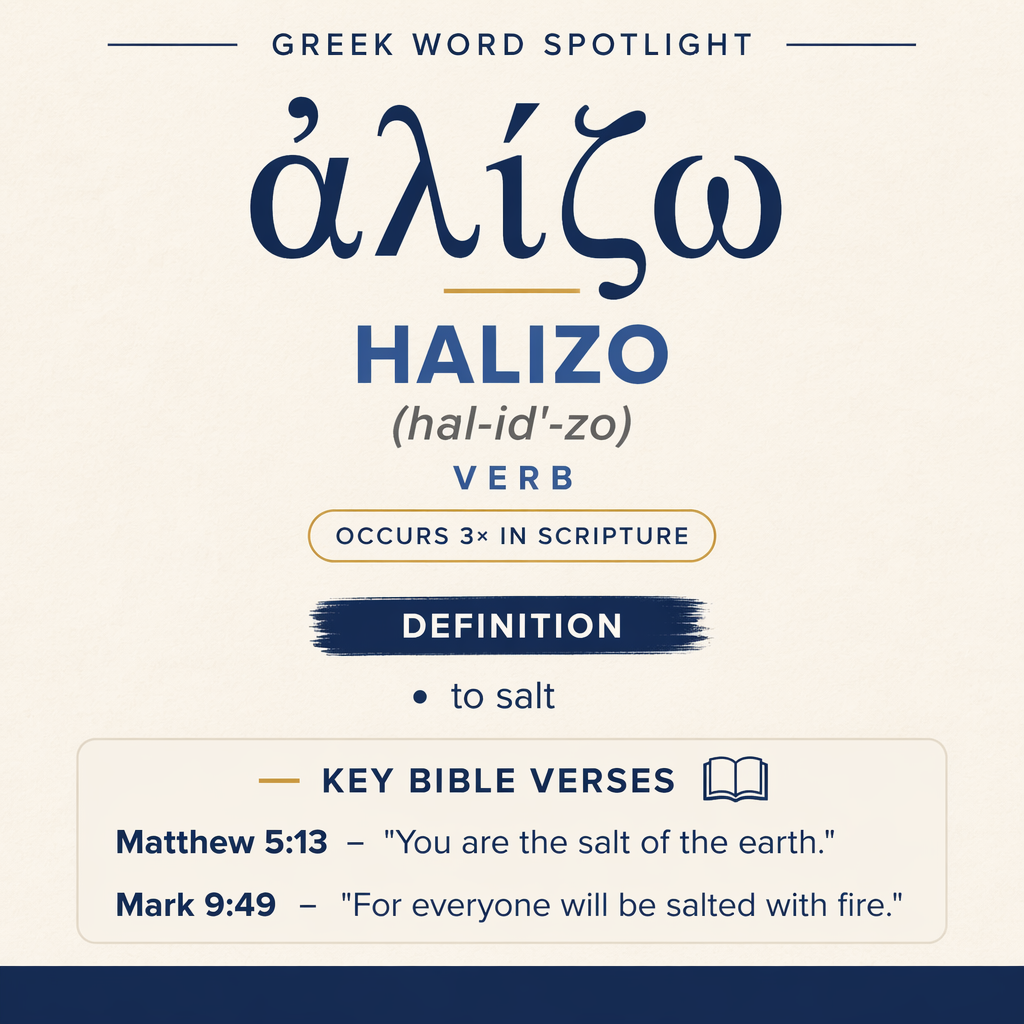
ἁλίζω means “to salt” and occurs three times in Scripture, including Matthew 5:13 and Mark 9:49.
Scripture Occurrences
This verb occurs 3 times in Scripture. It appears in Matthew 5:13 and Mark 9:49.
Learn More →Verse Contexts
In Matthew 5:13, Jesus speaks of salt losing its flavor and being salted again. In Mark 9:49, everyone will be salted with fire, and every sacrifice will be seasoned with salt.
Learn More →ἁλίζω means “to salt,” using the everyday act of applying salt as a vivid verbal image. It appears in Jesus’ teaching on the identity and influence of His disciples and in a saying that pairs salting with fire and with sacrifice.
Root and Related Words
ἁλίζω derives from ἅλς (hals), “salt” (Strong’s G251). The verb form turns the substance into an action: what salt is becomes something done—something is made “salted.”

Occurrences
“You are the salt of the earth, but if the salt has lost its flavor, with what will it be salted? It is then good for nothing, but to be cast out and trodden under the feet of men.” (Matthew 5:13)
Here ἁλίζω is framed as a practical question: once “the salt has lost its flavor,” what agent could perform the salting? The verb brings the illustration down to a concrete test: salting is what salt is for, and without that capacity the object called “salt” fails at its defining function in the scene. Jesus begins with a direct identification—“You are the salt of the earth”—and then uses ἁλίζω to press the consequence of losing the very quality that makes salt effective. The question “with what will it be salted?” is not merely about taste; it sets up the verdict that such salt is “good for nothing,” fit only “to be cast out and trodden under the feet of men.” In this setting, the verb highlights the irrecoverable loss of usefulness: if the thing meant to salt cannot salt, there is no obvious substitute within the illustration itself. The action of salting thus functions as the benchmark for whether the salt still has value, and the fate of the useless salt (thrown out, trampled) underscores how decisive that benchmark is.

For everyone will be salted with fire, and every sacrifice will be seasoned with salt. (Mark 9:49)
In Mark 9:49, ἁλίζω is placed alongside two striking instruments: “fire” and “salt.” The first clause—“everyone will be salted with fire”—uses the verb in an unexpected pairing, joining salting with a means that is not a culinary seasoning but “fire.” The line treats salting as something that happens to “everyone,” applying the verb broadly and impersonally: it is an action done to persons. The second clause, “and every sacrifice will be seasoned with salt,” keeps the same core action but shifts the subject matter from “everyone” to “every sacrifice,” and the language makes the culinary aspect explicit by adding “seasoned.” Together, the two clauses place ἁλίζω in a parallel structure: both “everyone” and “every sacrifice” are described in terms of being acted upon by a salting process. The verse’s compactness makes the verb carry much of the weight, linking bodily, experiential imagery (“salted with fire”) with ritual or offering imagery (“every sacrifice”). Even without elaboration in the immediate quotation, the juxtaposition suggests that the verb can describe more than sprinkling crystals on food; it can depict a treatment applied to persons and offerings, with fire and salt functioning as the media or accompanying elements in the description.
Sense and Usage
Across these sayings, “to salt” operates as a verb of purposeful treatment: something is acted on so that it is “salted.” In Matthew 5:13, ἁλίζω is used in a conditional and rhetorical way—salting is the very action that defines the usefulness of salt. The question “with what will it be salted?” treats salting as the essential operation that cannot proceed once the salt’s effective quality is gone. This creates an everyday logic: salt exists to perform salting; if it fails, it is discarded.
Mark 9:49 shows a broader, more figurative extension of the same action. The verb still conveys a real process being done to a recipient (“everyone,” “every sacrifice”), but the recipients and instruments expand the picture. “Salted with fire” keeps the action of salting while changing the accompanying element to “fire,” producing a compressed image of a person undergoing a kind of salting-process characterized by fire. The second half, “every sacrifice will be seasoned with salt,” stays closer to the ordinary culinary sense by using “seasoned,” yet applies it to “sacrifice,” not simply to a meal. In both halves, ἁλίζω retains the basic idea of applying salt (or a salting treatment) to something; the verse’s parallelism suggests that salting can be described with different accompanying elements or spheres (persons and sacrifices) while still being expressed by the same verb.
These uses also show how ἁλίζω can serve as a diagnostic verb: it asks whether an agent can accomplish its defining action (“with what will it be salted?”), and it states that certain recipients will undergo an action (“will be salted”). The imagery is concrete enough to evoke taste and seasoning, but flexible enough to describe a process that reaches beyond food preparation, while still being spoken of as “salting.”
Imagery in Context
In Matthew 5:13, the image of salting turns on loss and disposal: once the salt cannot perform the salting action, it ends up “cast out and trodden under the feet of men.” In Mark 9:49, the imagery turns on universality and intensity: “everyone” is pictured as undergoing a salting marked by “fire,” and “every sacrifice” is pictured as treated with salt as seasoning. Taken together, these sayings use ἁλίζω to connect ordinary, tangible practice with weighty outcomes—either the worthlessness of salt that cannot salt, or the comprehensive scope of being “salted” in association with fire and sacrifice.
Sources: Lexical data from Strong’s Exhaustive Concordance and the Translators Brief Lexicon of Extended Strongs for Greek (STEPBible, CC BY). Occurrence data from the Translators Amalgamated Greek New Testament (STEPBible, CC BY). Scripture quotations from the World English Bible (public domain).