Exploring the Meaning of Halieus in Greek
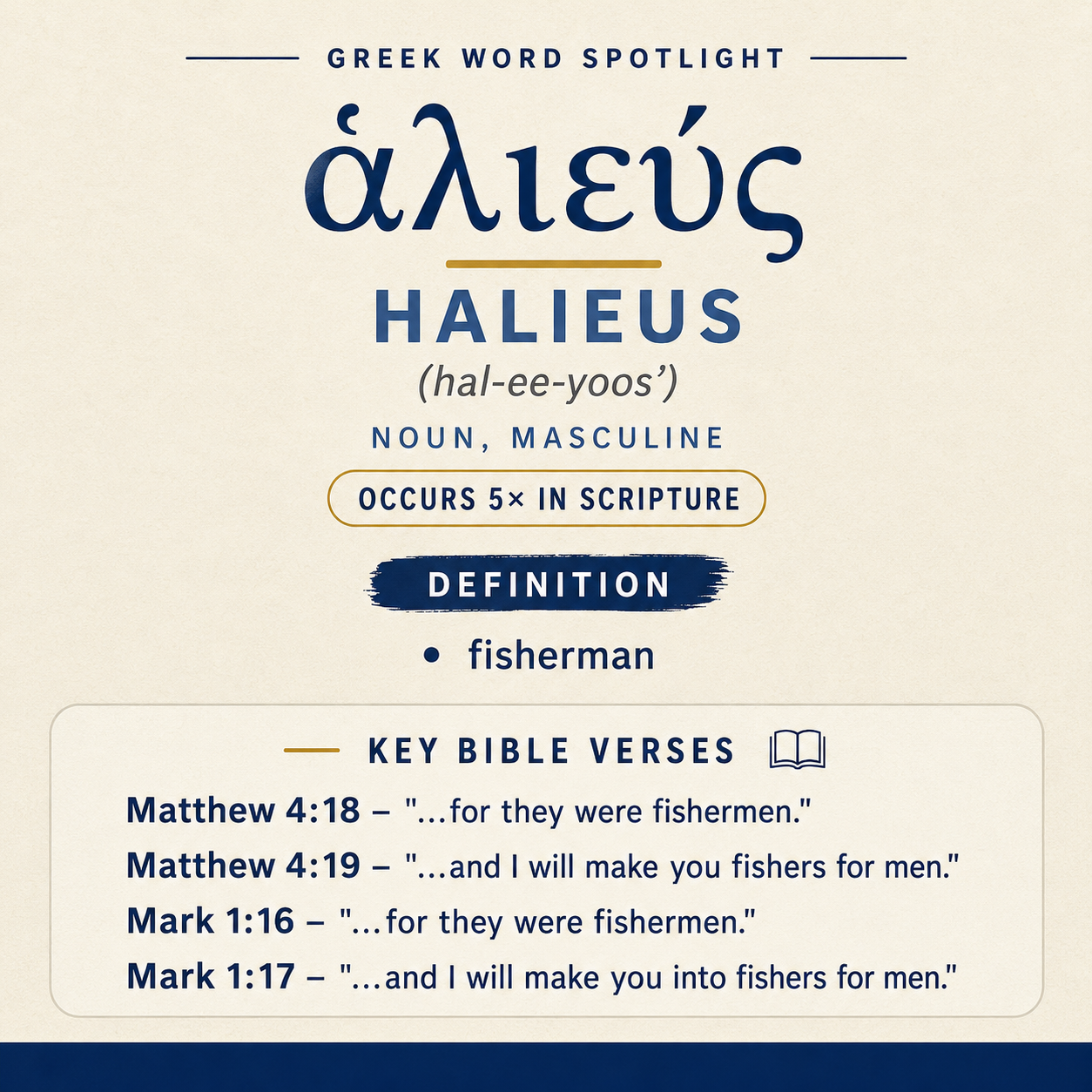
ἁλιεύς (Halieus) means “fisherman” and occurs 5 times in Scripture in Matthew 4:18–19, Mark 1:16–17, and Luke 5:2.
Gospel Scenes
It appears in calls by the sea of Galilee in Matthew 4:18–19 and Mark 1:16–17. Luke 5:2 describes fishermen washing their nets by the lake.
Learn More →Textual Context
In Matthew 4:19 and Mark 1:17, Jesus says, “Come after me, and I will make you fishers for men.”
Learn More →ἁλιεύς refers to a fisherman. In the Gospels it appears in scenes set by the sea or lake, identifying the occupation of Simon Peter, Andrew, and others, and forming the backdrop for Jesus’ call that turns their familiar work into a metaphor.
Root and Related Words
ἁλιεύς is related to ἅλς (hals), “salt” (Strong’s G251).

Occurrences
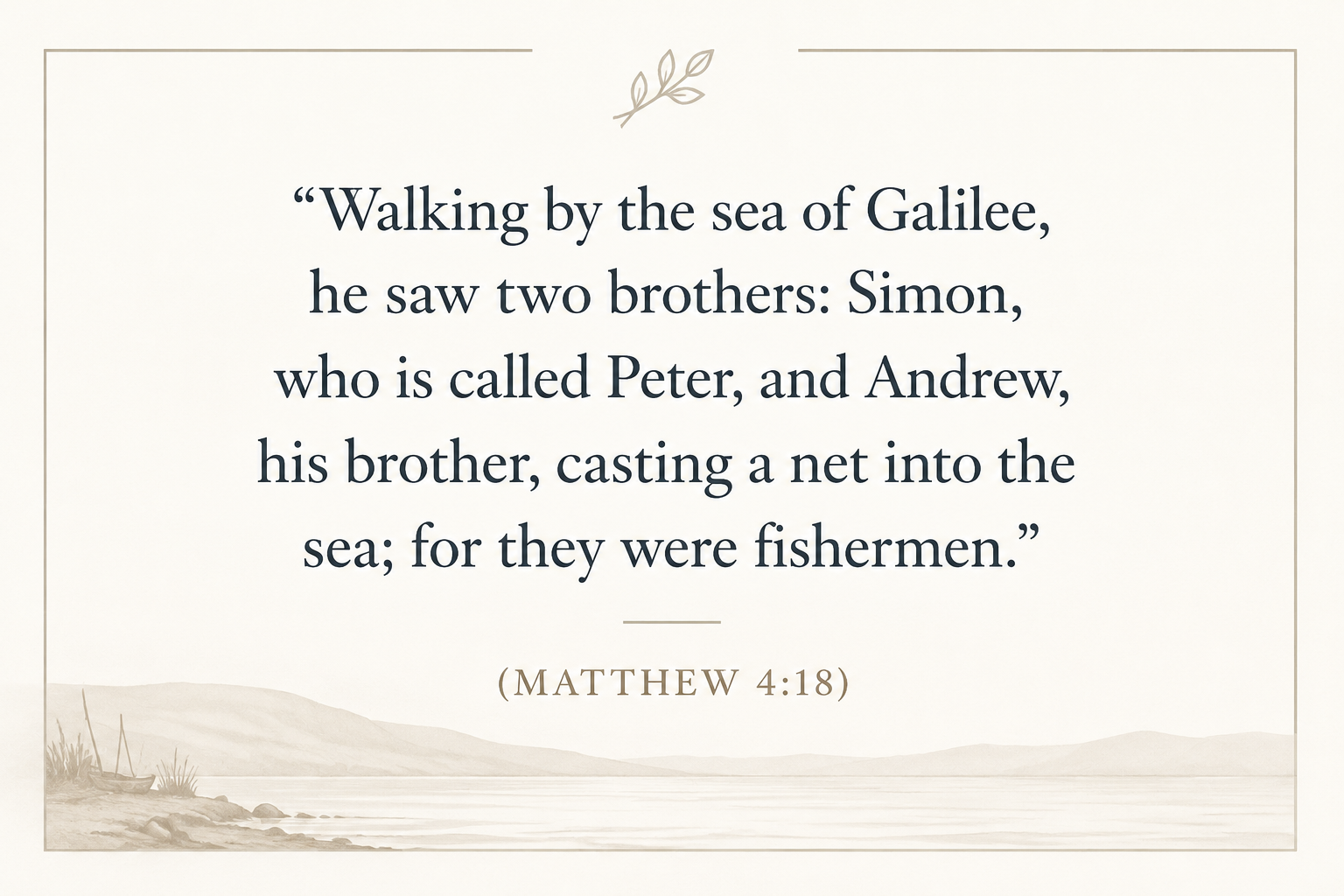
“Walking by the sea of Galilee, he saw two brothers: Simon, who is called Peter, and Andrew, his brother, casting a net into the sea; for they were fishermen.” (Matthew 4:18)
Here ἁλιεύς identifies Simon Peter and Andrew by trade at the moment they are first introduced in this setting. The word anchors the scene in ordinary labor: they are “casting a net into the sea,” and the explanation “for they were fishermen” presents their net-casting not as a one-off action but as the normal work that defines them. In this narrative frame, the term functions almost like a brief vocational label that makes their immediate response to Jesus’ next words intelligible against the weight of their established livelihood.
“He said to them, “Come after me, and I will make you fishers for men.”” (Matthew 4:19)
In this call, ἁλιεύς stands behind the wordplay of “fishers for men.” The force of the saying depends on the concrete identity already given: because they are fishermen, the promise “I will make you fishers for men” draws a straight line from what they already are in daily life to what they are being summoned to become. The term’s contribution is to supply the occupational reality that makes the metaphor vivid: the activity of fishing—already pictured through nets and the sea—becomes the conceptual bridge to a new kind of mission described in the same vocabulary of “fishers.”
“Passing along by the sea of Galilee, he saw Simon and Andrew, the brother of Simon, casting a net into the sea, for they were fishermen.” (Mark 1:16)
Mark’s wording closely parallels Matthew’s, and again ἁλιεύς marks Simon and Andrew as fishermen precisely while they are engaged in the characteristic action of their trade: “casting a net into the sea.” The term reinforces a down-to-earth realism: Jesus encounters them in the middle of work, not in a formal religious setting. By stating “for they were fishermen,” the narrative gives an explanatory rationale for the scene’s details (net, sea, casting) and frames their identity as something publicly recognizable at the lakeshore.
“Jesus said to them, “Come after me, and I will make you into fishers for men.”” (Mark 1:17)
As in Matthew, the occupation named by ἁλιεύς supplies the raw material for Jesus’ promise. Mark’s phrasing “make you into fishers for men” emphasizes transformation: the people who are fishermen in one sphere are to be reshaped into “fishers” in another. The word’s contribution lies in how it allows the call to be both familiar and disruptive—familiar because it speaks in the language of their trade, disruptive because it redirects the identity that “fisherman” represents toward a different object (“men”).
“He saw two boats standing by the lake, but the fishermen had gone out of them, and were washing their nets.” (Luke 5:2)
Luke uses ἁλιεύς in a slightly expanded shoreline tableau. The term identifies a group associated with “two boats,” and their actions are not the active catching of fish but the routine follow-up: they “had gone out of them, and were washing their nets.” In this scene, ἁλιεύς points to people whose work includes both the exertion of fishing and the quieter maintenance that supports it. The mention of nets being washed adds texture to what it means to be a fisherman: the trade involves tools, preparation, and cleanup, and the fishermen’s presence explains why boats and nets are foregrounded elements of the setting.
Sense and Usage
Across these passages, ἁλιεύς functions first as a plain occupational designation, locating certain individuals in a recognizable working world defined by water, boats, and nets. The word is consistently tied to physical actions: casting a net (Matthew 4:18; Mark 1:16) and washing nets (Luke 5:2). This repeated association narrows the reader’s imagination to the tangible rhythms of shoreline labor—gear in hand, water at the edge, and the purposeful movements of a practiced trade.
At the same time, the term carries narrative weight beyond simple description because Jesus’ call explicitly builds on that occupation. In Matthew 4:19 and Mark 1:17, the familiar identity of “fishermen” becomes the launching point for the metaphor “fishers for men.” The impact of the saying depends on the concreteness of ἁλιεύς: it evokes people whose work is to gather living creatures from the water with nets, so that the call can reframe their skill and purpose without abandoning the imagery that already fits their hands and environment. Within these scenes, ἁλιεύς therefore serves a dual role: it is a straightforward label of livelihood, and it is also the hinge on which a metaphorical commission turns.
Imagery
In these Gospel snapshots, ἁλιεύς evokes the shoreline as a workplace: the sea or lake in view, boats nearby, and nets either in use or being cleaned. That imagery gives the call narratives a grounded setting—Jesus speaks into the middle of ordinary labor—and it makes the promise about becoming “fishers for men” resonate with the texture of real work already pictured in the scenes (Matthew 4:18–19; Mark 1:16–17; Luke 5:2).
Sources: Lexical data from Strong’s Exhaustive Concordance and the Translators Brief Lexicon of Extended Strongs for Greek (STEPBible, CC BY). Occurrence data from the Translators Amalgamated Greek New Testament (STEPBible, CC BY). Scripture quotations from the World English Bible (public domain).