
Exploring the Meaning of Alethes in Greek
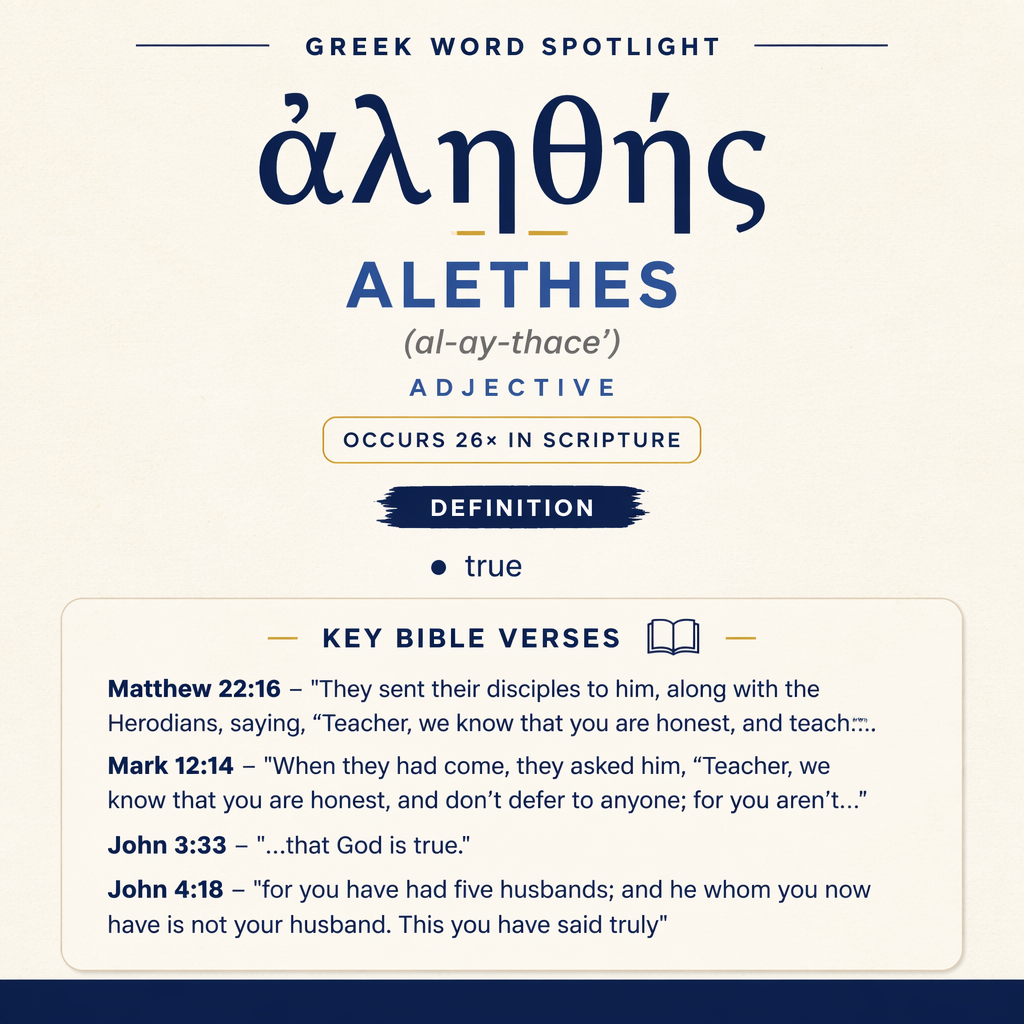
ἀληθής means “true” and appears 26 times in Scripture, including Matthew 22:16, Mark 12:14, and multiple uses in John.
Core Meaning
ἀληθής is defined as “true.” In John 3:33, it is used of God: “God is true.”
Learn More →Gospel Occurrences
It appears in Matthew 22:16 and Mark 12:14 in statements addressed to Jesus about being “honest.” Several occurrences are in John (e.g., John 3:33; 4:18; 5:32; 6:55; 7:18).
Learn More →Witness and Truth
In John 5:32, it describes testimony about Jesus: “the testimony…is true.” In John 4:18, Jesus says, “This you have said truly.”
Learn More →ἀληθής expresses what is “true,” especially where claims, testimony, teaching, and speech are being weighed. In the passages below, it is applied to God, to Jesus’ teaching and witness, and to statements whose accuracy is being affirmed.
Occurrences
Matthew 22:16 — “They sent their disciples to him, along with the Herodians, saying, “Teacher, we know that you are honest, and teach the way of God in truth, no matter whom you teach, for you aren’t partial to anyone.”
Here ἀληθής frames Jesus’ instruction as instruction that accords with truth. The speakers connect that truthfulness with impartiality (“you aren’t partial to anyone”), presenting “in truth” as a quality that stands independent of audience pressure or social rank.
Mark 12:14 — “When they had come, they asked him, “Teacher, we know that you are honest, and don’t defer to anyone; for you aren’t partial to anyone, but truly teach the way of God. Is it lawful to pay taxes to Caesar, or not?”
The word qualifies Jesus’ teaching as “truly” teaching the way of God, setting up a test question about taxes. In this scene, “true” functions as a claim about the reliability of his instruction and the integrity of his judgment—he teaches without deferring to people and without partiality.
John 3:33 — “He who has received his witness has set his seal to this, that God is true.”
ἀληθής is predicated of God: “God is true.” The statement is presented as something certified (“set his seal”) by receiving a witness; the adjective therefore supports the idea of confirmation—receiving the witness results in affirming God’s truthfulness.
John 4:18 — “for you have had five husbands; and he whom you now have is not your husband. This you have said truly.”
In Jesus’ assessment of the woman’s statement, ἀληθής marks her words as accurate to her real situation. The adjective (rendered adverbially in English, “truly”) draws a line between what has been spoken and the facts described in the same breath (“you have had five husbands…”).
John 5:31 — ““If I testify about myself, my witness is not valid.”
This line stands within a discussion of witness, and it introduces the standards by which testimony is received or rejected (“valid”). The setting prepares for ἀληθής to function not as a vague compliment but as a legal-and-relational assessment of testimony.
John 5:32 — “It is another who testifies about me. I know that the testimony which he testifies about me is true.”
ἀληθής qualifies “the testimony” borne by “another” as true. The emphasis falls on the trustworthiness of that external witness; truth here is attached to testimony that supports Jesus, distinguishing it from self-testimony whose validity is questioned in the prior sentence.
John 6:55 — “For my flesh is food indeed, and my blood is drink indeed.”
The doubled “indeed” uses ἀληθής to intensify the claim being made: what Jesus gives is genuinely what it is said to be—real food and real drink in the terms of the statement. The adjective reinforces the reality-status of the predicates (“food,” “drink”) as Jesus presents them.
John 7:18 — “He who speaks from himself seeks his own glory, but he who seeks the glory of him who sent him is true, and no unrighteousness is in him.”
In this contrast, ἀληθής is tied to a person’s orientation and aims: the one who seeks the sender’s glory “is true.” Truth is presented as consistent with a lack of unrighteousness (“no unrighteousness is in him”) and opposed to self-glorifying speech.
John 8:13 — “The Pharisees therefore said to him, “You testify about yourself. Your testimony is not valid.””
The objection targets the credibility of Jesus’ testimony (“not valid”). This dispute supplies the immediate context in which ἀληθής will be asserted about his testimony: the issue is not merely what is said, but whether it stands as acceptable witness.
John 8:14 — “Jesus answered them, “Even if I testify about myself, my testimony is true, for I know where I came from, and where I am going; but you don’t know where I came from, or where I am going.”
Here ἀληθής is Jesus’ direct counterclaim: his testimony “is true.” The reason given is grounded in knowledge of his own origin and destination (“I know where I came from, and where I am going”), contrasted with the opponents’ lack of that knowledge. Truth is thus tied to an internal grasp of the realities testified to, not merely to the formal objection raised.
John 8:17 — “It’s also written in your law that the testimony of two people is valid.”
The citation about two-person testimony continues the courtroom-like framework of validity and witness. Within that framework, ἀληθής functions as the positive quality sought for testimony—what is true is what can stand when weighed by recognized standards.
John 8:26 — “I have many things to speak and to judge concerning you. However he who sent me is true; and the things which I heard from him, these I say to the world.”
ἀληθής is again predicated of the sender: “he who sent me is true.” This grounds Jesus’ public speech (“these I say to the world”) in what he has heard from the true sender, linking the truthfulness of the source to the reliability of the message delivered.

Sense and Usage
Across these texts, ἀληθής functions as a weight-bearing adjective: it does not decorate a statement but helps decide whether a claim, testimony, or teacher deserves trust. In the Synoptic scenes (Matthew 22:16; Mark 12:14), the term attaches to teaching—“teach the way of God in truth” and “truly teach the way of God”—and it is paired with moral qualities that protect truth from distortion: impartiality and refusal to defer to people. Truth is thus portrayed as resilient under social pressure.
In John’s Gospel, ἀληθής repeatedly appears in the arena of witness. John 3:33 presents truth as something affirmed by accepting testimony: receiving the witness sets a “seal” on the confession “that God is true.” John 5:31–32 and 8:13–14 show truth and validity being argued in relation to testimony; objections about whether a witness counts (“valid”) are met with assertions that testimony can nevertheless be true, and that truth may be grounded in direct knowledge of what is being testified. John 8:17 keeps the discussion tethered to recognized standards for weighing testimony, so that “true” remains forensic and public, not private sentiment.
Several occurrences apply ἀληθής to persons rather than merely to sentences. God is called true (John 3:33), and “he who sent me is true” (John 8:26), so truth is a characteristic of the divine source behind the witness. In John 7:18, “he who seeks the glory of him who sent him is true,” where truth is aligned with proper aim and is explicitly incompatible with unrighteousness. In this way, the adjective can describe reliability not only in what is said but in the speaker’s orientation—whether speech issues from self-glory or from loyalty to the sender.
Other occurrences show ἀληθής as an affirmation of factual accuracy in a concrete exchange. In John 4:18, Jesus’ “This you have said truly” is a precision statement: the woman’s words correspond to the situation Jesus describes. In John 6:55, the adjective strengthens predication (“food indeed… drink indeed”), using “true” to underscore the genuineness of what is claimed about Jesus’ flesh and blood within that discourse.
Imagery and Emphasis
These passages repeatedly place ἀληθής in settings where words are tested—questions posed to entrap, testimony evaluated for validity, motives examined for self-glory, and speech traced back to its source. The adjective presses each scene toward a verdict: whether teaching is impartial, whether witness can stand, whether a statement matches reality, and whether the sender behind a message is himself true.
Sources: Lexical data from Strong’s Exhaustive Concordance and the Translators Brief Lexicon of Extended Strongs for Greek (STEPBible, CC BY). Occurrence data from the Translators Amalgamated Greek New Testament (STEPBible, CC BY). Scripture quotations from the World English Bible (public domain).





