Exploring the Meaning of Alektorophonia in Greek
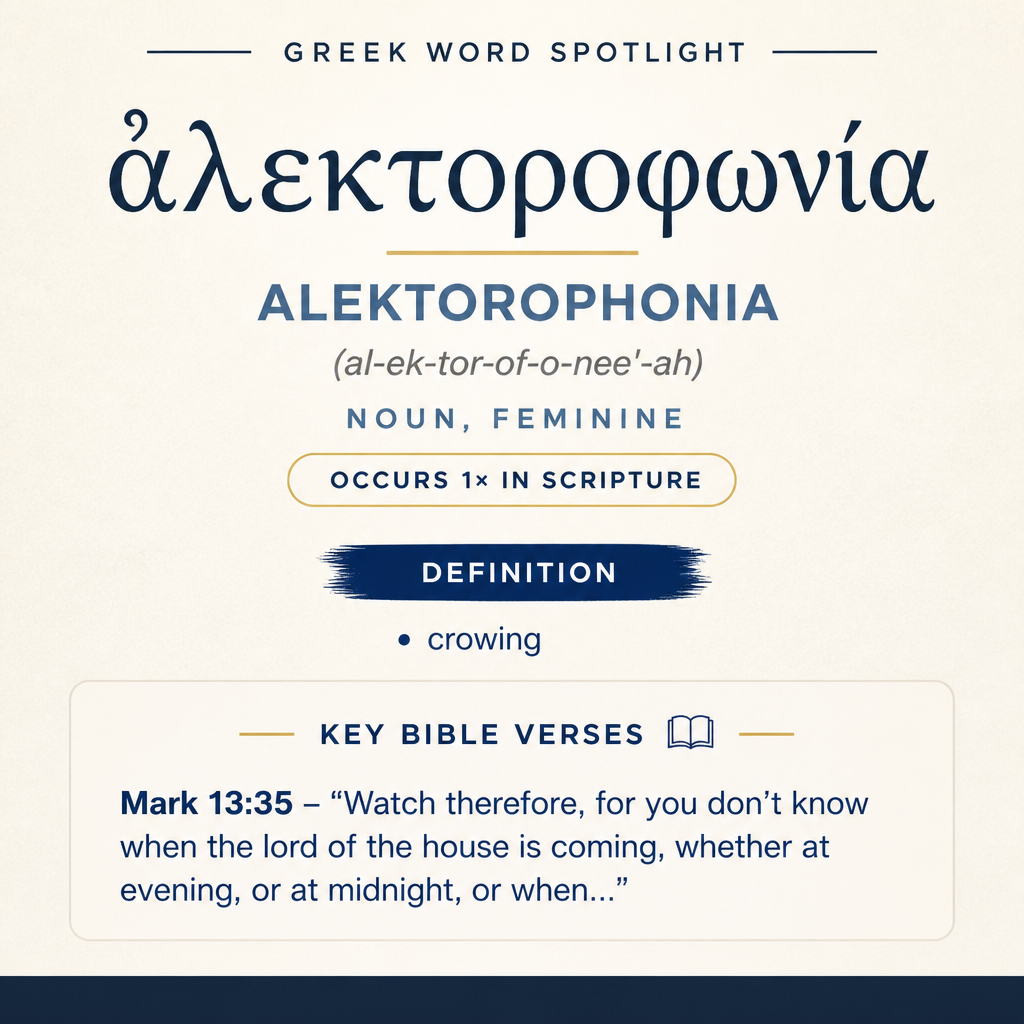
ἀλεκτοροφωνία means “crowing” and appears once in Scripture in Mark 13:35.
Verse Context
In Mark 13:35, it is listed as one of the time markers: “at evening, or at midnight, or when th…”.
Learn More →ἀλεκτοροφωνία means “crowing” and appears in Jesus’ watchfulness exhortation in Mark 13:35. In that saying it functions as a vivid time-marker within a night-to-morning sequence.
Root and Related Words
ἀλεκτοροφωνία is formed from ἀλέκτωρ (alektor), “rooster” (Strong’s G220), and φωνή (phone), “voice/sound: voice” (Strong’s G5456). The compound ties the sound of a rooster’s voice to the event named by the noun.

Occurrences
“Watch therefore, for you don’t know when the lord of the house is coming, whether at evening, or at midnight, or when the rooster crows, or in the morning;” (Mark 13:35)
Here ἀλεκτοροφωνία is embedded in a list of possible times: “at evening,” “at midnight,” “when the rooster crows,” and “in the morning.” The sequence sketches the progression of a night watch, and the “crowing” point stands out as a natural auditory cue within that progression. In the verse’s own imagery, the household is under the authority of “the lord of the house,” and the uncertainty is not whether he will come but when—the timing cannot be predicted, so the hearer is urged to “Watch therefore.” By naming “when the rooster crows,” the saying uses a commonplace, concrete moment to underline that the return could fall at any point, including a moment associated with sleep giving way to wakefulness.
The immediate effect of ἀλεκτοροφωνία in this line is to add specificity without granting predictability. “Evening,” “midnight,” and “morning” are broad spans; “when the rooster crows” is a sharper instant that can be heard. That sharpness heightens the force of the warning: vigilance is not merely for large blocks of time but for a particular moment that arrives suddenly, announced by a sound outside human scheduling. Within the verse, the crowing is not treated as an omen or message; it simply functions as one option among several for the master’s arrival. The imagery therefore presses the hearer to readiness that covers the entire cycle—from the settled hours of evening through the deepest part of the night, through the distinctive “crowing,” and into morning.
Sense and Usage
The single New Testament use of ἀλεκτοροφωνία shows how “crowing” can operate as a temporal boundary in ordinary experience. Because the noun is linked to a rooster’s “voice,” it presents the time in terms of what is heard rather than what is measured. In Mark 13:35 the point is not the biology of the animal but the recognizability of the moment: a sound that breaks the night’s quiet and signals that time has moved forward. The verse uses that recognizability to serve the command “Watch therefore,” treating the night as a period in which decisive events may occur without warning.
Within the list, “when the rooster crows” is framed by other time references, and that framing clarifies its function. It does not replace “morning,” but stands alongside it, marking a stage on the way to morning that is experiential and concrete. The hearer is made to imagine the household at various points of the night—some at the beginning (“evening”), some at the depth (“midnight”), some at a transitional moment that is audibly announced (“crowing”), and some after (“morning”). The word therefore serves the saying’s practical pressure: readiness cannot be postponed to a safer, more convenient time. The master’s coming is explicitly unknown, and the range of times named—ending with the crowing as one named possibility—closes off excuses that depend on predicting the hour.
Because ἀλεκτοροφωνία denotes an event that is brief and easily missed if one is asleep or inattentive, it pairs naturally with the imperative “Watch.” The verse itself does not define how long the “crowing” lasts or how many times it occurs; its rhetorical force comes from the very idea of a sudden, recognizable sound that could coincide with the master’s arrival. In that way the noun contributes not only a timestamp but also an atmosphere: the world is quiet, time is passing, and a sharp sound can arrive at any moment.
Imagery
Mark 13:35 places “crowing” in the setting of a “lord of the house” whose return time is unknown. The image is domestic and nocturnal: a house in the dark, watchers uncertain of the hour, and outside the brief cry of a rooster marking one moment among many. The word’s sound-based character helps the verse’s picture feel immediate—vigilance is portrayed not as abstract alertness but as the readiness that listens through the night for the moment that arrives unexpectedly.
Sources: Lexical data from Strong’s Exhaustive Concordance and the Translators Brief Lexicon of Extended Strongs for Greek (STEPBible, CC BY). Occurrence data from the Translators Amalgamated Greek New Testament (STEPBible, CC BY). Scripture quotations from the World English Bible (public domain).