Exploring the Meaning of Halas in Greek
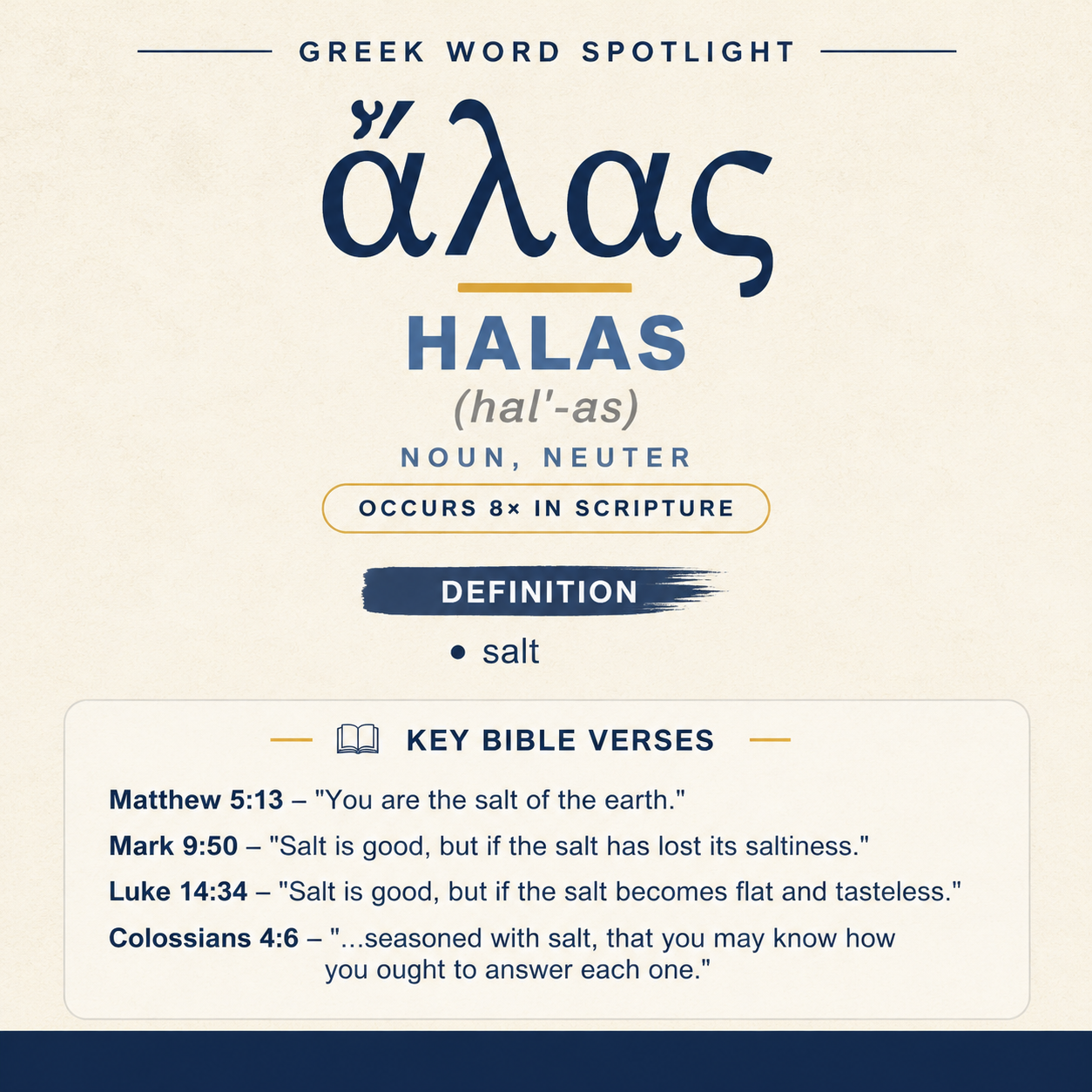
ἅλας means “salt” and appears 8 times in Scripture, including Matthew 5:13, Mark 9:50, Luke 14:34, and Colossians 4:6.
Key Passages
It appears in teachings about salt losing its flavor or saltiness in Matthew 5:13, Mark 9:50, and Luke 14:34.
Learn More →Figurative Use
In Colossians 4:6, speech is described as “with grace, seasoned with salt.”
Learn More →ἅλας means “salt” and appears in sayings of Jesus about what is good and what can become ineffective, and in a pastoral instruction about speech. In these passages, salt functions as a concrete substance whose usefulness depends on retaining what makes it salt.
Occurrences
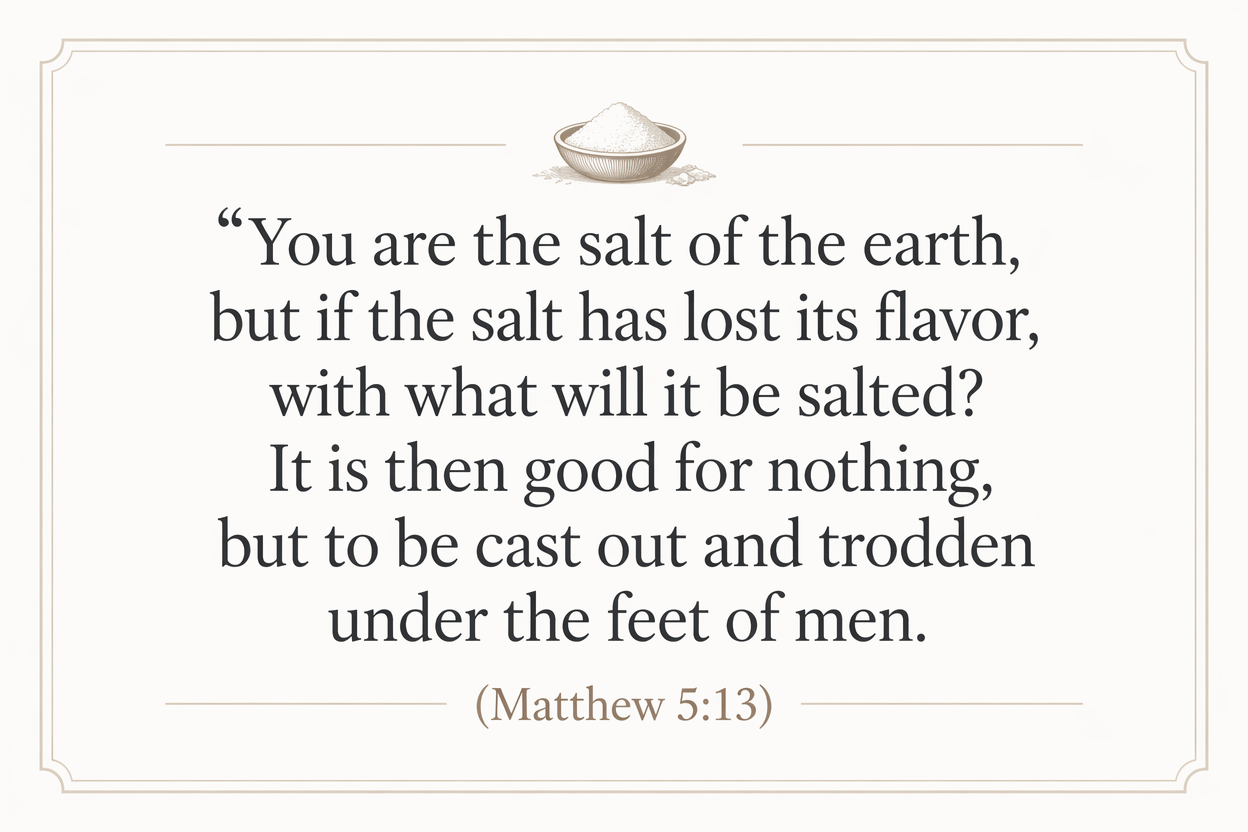
“You are the salt of the earth, but if the salt has lost its flavor, with what will it be salted? It is then good for nothing, but to be cast out and trodden under the feet of men. (Matthew 5:13)
Here ἅλας is set in a striking identification: “You are the salt of the earth.” The saying immediately turns to a practical test of salt’s value—whether it still has “flavor.” The repeated mention of “salt” keeps the illustration anchored in the ordinary material, while the rhetorical question (“with what will it be salted?”) stresses a loss that is not easily reversed from within the illustration itself. The closing consequence—“good for nothing… cast out… trodden under the feet of men”—connects the failed salt to public disposal, so the image is not merely about diminished quality but about a change in status: from something fit for use to something thrown away and stepped on.
Salt is good, but if the salt has lost its saltiness, with what will you season it? Have salt in yourselves, and be at peace with one another.” (Mark 9:50)
In Mark the statement begins with an appraisal: “Salt is good.” ἅλας stands for a substance that has a recognized beneficial use, and the conditional clause again raises the possibility of failure: salt that has “lost its saltiness.” The follow-up question, “with what will you season it?” keeps the focus on salt’s role in seasoning, and on the practical problem posed if the substance no longer does what salt does. The closing imperatives apply the image inwardly and socially: “Have salt in yourselves, and be at peace with one another.” The command “have salt” treats salt as something one can “have” within, and the immediate pairing with being “at peace” frames the salt-image as relevant to communal relations in the very way the sentence concludes.
Salt is good, but if the salt becomes flat and tasteless, with what do you season it? (Luke 14:34)
Luke repeats the core observation found elsewhere: “Salt is good,” followed by the scenario in which it “becomes flat and tasteless.” ἅλας again refers to literal salt, and its usefulness is described in sensory terms (“flat and tasteless”), highlighting that salt’s value is experienced and recognized. The verse ends with the same practical question about seasoning, keeping the picture within everyday culinary experience. The brevity of the saying here intensifies its point: the goodness of salt is assumed, yet the possibility of salt turning ineffective is presented as a decisive problem for its intended use.
Let your speech always be with grace, seasoned with salt, that you may know how you ought to answer each one. (Colossians 4:6)
In Colossians, ἅλας appears as a metaphorical seasoning applied to “speech.” The command is not merely to speak, but to let speech be “always… with grace,” and then to have it “seasoned with salt.” Salt functions here as an added element that affects how speech comes across, fitting with the image of seasoning as a deliberate preparation rather than an accident. The purpose clause—“that you may know how you ought to answer each one”—connects the salt-seasoning imagery to discernment and appropriateness in responses. Within this one sentence, salt is not set against losing its character, but is presented as something to be present in communication so that answering others is done well.

Sense and Usage
Across these passages ἅλας remains a concrete substance—salt—used as an image precisely because it has a recognizable function in ordinary life. The sayings in Matthew, Mark, and Luke each begin with the premise that salt is valuable (“You are the salt of the earth”; “Salt is good”), and each turns on the idea that salt can become ineffective (“lost its flavor,” “lost its saltiness,” “becomes flat and tasteless”). This repeated motif does two things within the imagery. First, it assumes that salt is defined in practice: it is known by what it does—flavoring and seasoning are the explicit points of reference in the questions, “with what will it be salted?” and “with what will you season it?” Second, it highlights how alarming it would be if the substance were to lose what makes it useful: in Matthew, the result is disposal and trampling, a vivid portrayal of worthlessness once salt no longer serves its purpose.
The three Gospel sayings use slightly different descriptors for the failure of salt, but they converge on the same practical outcome: salt that does not function as salt leaves no obvious remedy within the illustration. The rhetorical questions emphasize that the problem is not solved by simply applying “more salt” if the thing called salt is no longer effective. In the logic of these sayings, the identity “salt” is not treated as a mere label but as a reality that must correspond to an active quality—hence the sense of irreversible loss when that quality is gone. Matthew’s sequence presses this to a social, visible end: the discarded salt is “cast out” and “trodden under the feet of men,” suggesting not only rejection but exposure in public space, where it becomes something people step on rather than use.
Mark adds a distinctive turn by moving from the general statement (“Salt is good”) and the warning about lost saltiness to two imperatives: “Have salt in yourselves, and be at peace with one another.” The imagery of salt here is not left at the level of evaluating an external substance; it is applied to the inner life (“in yourselves”) and immediately tied to relationships (“be at peace with one another”). The phrase “have salt” treats salt as something that can be possessed and maintained. This fits the overall pattern of the salt sayings: what matters is not the name of the substance but the continued presence of what makes it useful. Mark’s construction places that responsibility on the hearers, moving from the hypothetical “if the salt has lost…” to the direct exhortation that they themselves should “have” salt.
Colossians uses ἅλας with a more explicitly everyday culinary metaphor: speech is to be “seasoned with salt.” Unlike the Gospel warnings, which focus on salt becoming ineffective, Colossians presents salt as a positive additive—something that shapes the character of speech when it is present. The image of seasoning implies intentionality and measure: seasoning is applied so that what is spoken comes out in an improved form. In the context of the verse itself, salt-seasoned speech sits alongside “grace” and serves the aim of knowing “how you ought to answer each one.” The salt metaphor therefore supports communication that is prepared, fitting, and responsive to the individual person being addressed (“each one”).
Taken together, these uses show that ἅλας carries a stable, literal reference—salt—while serving as a flexible image. It can mark identity (“You are the salt of the earth”), commend an inherent usefulness (“Salt is good”), warn against a practical failure (“lost its flavor… lost its saltiness… becomes flat and tasteless”), call for an inwardly held quality (“Have salt in yourselves”), and describe a deliberate shaping of speech (“seasoned with salt”). In every case, the force of the image depends on salt being a familiar material whose value is shown in tangible effects, especially in relation to taste and seasoning.
Imagery
The passages paint salt as something good when it remains what it is, and as something paradoxical when it ceases to function: “if the salt has lost its flavor… with what will it be salted?” (Matthew 5:13). That paradox drives the warning imagery in the sayings: the substance called salt can become “good for nothing” (Matthew 5:13) or “flat and tasteless” (Luke 14:34), and the questions about re-seasoning underline the seriousness of that condition. Alongside that warning stands a constructive picture: speech can be “seasoned with salt” (Colossians 4:6), where salt evokes careful preparation and an effect that others will experience in the very act of hearing and responding.
Sources: Lexical data from Strong’s Exhaustive Concordance and the Translators Brief Lexicon of Extended Strongs for Greek (STEPBible, CC BY). Occurrence data from the Translators Amalgamated Greek New Testament (STEPBible, CC BY). Scripture quotations from the World English Bible (public domain).