Understanding the Significance of Akuroo in Greek
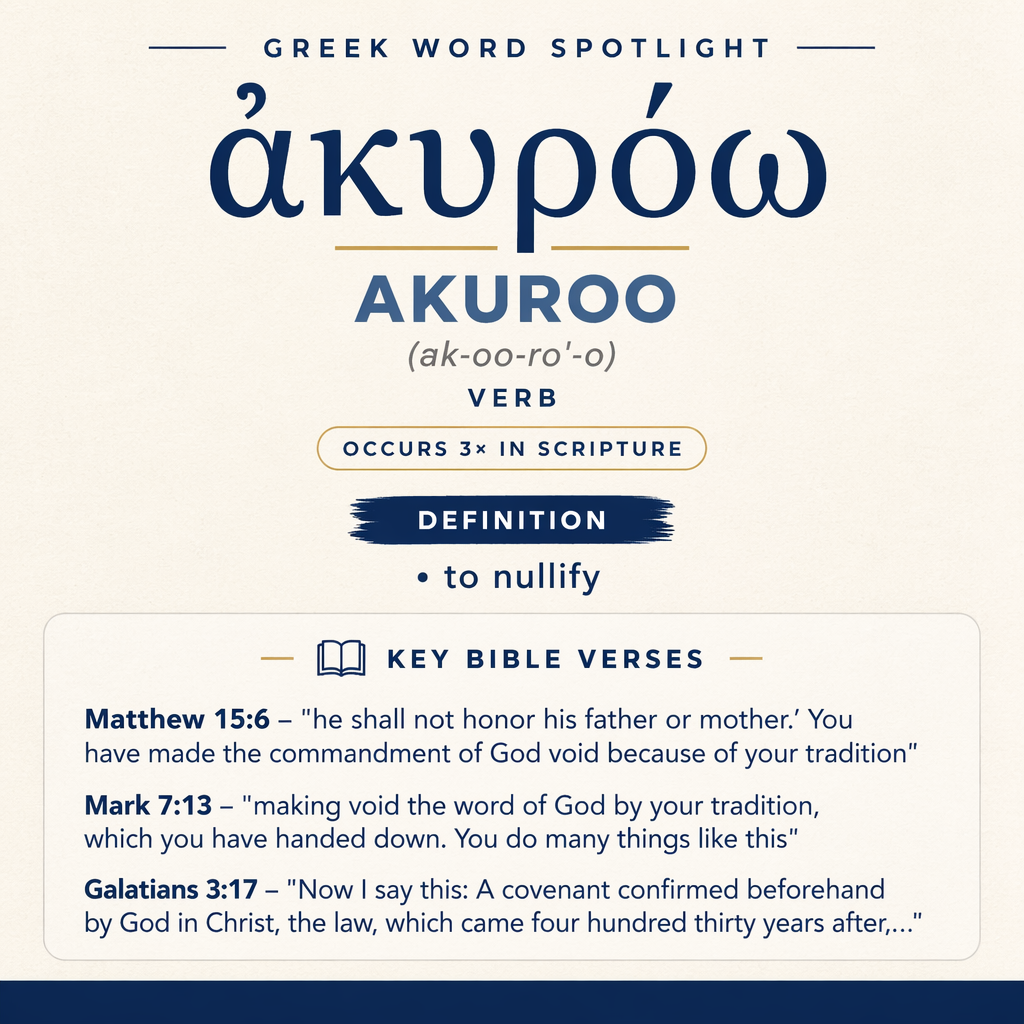
ἀκυρόω means “to nullify” and appears three times: Matthew 15:6, Mark 7:13, and Galatians 3:17.
Gospel Context
In Matthew 15:6 and Mark 7:13, it describes making God’s commandment/word void by tradition.
Learn More →Galatians Context
In Galatians 3:17, it appears in a statement about a covenant confirmed beforehand by God in Christ and the later law.
Learn More →ἀκυρόω means “to nullify.” It appears in Jesus’ criticism of tradition that cancels God’s command (Matthew 15:6; Mark 7:13) and in Paul’s argument that a later law does not cancel an earlier divine covenant promise (Galatians 3:17).
Root and Related Words
ἀκυρόω is related to κυρόω (kyroo), “to affirm” (Strong’s G2964). Strong’s also connects it with Α (Alpha; α, Ἀλφα), “Alpha” (Strong’s G1).

Occurrences
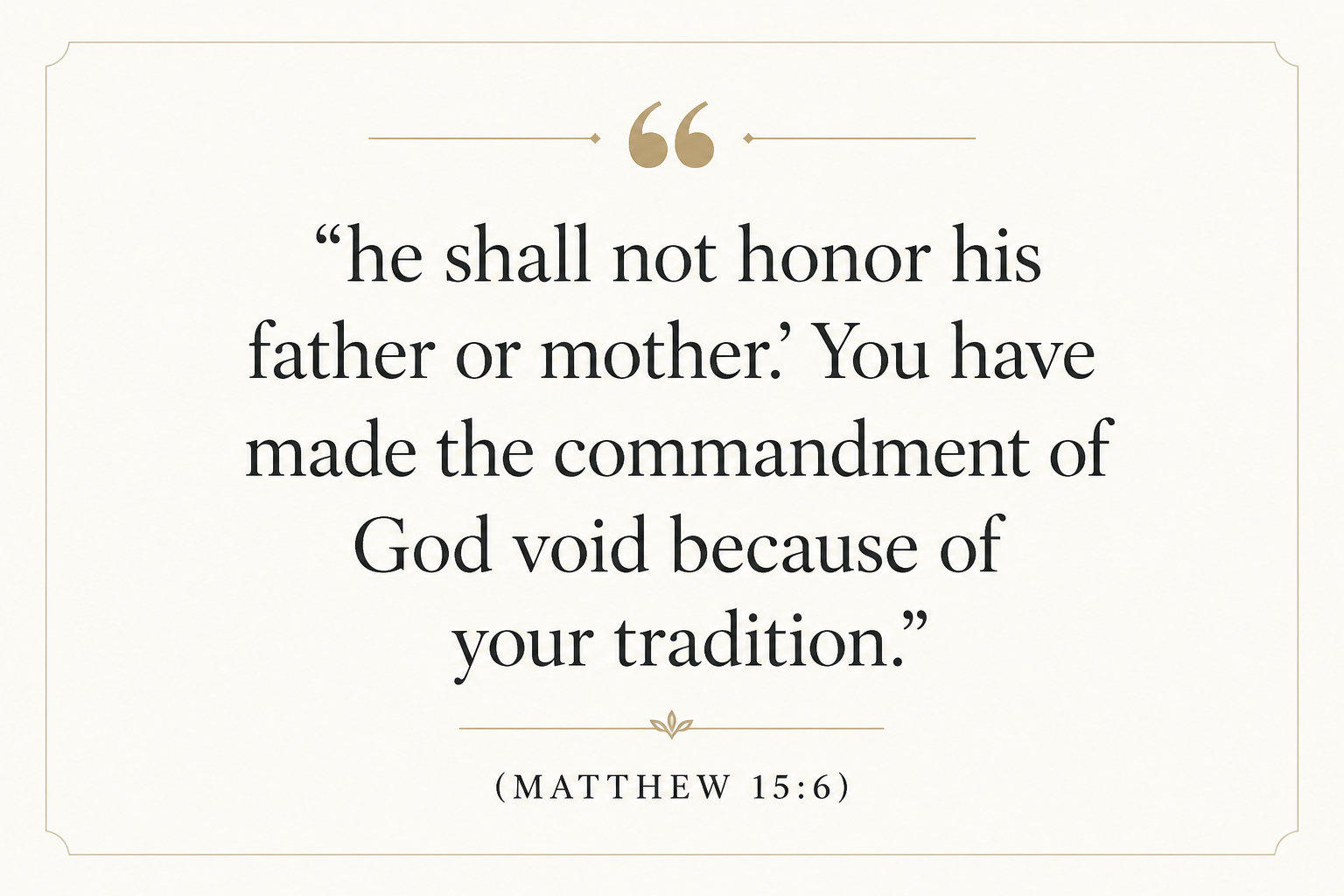
“he shall not honor his father or mother.’ You have made the commandment of God void because of your tradition.” (Matthew 15:6)
Here the verb is set in a direct accusation: “You have made the commandment of God void.” The sentence places two authorities side by side—“the commandment of God” and “your tradition”—and presents the tradition as the instrument that produces the nullifying effect (“because of your tradition”). Within the flow of the line, the force of ἀκυρόω is practical rather than merely theoretical: the commandment is treated as if it no longer carries binding weight in the matter at hand. The wording “you have made…void” assigns responsibility to the hearers; the act is not accidental but the result of a choice to let a customary practice override what God commanded. The immediate context also frames this as a moral failure toward parents (“honor his father or mother”), so the nullifying does not stay in the realm of interpretation; it issues in a concrete neglect of obligation.
“making void the word of God by your tradition, which you have handed down. You do many things like this.” (Mark 7:13)
Mark’s phrasing is closely aligned but not identical: the object is “the word of God,” and the action is described as an ongoing characteristic (“making void”). The prepositional phrase “by your tradition” again names the means; the tradition functions as the tool that accomplishes the nullifying. Mark adds two clarifying features. First, the tradition is described as something “which you have handed down,” emphasizing its received and transmitted character; the nullifying occurs through a chain of human transmission. Second, Jesus’ closing line, “You do many things like this,” places ἀκυρόω within a pattern: the act of nullifying is not isolated to one disputed practice but represents a repeated way of operating. In this setting, ἀκυρόω marks the point where a revered human inheritance becomes so determinative that God’s word is effectively cancelled in practice.
“Now I say this: A covenant confirmed beforehand by God in Christ, the law, which came four hundred thirty years after, does not annul, so as to make the promise of no effect.” (Galatians 3:17)
Paul uses ἀκυρόω in a legal-covenantal argument that turns on sequence and stability. The verse sets up two items: “A covenant confirmed beforehand by God in Christ” and “the law, which came four hundred thirty years after.” The temporal description is not background detail; it supports Paul’s claim about what the later law “does not” do. In this sentence ἀκυρόω is tied to a purpose clause: “does not annul, so as to make the promise of no effect.” The verb therefore names the cancelling action that would be required if the later law were to invalidate what was confirmed earlier; but Paul denies that such cancellation occurs. The rhetorical effect is to protect the efficacy of “the promise” by asserting that no later development can nullify the already-confirmed covenant. The pairing of “does not annul” with “so as to make the promise of no effect” shows what nullifying would entail in this argument: rendering the promise ineffective in its intended outcome.
Sense and Usage
Across these passages, ἀκυρόω consistently operates in contexts where an authoritative word stands to be cancelled by a competing claim. In the Gospels, the competing claim is “your tradition,” and the nullifying is portrayed as a human action that empties God’s directive of its operative force. The wording in Matthew highlights culpability (“You have made…”), while Mark stresses habitual practice (“You do many things like this”) and the way traditions are perpetuated (“handed down”). In both, the verb highlights a tension between what is received from God and what is received from human transmission; nullifying occurs when the latter is treated as controlling in a way that cancels the former.
In Galatians, the structure is different but the core idea remains the same: the question is whether a later authoritative-sounding reality (“the law”) can cancel an earlier, confirmed divine covenant and its promise. Paul’s use shows ἀκυρόω functioning within the logic of confirmation and effect: to annul would be to make the promise “of no effect.” The verse therefore frames nullifying as the act that would strip a divine commitment of its effective outcome. The denial (“does not annul”) underscores the endurance of what God has confirmed; the verb’s force is felt in what is ruled out—cancellation that would reverse or neutralize the promise’s efficacy.
Taken together, the occurrences show ἀκυρόω describing cancellation at the level of practical authority and covenantal effect. Whether the object is “the commandment of God,” “the word of God,” or a previously confirmed covenant promise, the verb marks the attempt (or hypothetical possibility) of rendering that divine word ineffective—either by substituting tradition as the controlling norm or by treating a later law as overriding what was confirmed before. The passages also show that nullifying can be spoken of as an achieved result (“You have made…void”), an ongoing practice (“making void”), or an action explicitly denied (“does not annul”), giving the verb a clear role in exposing what cancels God’s word and in defending what cannot be cancelled.
Imagery
The imagery in these texts is the imagery of cancellation: God’s command or promise stands as a binding word, and ἀκυρόω names the move that would reduce it to something ineffective. In Matthew and Mark, tradition is portrayed as the agent that cancels; in Galatians, the later law is described as unable to perform that cancelling act against a covenant “confirmed beforehand.”
Sources: Lexical data from Strong’s Exhaustive Concordance and the Translators Brief Lexicon of Extended Strongs for Greek (STEPBible, CC BY). Occurrence data from the Translators Amalgamated Greek New Testament (STEPBible, CC BY). Scripture quotations from the World English Bible (public domain).