
Understanding the Meaning of Adoniy-Bezeq in Hebrew
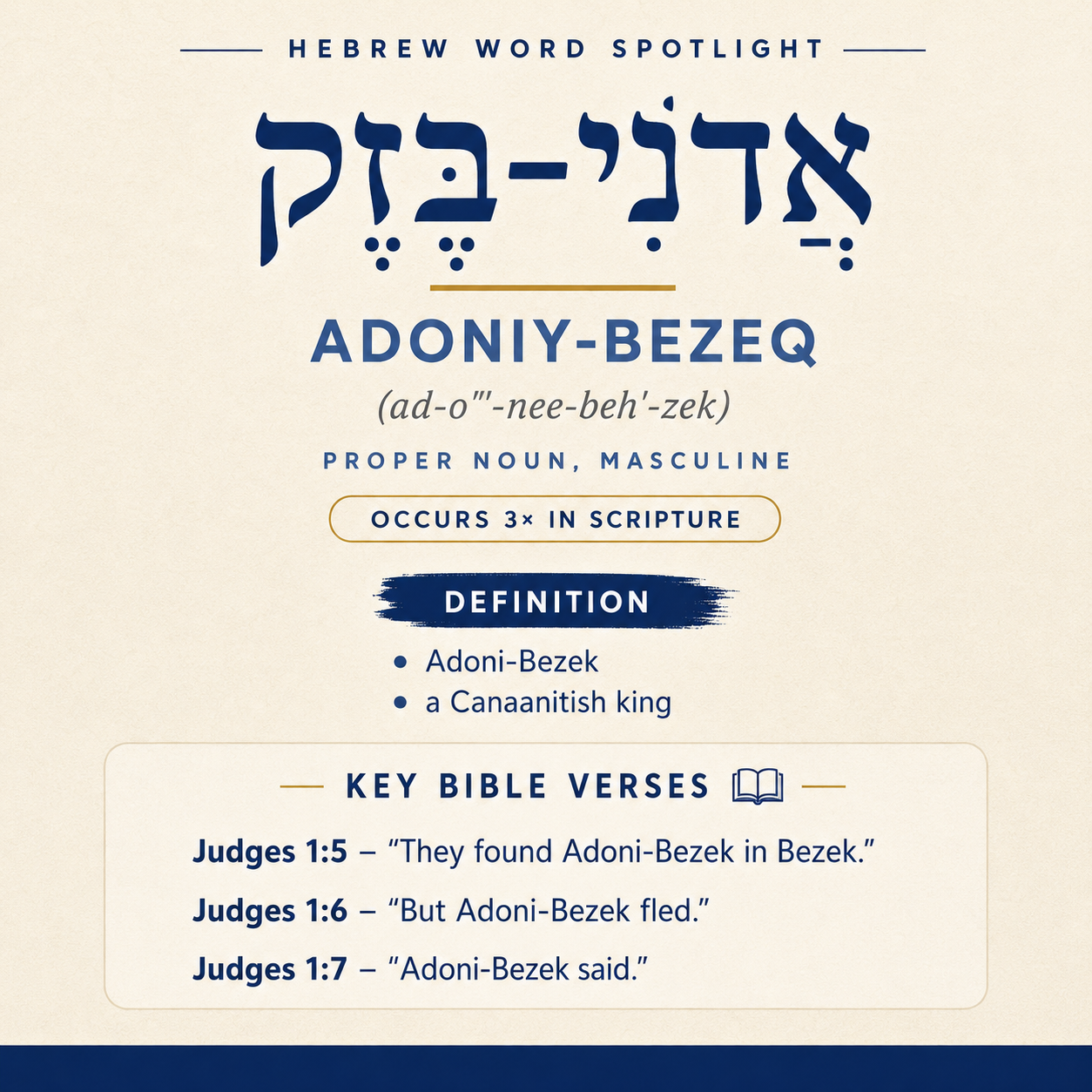
אֲדֹנִי־בֶזֶק means “Adoni-Bezek,” a Canaanitish king, appearing in Judges 1:5–7.
Judges Account
In Bezek, Israel fought Adoni-Bezek and struck the Canaanites and the Perizzites. He fled, was pursued and caught, and his thumbs and big toes were cut off.
Learn More →His Statement
Adoni-Bezek said seventy kings with cut-off thumbs and big toes scavenged under his table. He connected his own treatment with what he had done.
Learn More →אֲדֹנִי־בֶזֶק (Adoniy-Bezeq) refers to “Adoni-Bezek; a Canaanitish king.” The name appears in Judges 1:5–7 in a short sequence that introduces him, describes his capture and mutilation, and records his own speech interpreting his fate.
Occurrences
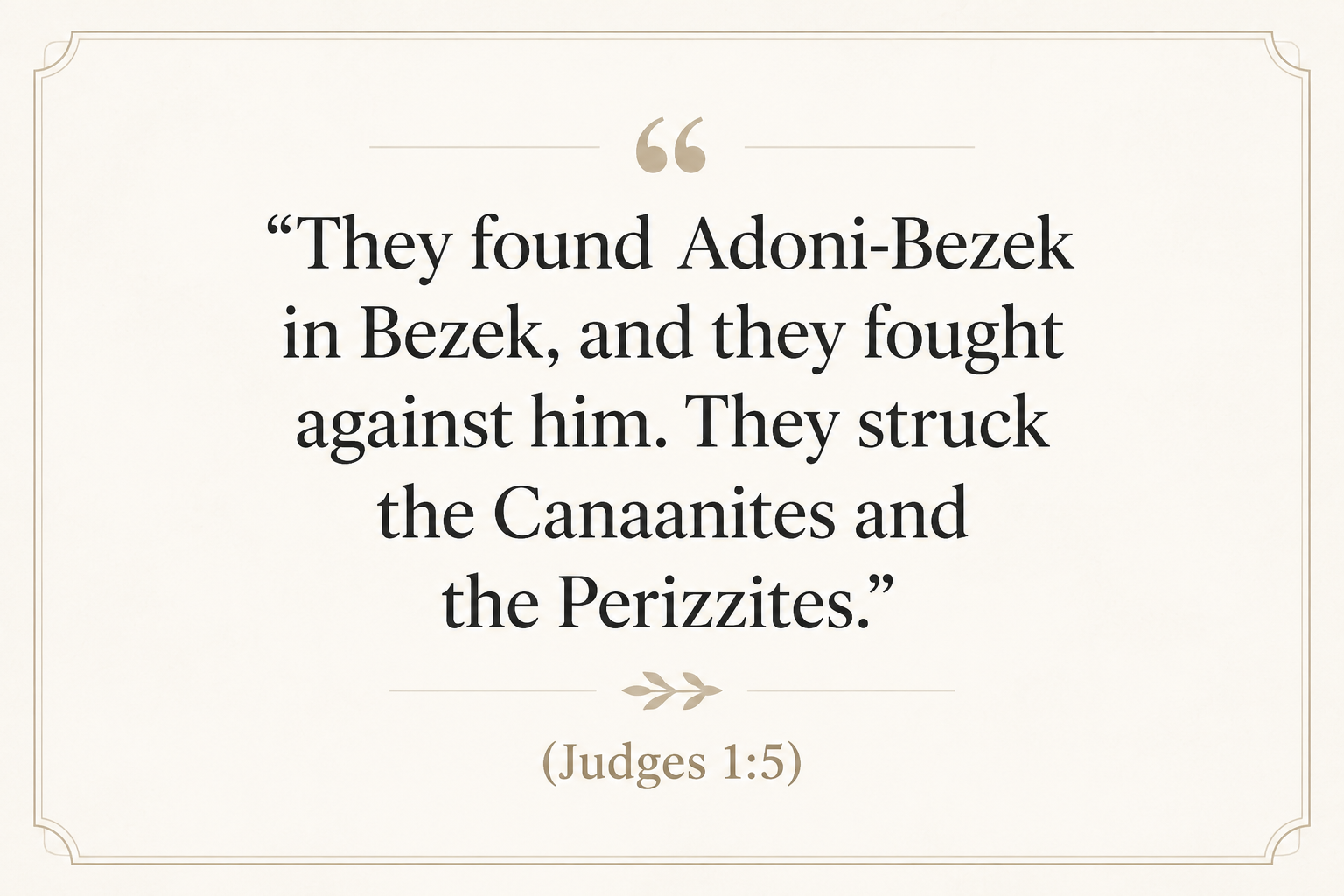
“They found Adoni-Bezek in Bezek, and they fought against him. They struck the Canaanites and the Perizzites.” (Judges 1:5)
Here Adoni-Bezek is presented as a specific royal opponent encountered “in Bezek.” The narrative treats him as a central figure within a broader clash: alongside the statement that “they fought against him,” the verse immediately widens to the larger military action—“They struck the Canaanites and the Perizzites.” Within that compressed report, the name functions as a focal point for the engagement at Bezek, identifying a king whose presence gives the conflict a particular target and locality. The verse also frames him as someone who can be “found,” suggesting he is located and engaged as a concrete adversary rather than merely a distant ruler; the wording makes the encounter direct and immediate.
“But Adoni-Bezek fled. They pursued him, caught him, and cut off his thumbs and his big toes.” (Judges 1:6)
This occurrence places Adoni-Bezek in motion: he “fled,” becomes the object of pursuit, is “caught,” and is then subjected to a deliberate disabling. The sequence of verbs is rapid and unadorned, moving from attempted escape to capture to physical punishment. The mention of “his thumbs and his big toes” attaches the action to the king’s own body; the narrative emphasizes that the treatment is personal and concrete, not merely political defeat. By naming him at the start of the verse (“But Adoni-Bezek fled”), the text keeps the king in the foreground and treats what follows as something happening specifically to this ruler. The naming also heightens the contrast between royal status and vulnerability: a king who would be expected to command others is instead hunted and mutilated.
“Adoni-Bezek said, “Seventy kings, having their thumbs and their big toes cut off, scavenged under my table. As I have done, so God has done to me.” They brought him to Jerusalem, and he died there.” (Judges 1:7)
In this final occurrence the name introduces Adoni-Bezek’s own voice, and his speech becomes an interpretive lens on the previous action. He describes a scene of dominance and humiliation: “Seventy kings, having their thumbs and their big toes cut off, scavenged under my table.” The detail matches the punishment described in the prior verse, connecting his present condition with a pattern of cruelty he claims to have imposed on others. His words “As I have done, so God has done to me” explicitly frame his capture and mutilation as a fitting return for his earlier actions. In the immediate narrative flow, the name anchors a shift from external description (“They pursued him…”) to internal testimony: the king himself narrates what his rule looked like and how he understands his downfall. The verse ends with removal from Bezek’s setting to a different destination—“They brought him to Jerusalem”—and the closing note, “and he died there,” completes his story with a terse finality. The named king thus moves from being an opponent in battle, to a captive under judgment, to a figure whose own confession supplies the moral logic of the episode.

Sense and Usage
Across Judges 1:5–7, Adoni-Bezek is consistently treated as a recognizable royal figure—“a Canaanitish king”—whose identity matters to the story’s movement. The name serves more than a label for an enemy combatant; it gathers the surrounding details into a coherent portrayal of kingship expressed through power over other rulers, followed by the collapse of that power. In the first verse, Adoni-Bezek is encountered in a specific place (“in Bezek”), and the conflict is summarized with a broad stroke against multiple peoples. The effect is to situate him within the larger landscape of Canaanite and related groups, while still singling him out as the immediate royal adversary at that moment.
The second verse narrows the focus from battle outcome to the king’s personal fate. The narrative’s concern is not simply that he is defeated but that he attempts to evade defeat (“fled”) and is forcibly subdued (“caught”). The cutting off of “thumbs” and “big toes” is described without explanation, leaving the action to speak for itself as a decisive, degrading reduction of the king’s former capability. By keeping the proper name attached to these actions, the text ensures the reader tracks the same person through each step: the one who was “found” and fought is the one who flees, is captured, and is disabled.
The third verse develops the king’s identity by placing a remembered practice of domination in his mouth. The claim that “Seventy kings… scavenged under my table” portrays his earlier authority as expansive and humiliating toward rivals; the imagery of maimed kings reduced to scavenging under his table depicts the table not as hospitality but as a stage for enforced abasement. Within that same sentence, the specific mutilation mentioned becomes a marker of his prior policy: he is not merely a king among others but one who systematically reduced other kings. His interpretation—“As I have done, so God has done to me”—presents his own downfall as symmetrical with what he inflicted. In these verses, then, the usage of Adoni-Bezek centers on a king whose rule is characterized by humiliating superiority and whose defeat is narrated as an enacted reversal of his own actions.
The name also helps structure the passage’s geography and movement. The first occurrence anchors him at Bezek; the final occurrence relocates him—“They brought him to Jerusalem”—and closes his story there. This shift underscores that Adoni-Bezek is not only a battlefield opponent but also a captive whose end is determined by others. The proper name maintains continuity as the scene changes from combat, to chase and capture, to confession and transport. In this tight narrative, Adoni-Bezek functions as a concentrated example of kingship brought low: the text identifies him as a king, depicts him suffering a humiliation he once imposed, and ends with his death away from the place where he was first encountered.
Imagery
The episode’s imagery is stark and bodily: thumbs and big toes cut off, kings scavenging “under my table,” a captured ruler carried to another city and dying there. Adoni-Bezek’s name becomes attached to the picture of a king who once presided over a table of subjugation and then experiences a mirrored humiliation. The narrative places the interpretive weight on his own words—“As I have done, so God has done to me”—so that the name evokes not only a defeated Canaanite king but a story of reversal in which the ruler’s past cruelty is reflected back upon him in the same form.
Sources: Lexical data from Strong’s Exhaustive Concordance and the Open Scriptures Hebrew Lexicon. Occurrence data from the Westminster Leningrad Codex with STEPBible reference data (CC BY). Scripture quotations from the World English Bible (public domain).





