Discovering the Meaning of ‘Adoniyah in Hebrew
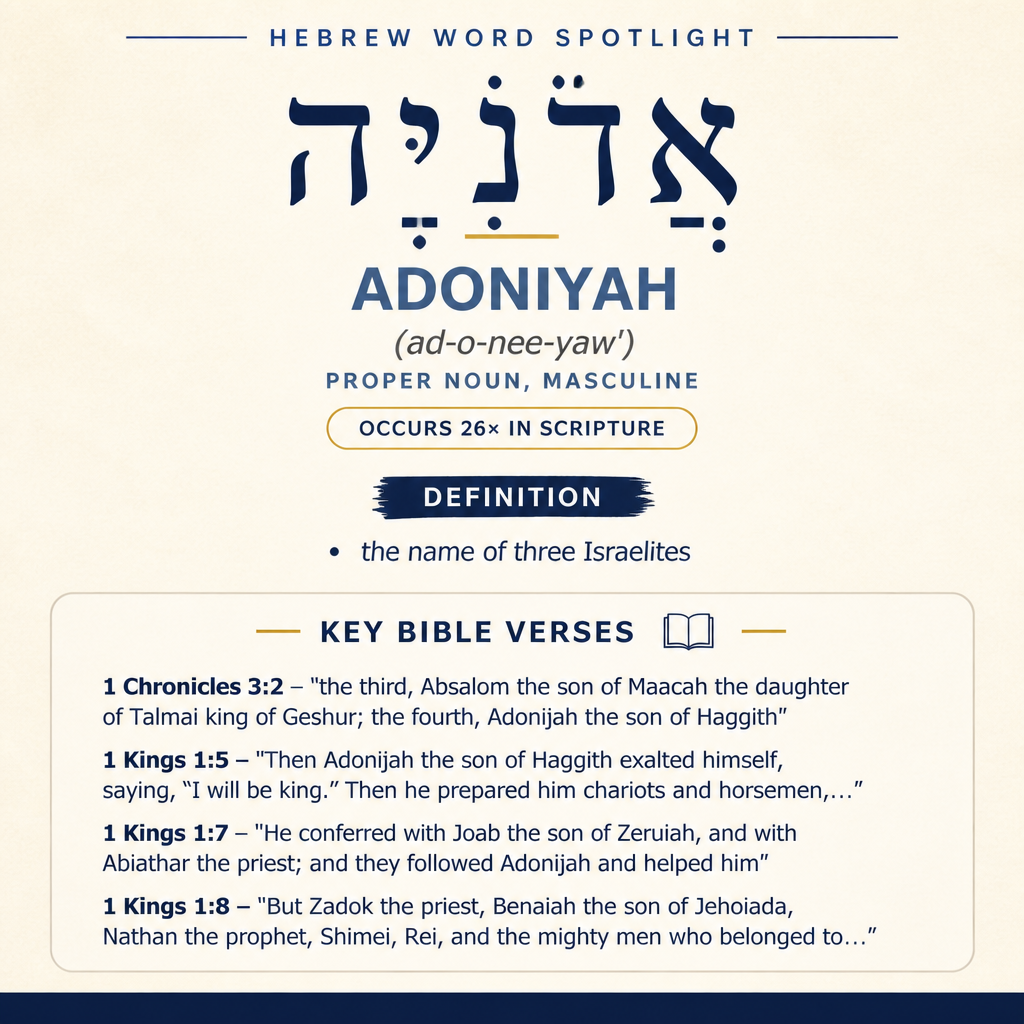
אֲדֹנִיָּה (Adoniyah) is the name of three Israelites, appearing 26 times in Scripture including 1 Chronicles 3:2 and 1 Kings 1.
Scripture Occurrences
This name occurs 26 times in Scripture. It appears in passages such as 1 Chronicles 3:2 and 1 Kings 1:5–18.
Learn More →Narrative Snapshot
In 1 Kings 1:5 Adonijah the son of Haggith exalted himself, saying, “I will be king.” 1 Chronicles 3:2 lists Adonijah as the son of Haggith.
Learn More →אֲדֹנִיָּה (Adoniyah) is a personal name borne by three Israelites. In the passages cited here, it identifies a son of David and the central figure in a contested royal moment narrated in 1 Kings 1, with one genealogical notice in 1 Chronicles.
Occurrences
1 Chronicles 3:2 — “the third, Absalom the son of Maacah the daughter of Talmai king of Geshur; the fourth, Adonijah the son of Haggith;”
Here Adonijah is introduced within a list of David’s sons. The name functions to locate him precisely in David’s family line as “the fourth” son, and it anchors his identity by maternal connection (“the son of Haggith”), a detail that later narratives also retain.
1 Kings 1:5 — “Then Adonijah the son of Haggith exalted himself, saying, “I will be king.” Then he prepared him chariots and horsemen, and fifty men to run before him.”
This first narrative occurrence frames Adonijah as an actor pursuing kingship on his own initiative. The name stands at the head of the action: he “exalted himself” and declares, “I will be king,” then organizes public display and force—“chariots and horsemen” and “fifty men to run before him”—to give his claim visibility and momentum.
1 Kings 1:7 — “He conferred with Joab the son of Zeruiah, and with Abiathar the priest; and they followed Adonijah and helped him.”
Adonijah’s name becomes the focal point of a coalition. The verse portrays his bid as supported by key leadership figures—military (“Joab”) and priestly (“Abiathar”)—who “followed” him and “helped him,” language that presents him as the center of a deliberate alignment.
1 Kings 1:8 — “But Zadok the priest, Benaiah the son of Jehoiada, Nathan the prophet, Shimei, Rei, and the mighty men who belonged to David, were not with Adonijah.”
By naming those “not with Adonijah,” the text defines his camp by contrast. Adonijah’s name is the reference point for a line of separation: a priest (Zadok), a military leader (Benaiah), a prophet (Nathan), and “the mighty men who belonged to David” are explicitly outside his support, suggesting that his following is significant but not comprehensive.
1 Kings 1:9 — “Adonijah killed sheep, cattle, and fatlings by the stone of Zoheleth, which is beside En Rogel; and he called all his brothers, the king’s sons, and all the men of Judah, the king’s servants;”
This verse places Adonijah at a named location and depicts him acting as host and convener. The slaughter of “sheep, cattle, and fatlings” conveys a large-scale feast, and the invitations extend broadly: “all his brothers,” “the king’s sons,” and “all the men of Judah, the king’s servants.” The name marks the one orchestrating a public gathering that resembles a coronation celebration in tone and scope.
1 Kings 1:11 — “Then Nathan spoke to Bathsheba the mother of Solomon, saying, “Haven’t you heard that Adonijah the son of Haggith reigns, and David our lord doesn’t know it?”
Adonijah is presented as an urgent political reality: “Adonijah … reigns,” yet David “doesn’t know it.” The name here functions as a trigger for action—Nathan’s report to Bathsheba is framed around Adonijah’s apparent success and the danger implied by a kingship proceeding without the king’s awareness.
1 Kings 1:13 — “Go in to king David, and tell him, ‘Didn’t you, my lord, king, swear to your servant, saying, “Assuredly Solomon your son shall reign after me, and he shall sit on my throne?” Why then does Adonijah reign?’”
In this counsel, Adonijah’s name becomes the problem statement in a question of legitimacy: “Why then does Adonijah reign?” The verse sets Adonijah’s reign claim directly against an oath concerning Solomon and “my throne,” using the name to crystallize a conflict between a declared succession and an emerging rival rule.
1 Kings 1:18 — “Now, behold, Adonijah reigns; and you, my lord the king, don’t know it.”
Adonijah’s name is repeated in a direct address to David to emphasize immediacy and secrecy. The double emphasis—“behold” and “don’t know it”—positions Adonijah as a reigning figure operating in a space where the acknowledged king is uninformed, heightening the sense of crisis attached to the name in this narrative moment.
1 Kings 1:24 — “Nathan said, “My lord, king, have you said, ‘Adonijah shall reign after me, and he shall sit on my throne?’”
Here Adonijah’s name appears in a pointed question meant to elicit denial. The phrasing places the name in the mouth of Nathan as a hypothetical succession decree—“have you said…?”—and ties it to royal authority (“after me,” “my throne”). The name functions as a test case: did David authorize Adonijah’s claim or not?
1 Kings 1:25 — “For he has gone down today, and has slain cattle, fatlings, and sheep in abundance, and has called all the king’s sons, the captains of the army, and Abiathar the priest. Behold, they are eating and drinking before him, and saying, ‘Long live king Adonijah!’”
Adonijah’s name is now attached to public acclamation: “Long live king Adonijah!” The verse describes a coordinated event—sacrifice/feasting “in abundance,” selected invitees including “the captains of the army” and “Abiathar the priest,” and a crowd “eating and drinking before him.” The name is the shouted banner over the gathering, portraying Adonijah as the object of celebration and allegiance.
1 Kings 1:41 — “Adonijah and all the guests who were with him heard it as they had finished eating. When Joab heard the sound of the trumpet, he said, “Why is this noise of the city being in an uproar?””
Adonijah’s name here is linked to a sudden interruption and uncertainty. He is pictured with “all the guests who were with him” at the conclusion of a meal; then a trumpet and “uproar” in the city provoke questions. The name identifies the party whose plans are being challenged by developments outside their feast.
1 Kings 1:42 — “While he yet spoke, behold, Jonathan the son of Abiathar the priest came; and Adonijah said, “Come in; for you are a worthy man, and bring good news.””
Adonijah speaks as a figure expecting favorable confirmation. By inviting Jonathan in as “a worthy man” presumed to “bring good news,” Adonijah’s name is associated with anticipation and the desire to interpret unfolding events as supportive of his position, even as the surrounding context (trumpet, uproar) suggests uncertainty.

Sense and Usage
Across these verses, Adoniyah functions strictly as a personal name, but the narrative settings show how a name can carry distinct weight depending on genre and context. In 1 Chronicles 3:2, the name is archival and classificatory: it serves family record and order (“the fourth”). In 1 Kings 1, the same name becomes politically charged, repeatedly placed in clauses of rule and succession (“I will be king,” “Adonijah … reigns,” “Adonijah shall reign after me,” “Long live king Adonijah!”). The persistent apposition “the son of Haggith” (1 Kings 1:5; 1 Kings 1:11) mirrors the genealogical framing found in 1 Chronicles, tying the political figure to a specific place in David’s household.
The occurrences also show Adoniyah’s name moving through different speakers and settings: the narrator introduces his self-exaltation (1 Kings 1:5), supporters “followed Adonijah” (1 Kings 1:7), opponents are defined as “not with Adonijah” (1 Kings 1:8), and then the name enters warnings and strategic speech in the palace (1 Kings 1:11, 1 Kings 1:13, 1 Kings 1:18, 1 Kings 1:24–25). Finally, the name sits within a scene of hearing, questioning, and expectation amid public noise (1 Kings 1:41–42). In these texts, Adoniyah is not merely identified; he is the named center around which loyalties are listed, feasts are arranged, claims are reported, and rumors are interpreted.
Imagery
The passages pair Adoniyah’s name with concrete images of royal aspiration and public gathering: “chariots and horsemen” and runners (1 Kings 1:5), slaughtered animals and abundant feasting (1 Kings 1:9; 1 Kings 1:25), and the city’s trumpet-driven “uproar” heard by a banquet company (1 Kings 1:41). Within this cluster, the shouted formula “Long live king Adonijah!” (1 Kings 1:25) gives the name a public, celebratory sound, even as other voices use the same name to question how such a reign could proceed without the king’s knowledge (1 Kings 1:11; 1 Kings 1:18).
Sources: Lexical data from Strong’s Exhaustive Concordance and the Open Scriptures Hebrew Lexicon. Occurrence data from the Westminster Leningrad Codex with STEPBible reference data (CC BY). Scripture quotations from the World English Bible (public domain).