
Exploring the Meaning of Akmazo in Greek
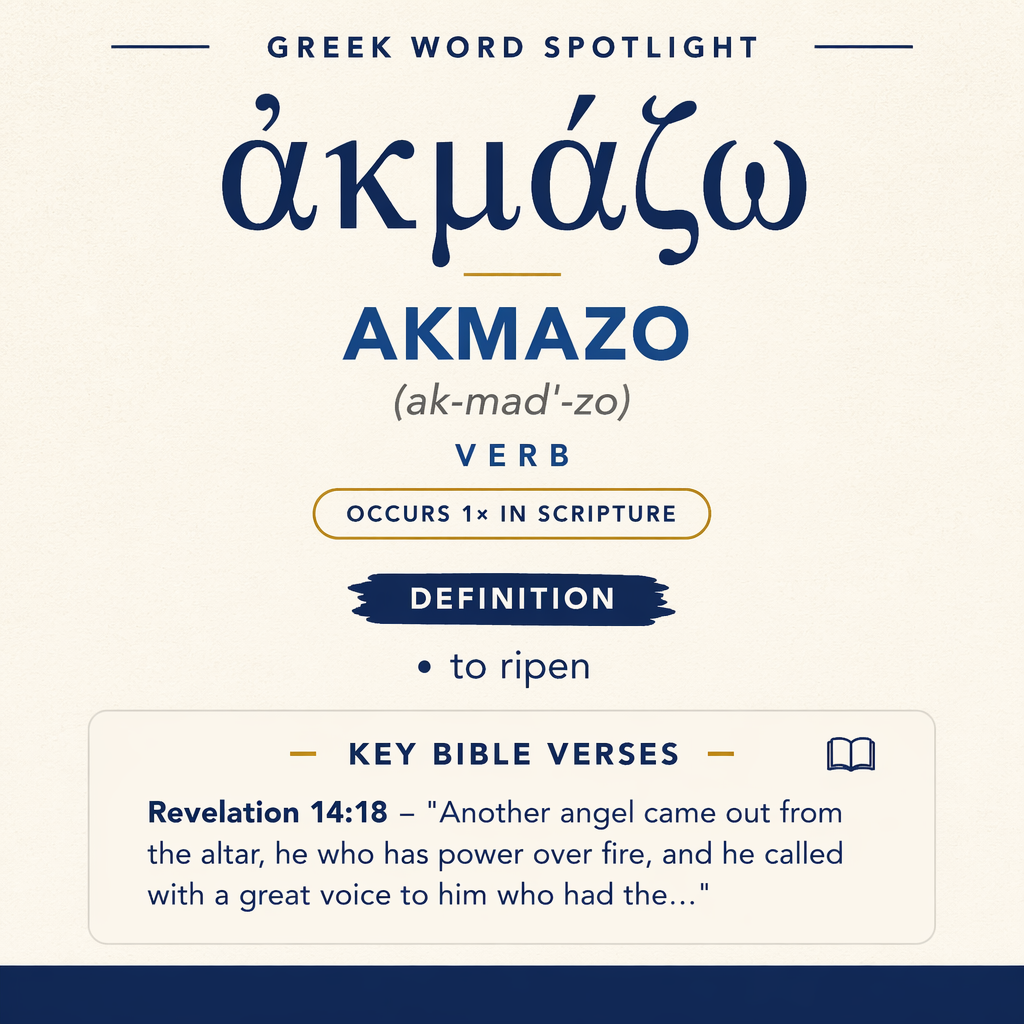
ἀκμάζω means “to ripen” and appears once in Scripture, in Revelation 14:18.
Scripture Occurrence
It occurs 1 time in Scripture. The occurrence is in Revelation 14:18.
Learn More →Context Snapshot
In Revelation 14:18, the word occurs within a scene involving an angel calling out with a great voice.
Learn More →ἀκμάζω means “to ripen,” and it appears in the imagery of harvest in Revelation 14:18. In that single scene it supplies the decisive agricultural condition that triggers gathering.
Root and Related Words
Related to akmen (ἀκμήν), “still” (Strong’s G188).

Occurrences
“Another angel came out from the altar, he who has power over fire, and he called with a great voice to him who had the sharp sickle, saying, “Send your sharp sickle, and gather the clusters of the vine of the earth, for the earth’s grapes are fully ripe!”” (Revelation 14:18)
In Revelation 14:18, ἀκμάζω stands in the angel’s shouted directive as the stated reason that harvesting action must begin. The command is expressed with concrete tools and motions—“Send your sharp sickle” and “gather the clusters”—but the clause “for the earth’s grapes are fully ripe!” gives the ground for the command: the crop has reached its ripening point. The verb therefore does more than supply a descriptive detail; it functions as the pivot between readiness and reaping, linking a condition in the vine (“grapes are fully ripe”) to an immediate summons to cut and collect.
The verse frames this ripeness within a dramatic setting: “Another angel came out from the altar, he who has power over fire.” The call is “with a great voice,” and the target of the call is “him who had the sharp sickle.” Within that heightened scene, ἀκμάζω contributes a plain agricultural criterion—ripeness—that nonetheless carries urgency because it is voiced as the justification for decisive action. The ripeness is attributed to “the earth’s grapes,” and the harvest to be gathered is “the clusters of the vine of the earth.” In other words, the verb anchors the command in the maturation of a specific crop (“grapes”), not in the mere presence of vines or clusters. Harvest does not proceed simply because there is fruit, but because the fruit has ripened.
The immediate syntax of the verse also places the ripening in a completed, observable state: “are fully ripe.” That phrasing portrays ripeness not as a process underway but as an attained condition that can be recognized and acted upon. In the scene, the angel’s announcement treats this condition as sufficiently clear to justify an imperative delivered to a figure already equipped for harvest (“the sharp sickle”). Thus ἀκμάζω contributes a sense of timeliness—an appropriate moment—without shifting the focus away from its literal agricultural meaning.
Sense and Usage
The definition “to ripen” is expressed here with vine imagery and the language of harvest. Ripening, in ordinary agricultural terms, marks the transition from developing fruit to fruit ready for picking. Revelation 14:18 draws on that everyday threshold and turns it into the explicit rationale for action: because the grapes have ripened, the sickle should be sent and the clusters gathered. The verb therefore operates as a readiness term: it identifies the state of the crop as having reached the point where delay is no longer the fitting response.
Because the only occurrence is embedded in a command (“Send… and gather…”), the ripening is not presented as a quiet fact but as a decisive condition that authorizes and compels the next step. The speaker does not describe ripeness for its own sake; he cites it to ground an instruction. This use highlights a practical aspect of ripening: it is a state that calls for response. In the verse, the response is reaping—cutting with a sickle and collecting clusters—actions that are appropriate only once ripening has occurred. In that way, ἀκμάζω sits at the junction between biological development (fruit reaching maturity) and human (or angelic) activity (harvest).
The ripening is also linked to abundance and grouping: the command is to “gather the clusters,” not isolated grapes. Ripeness, as described, is not limited to a small sample; it characterizes “the earth’s grapes” in general terms. This broadness reinforces the harvest setting: the verb supports the picture of a crop ready on a large scale. Yet the word retains its concrete sense; it does not itself name the harvest, the judgment, the fire, or the angelic authority. It simply marks the fruit as having reached ripeness, allowing the rest of the verse’s imagery—sickle, clusters, vine, earth—to move into action with a stated justification.
The relationship to akmen (ἀκμήν), “still,” places ἀκμάζω within vocabulary that can express a point of timing. In Revelation 14:18, timing is central: the situation is no longer “still” in the sense of waiting, but has arrived at the moment when ripeness warrants gathering. The verse’s logic is straightforward—ripeness leads to harvesting—and the verb supplies the key condition in that logic.
Imagery
Revelation 14:18 presents ripening in the most tangible way possible: grapes on a vine reaching the point where a sickle can be put to work. The word ἀκμάζω carries the sensory world implied by that picture—fruit that has reached its proper stage—while the verse surrounds it with heightened elements (“another angel,” “power over fire,” “a great voice”). Against that intense backdrop, the simple agricultural reality of ripeness becomes the announced signal that the time for gathering has come.
Sources: Lexical data from Strong’s Exhaustive Concordance and the Translators Brief Lexicon of Extended Strongs for Greek (STEPBible, CC BY). Occurrence data from the Translators Amalgamated Greek New Testament (STEPBible, CC BY). Scripture quotations from the World English Bible (public domain).




