Exploring the Meaning of ‘Iddow in Hebrew
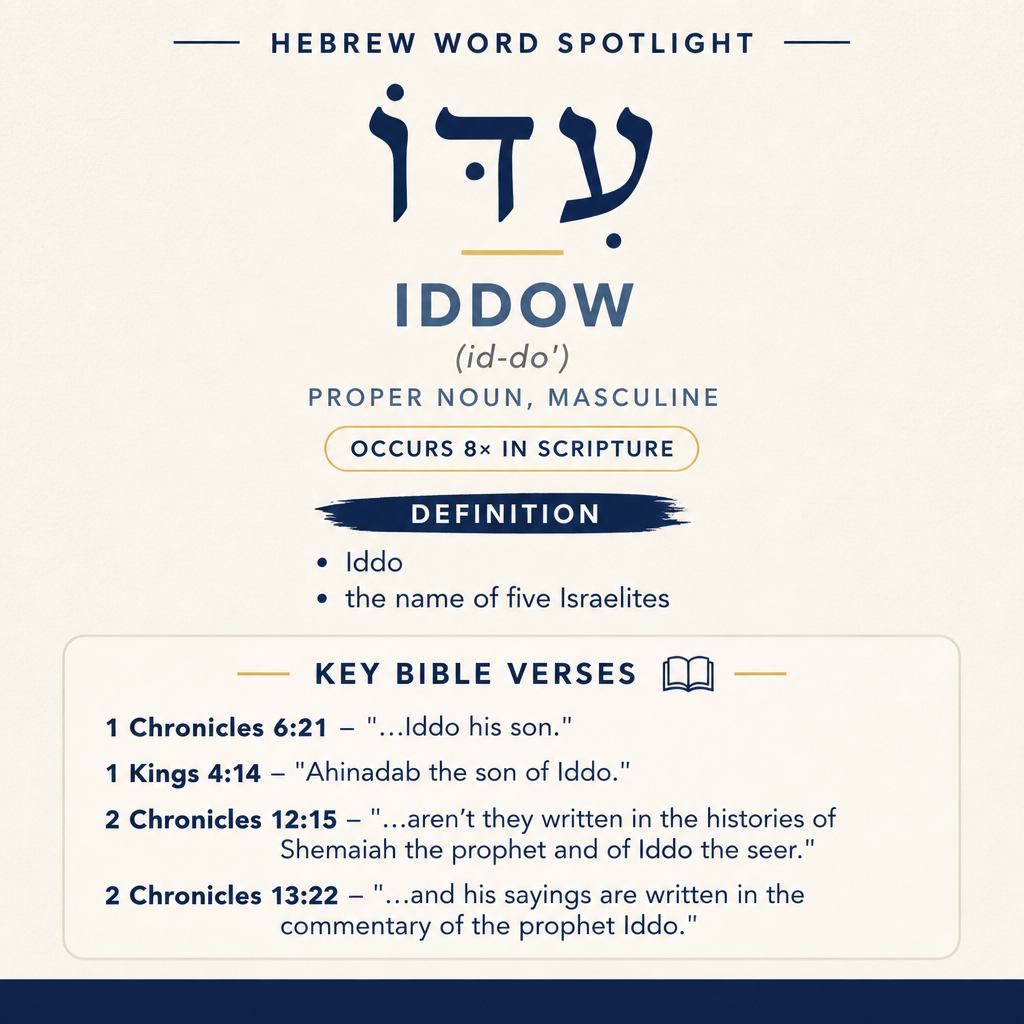
עִדּוֹ (Iddow) means “Iddo,” the name of five Israelites, appearing 8 times across 1 Chronicles, 1 Kings, 2 Chronicles, Ezra, Nehemiah, and Zechariah.
Meaning & Identity
עִדּוֹ (Iddow) is a proper name: “Iddo.” It refers to five Israelites in Scripture.
Learn More →Historical Mentions
Iddo appears in genealogical and historical notices, including 1 Chronicles 6:21 and 1 Kings 4:14. 2 Chronicles references writings connected with Iddo in the reigns of Rehoboam and Abijah.
Learn More →Postexilic References
Ezra 6:14 names Zechariah as “the son of Iddo.” Nehemiah 12:4 and 12:16 list Iddo among priestly names, and Zechariah 1:7 occurs in the prophet’s book.
Learn More →עִדּוֹ (Iddow) is a personal name borne by five Israelites and appears in genealogical lists, administrative notices, prophetic lineages, and references to written historical records. Across its occurrences it functions to anchor individuals in family descent and to identify an authoritative figure remembered for prophetic or seer activity.
Occurrences
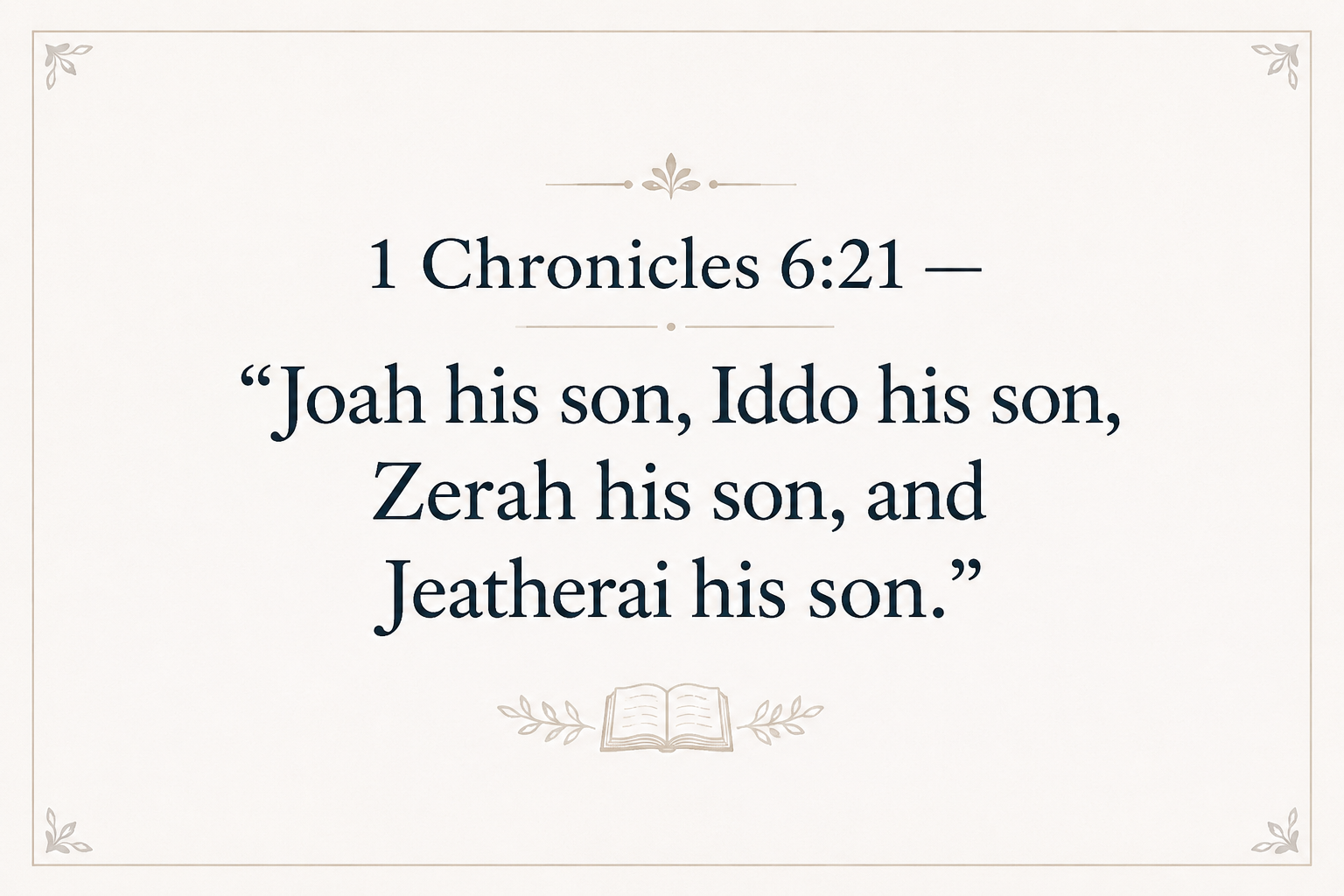
1 Chronicles 6:21 — “Joah his son, Iddo his son, Zerah his son, and Jeatherai his son.”
Here עִדּוֹ is placed within a chain of descent: Joah → Iddo → Zerah → Jeatherai. The name’s contribution is purely genealogical, serving as a fixed link that connects one generation to the next inside a formal lineage notice.
1 Kings 4:14 — “Ahinadab the son of Iddo, in Mahanaim;”
In this brief administrative line, עִדּוֹ identifies the father of Ahinadab. The phrase “the son of Iddo” distinguishes Ahinadab by parentage, and the mention “in Mahanaim” situates the son’s appointment or sphere while leaving the father’s role unspoken. The name functions as an identifier that prevents confusion among officials by tying a public figure to his household.
2 Chronicles 12:15 — “Now the acts of Rehoboam, first and last, aren’t they written in the histories of Shemaiah the prophet and of Iddo the seer, in the genealogies? There were wars between Rehoboam and Jeroboam continually.”
עִדּוֹ appears as “Iddo the seer,” paired with “Shemaiah the prophet,” and associated with “histories” and “genealogies” that record “the acts of Rehoboam, first and last.” The name therefore marks an individual remembered as a recognized recorder of royal events. In this setting, עִדּוֹ carries documentary weight: the name authenticates the claim that Rehoboam’s deeds were preserved in established written sources.
2 Chronicles 13:22 — “The rest of the acts of Abijah, his ways, and his sayings are written in the commentary of the prophet Iddo.”
Here עִדּוֹ is “the prophet Iddo,” and his “commentary” is cited as a repository for “the rest of the acts of Abijah,” including “his ways, and his sayings.” The name contributes an attribution: it points to a named prophetic figure whose written work is treated as a meaningful source for understanding a king’s conduct and speech. Unlike the bare genealogical notices, this use ties עִדּוֹ to interpretive or narrative writing (“commentary”) connected to prophetic authority.
Ezra 6:14 — “The elders of the Jews built and prospered, through the prophesying of Haggai the prophet and Zechariah the son of Iddo. They built and finished it, according to the commandment of the God of Israel, and according to the decree of Cyrus, Darius, and Artaxerxes king of Persia.”
In Ezra, עִדּוֹ appears inside a patronymic: “Zechariah the son of Iddo.” The name’s immediate function is to identify which Zechariah is meant, but it also helps frame the community’s rebuilding work as occurring “through the prophesying” of named prophetic agents: “Haggai the prophet” and Zechariah, whose family identification is supplied through עִדּo. The rebuilding is described as prospering and finishing “according to the commandment of the God of Israel” and royal decrees; within that narrative, the name attaches a concrete family lineage to one of the voices whose prophesying supported the work.
Nehemiah 12:4 — “Iddo, Ginnethoi, Abijah,”
This occurrence places עִדּo in a list of names with no further descriptors in the verse itself. The name functions as one item among other personal names, suggesting a roster or register where the mere presence of the name is the key information. In such a list, עִדּo’s contribution is its ability to mark membership or representation within the recorded group.
Nehemiah 12:16 — “of Iddo, Zechariah; of Ginnethon, Meshullam;”
Here עִדּo stands in a genitive relationship: “of Iddo, Zechariah.” The structure links one named person to another by association, using עִדּo as the head name under which “Zechariah” is listed. In this verse the name functions as an organizing label within a structured roster, pairing names in a way that indicates responsibility, descent, or representation as the list proceeds.
Zechariah 1:7 — “On the twenty-fourth day of the eleventh month, which is the month Shebat, in the second year of Darius, Yahweh’s word came to Zechariah the son of Berechiah, the son of Iddo, the prophet, saying,”
In this dated prophetic introduction, עִדּo appears within a two-generation lineage: “Zechariah the son of Berechiah, the son of Iddo.” The name therefore secures Zechariah’s identity by placing him within a known family line, while the phrase “Yahweh’s word came to Zechariah” highlights the moment of revelation. The addition “the prophet” at the end of the identification gives the lineage a public significance: the name is not merely private ancestry but part of the formal designation of a prophetic messenger in a precisely dated setting.

Sense and Usage
The definition of עִדּo as “the name of five Israelites” is expressed not through a single narrative about one person, but through multiple, distinct roles in which the name appears. Several occurrences use עִדּo as a genealogical connector. In 1 Chronicles 6:21 the name is one link in a multi-generational chain, functioning to preserve continuity of descent. In Ezra 6:14 and Zechariah 1:7, it forms part of Zechariah’s identification; the name helps distinguish a prophet by locating him within a family line, and the repeated use of patronymics gives the prophetic figure a concrete place among the people.
Other occurrences show the name used to support public recordkeeping and historical memory. In 2 Chronicles 12:15, “Iddo the seer” is mentioned as connected to “histories” and “genealogies” where royal acts were written, and in 2 Chronicles 13:22, “the prophet Iddo” is associated with a “commentary” that contains a king’s acts, ways, and sayings. In both verses, עִדּo is more than a label; it points to recognized sources of written remembrance. The name is invoked to legitimize the Chronicler’s summary by directing the reader toward named witnesses or compilers tied to prophetic or seer authority.
A further use appears in civic-administrative identification. In 1 Kings 4:14, the name marks paternity (“Ahinadab the son of Iddo”), a conventional method of distinguishing individuals who serve in official capacities. In Nehemiah 12:4 and 12:16, עִדּo occurs in list format—first as a standalone item among other names, then as a head name in a structured pairing (“of Iddo, Zechariah”). Across these list contexts, the name’s purpose is organizational and relational: it supports the careful cataloging of persons and their connections within the community.
Reflections
Across these passages, עִדּo is repeatedly embedded in the architecture of memory: lines of descent, curated lists, and citations of written records. Whether in a terse sequence of names (“Joah his son, Iddo his son…”) or in a formal prophetic superscription dated to “the twenty-fourth day of the eleventh month,” the name participates in Scripture’s habit of attaching people to families, communities, and documents, so that actions, words, and callings are not left anonymous.
Sources: Lexical data from Strong’s Exhaustive Concordance and the Open Scriptures Hebrew Lexicon. Occurrence data from the Westminster Leningrad Codex with STEPBible reference data (CC BY). Scripture quotations from the World English Bible (public domain).