
Exploring the Meaning of ‘agartal in Hebrew
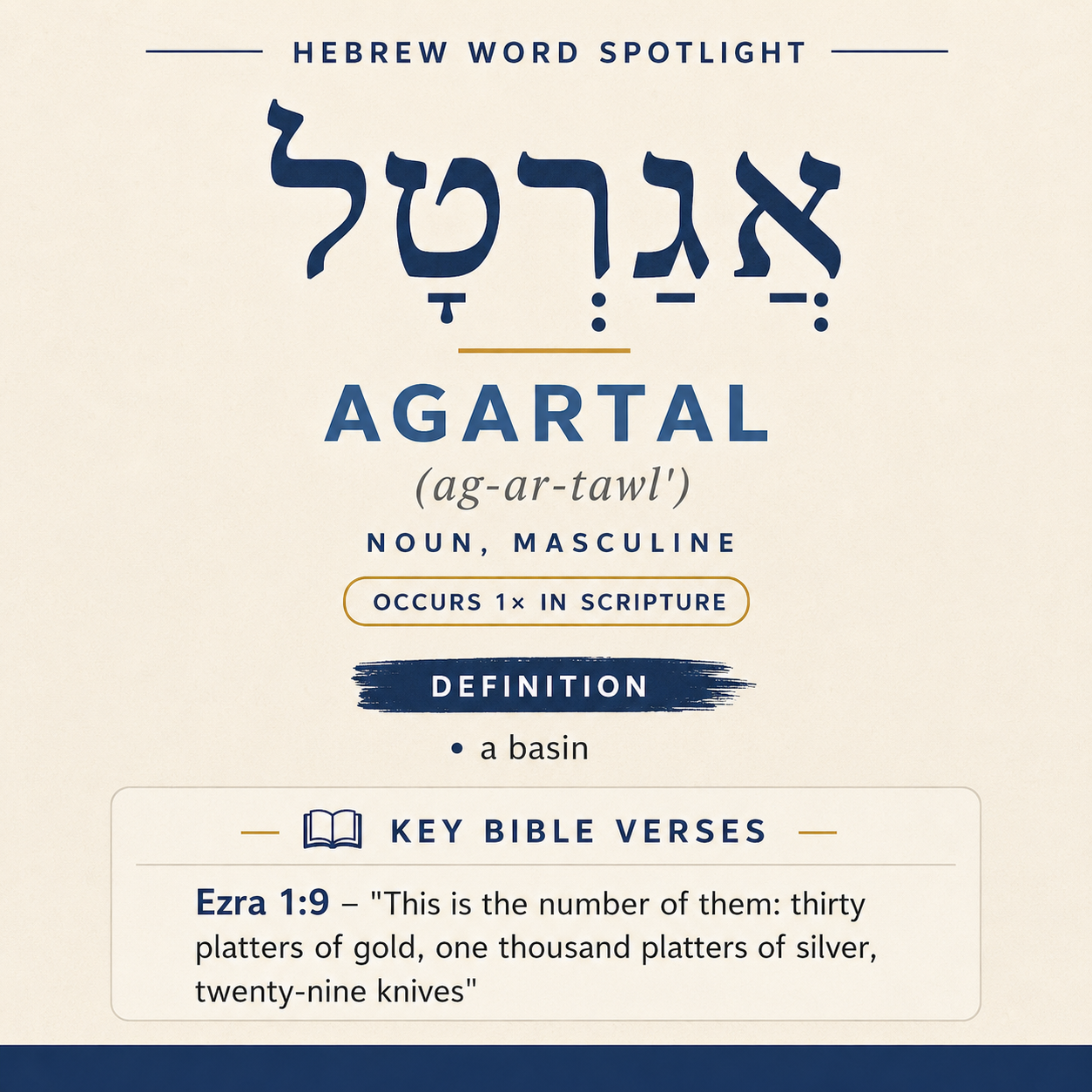
אֲגַרְטָל means “a basin” and appears once in Scripture, in Ezra 1:9.
Verse Context
In Ezra 1:9, it appears in an inventory list that includes platters of gold and silver and knives.
Learn More →אֲגַרְטָל (agartal) refers to a basin, a kind of container. It appears in a single inventory scene in Ezra, where temple articles are carefully counted and listed for return.
Occurrences
“This is the number of them: thirty platters of gold, one thousand platters of silver, twenty-nine knives,” (Ezra 1:9)
In Ezra 1:9 the word belongs to a formal register of counted objects. The verse opens with the inventory formula, “This is the number of them,” then names several categories of valuable items (“platters of gold,” “platters of silver,” and “knives”) and assigns precise quantities. Within this setting, אֲגַרְטָל functions as one of the discrete vessel-types that can be tallied: it contributes the idea of a specific container—here, a basin—treated as a recognizable unit within a larger collection of temple equipment. The emphasis of the line is not on the basin’s appearance or use in action, but on its being a concrete article of cultic property that can be counted, grouped, and transferred along with other vessels.
The inventory style also frames the basin as part of a structured set: metals are specified, and the objects named are the kinds of items that typically come in multiples. In this verse, the presence of such vessel terms side by side underscores that the return of property is being documented with administrative precision. The basin, like the platters and knives, is presented as a standardized article suitable for record-keeping—an item whose identity is stable enough that it can be listed without description and understood from its name alone.

Sense and Usage
The sense “basin” points to a contained, bounded vessel—an article defined by its capacity to hold something. In Ezra 1:9 the basin is not introduced for what it contains, nor for an action performed with it, but as part of a ledger of valuable objects. That placement is significant for how the word is used here: the term carries a practical, object-centered meaning that fits an inventory environment, where items are categorized by type and quantity rather than narrated as tools in a scene.
Because the verse lists multiple kinds of temple articles, the basin stands among other utensils that would have been handled, stored, and transported. The wording “This is the number of them” makes the category itself important: the word denotes a vessel type that can be counted as an individual piece of property. In an inventory, a “basin” is not merely a generic container; it is a named article whose inclusion signals completeness in the accounting of what is being returned. The text’s concern with exact numbers suggests that each basin is treated as a distinct, accountable object, not an incidental accessory.
The immediate co-text—gold and silver platters and a set of knives—also clarifies the basin’s semantic profile as a tangible implement alongside other crafted goods. The basin belongs to the world of manufactured vessels: a durable item that can be collected and enumerated. Even though Ezra 1:9 does not describe the basin’s dimensions or material, it places the word in a context where metalwork and valuable utensils are in view, reinforcing the sense of a physical receptacle that is part of a curated collection of temple articles.
Finally, this usage shows how the term can function without further qualifiers. The verse assumes the reader can recognize the category simply by the noun, which suggests that “basin” here is sufficiently specific to stand on its own in a list. In short, אֲגַרְטָל contributes the idea of a basin as a countable vessel within a formal register of returned valuables.
Imagery
Although Ezra 1:9 is administrative in tone, the word still evokes a concrete image: a basin laid out with other temple vessels as they are sorted and numbered. The scene is one of ordered objects—gold and silver pieces arranged for counting—where a basin is part of the visible, handled inventory of sacred property being restored.
Sources: Lexical data from Strong’s Exhaustive Concordance and the Open Scriptures Hebrew Lexicon. Occurrence data from the Westminster Leningrad Codex with STEPBible reference data (CC BY). Scripture quotations from the World English Bible (public domain).





