npacking the Meaning of ‘Agowrah in Hebrew
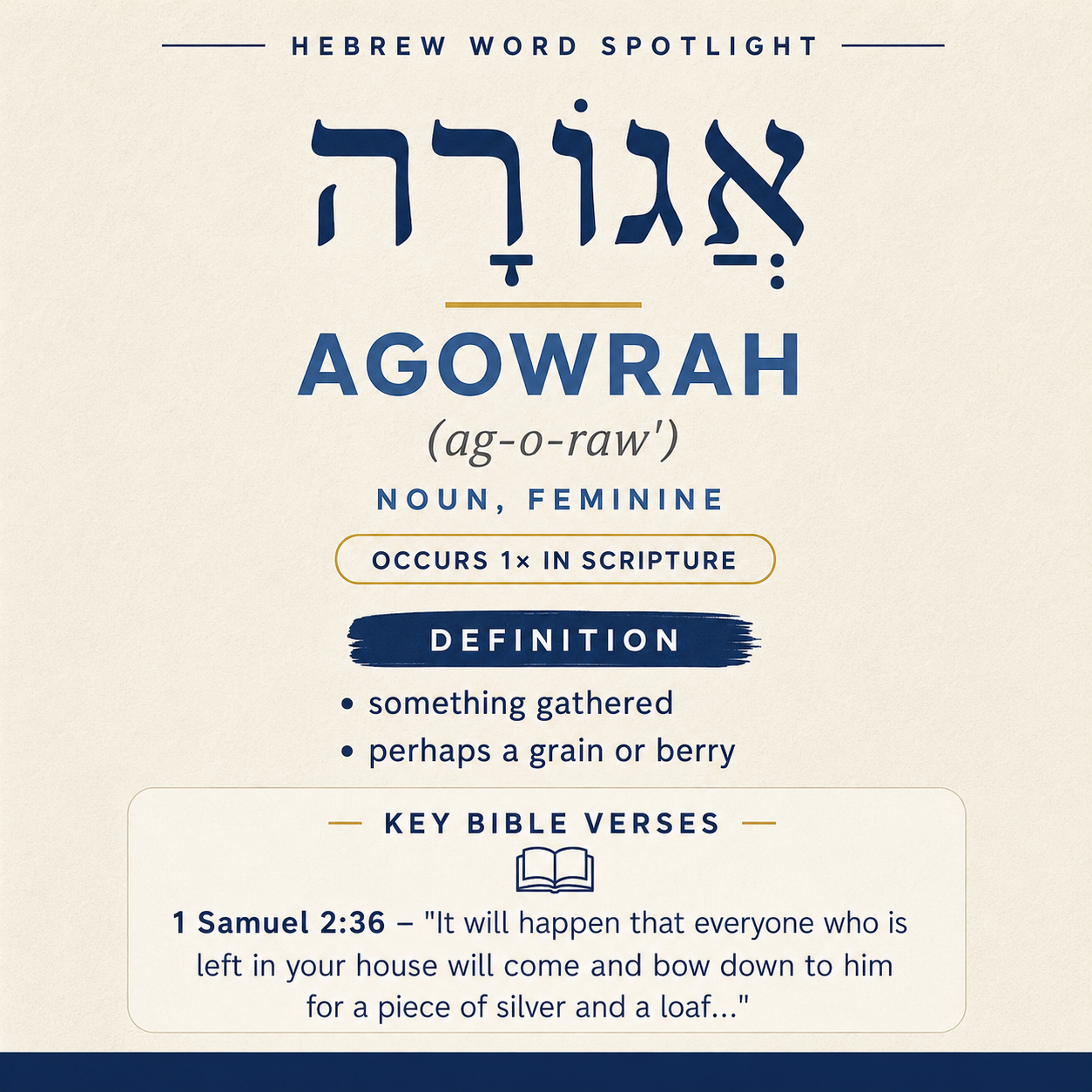
אֲגוֹרָה means “something gathered,” perhaps a grain or berry, and appears in 1 Samuel 2:36.
Biblical Occurrence
אֲגוֹרָה occurs once in Scripture. Its single occurrence is in 1 Samuel 2:36.
Learn More →Verse Context
In 1 Samuel 2:36, it appears in a request that includes “a piece of silver and a loaf of” something. The verse places it alongside basic provisions.
Learn More →אֲגוֹרָה (agowrah) denotes something gathered, with the sense that it may be a grain or a berry. It appears in the speech of a desperate petitioner who asks for basic provisions and a place of service.
Occurrences
“It will happen that everyone who is left in your house will come and bow down to him for a piece of silver and a loaf of bread, and will say, “Please put me into one of the priests’ offices, that I may eat a morsel of bread.” ’ ” (1 Samuel 2:36)
In this scene the word stands within a plea framed by hunger and dependency. The speaker imagines survivors reduced to approaching another priestly authority, “bow[ing] down … for a piece of silver and a loaf of bread,” and then making a specific request: “Please put me into one of the priests’ offices, that I may eat a morsel of bread.” Within that tightly drawn picture of need, אֲגוֹרָה names a small, concrete edible portion—something that can be gathered and then eaten. The verse pairs larger units (“a loaf of bread”) with a smaller portion (“a morsel of bread”), and the request aims at obtaining just enough to survive. In that context, the gathered thing is not an object of commerce or luxury; it functions as the tangible end of the petitioner’s appeal.
The verse also links the gathered food to access and status: the person asks to be assigned “into one of the priests’ offices” for the purpose of eating. The gathered item thus belongs to a setting where food is tied to institutional provision—someone receives sustenance because they are granted a role. The imagined petitioner is not claiming entitlement but begging for a minimal share. That rhetorical framing presses the meaning of אֲגוֹרָה toward the smallest practical outcome of being “put … into” an office: the ability to obtain a bite-sized portion that has been collected and made available.

Sense and Usage
The idea “something gathered” points to food that is collected in discrete bits rather than taken as a whole object. The verse’s language places that gathered portion alongside bread, reinforcing the physicality of the term: it belongs to the realm of eating, not merely to an abstract notion of provision. The possible nuance “grain or berry” fits the kind of food that is naturally gathered piece by piece—an image of small items amassed into a share. The request “that I may eat” makes the word’s function explicit: the gathered thing is valued for immediate sustenance.
Because the verse is cast as direct speech (“will say”), the word’s force is also social and emotional. The petitioner is reduced to asking for appointment so as to receive what is, by the verse’s own framing, a minimal quantity. A gathered morsel is the opposite of abundance: it suggests scraping together enough to eat. The term therefore carries a sense of precariousness within the narrative: those “left in your house” foresee a future in which their resources have dwindled to the point that even a gathered bite must be requested from someone in authority.
The juxtaposition of “a piece of silver” with “a loaf of bread” and then “a morsel of bread” creates a layered picture of exchange and need. Monetary payment and physical food are both mentioned, but the speech climaxes in the bare necessity of eating. In that progression, אֲגוֹרָה functions as the concrete endpoint: whatever is gathered—whether conceived as grain, berry, or another small edible—becomes emblematic of the petitioner’s aim. The gathered item is not defined by its agricultural process or by its storage but by its role as a small, edible portion obtained through pleading for a place.
Even without elaboration on the method of gathering, the word naturally evokes the action of collecting: small things accumulated into a portion. Within the verse’s scenario, that accumulation is not pictured as the petitioner’s own successful labor; rather, it is made possible by being admitted to “one of the priests’ offices.” The gathered food is thus imagined as coming from a sphere of controlled distribution—food on hand, gathered and portioned, to which one gains access through appointment. This use situates the term within everyday material realities: hunger, bread, small portions, and the social mechanisms by which food is obtained.
Imagery
The verse frames the gathered morsel with bodily posture and speech: “bow down,” “will say,” “Please.” The imagery that surrounds אֲגוֹרָה is therefore not only edible but also humbling. The gathered portion stands for the smallest sustenance sought at the cost of lowered status and urgent request. In 1 Samuel 2:36 the gathered food becomes a vivid marker of how drastically circumstances can change: those “left” must seek a mere bite, and the gathered morsel is the concrete shape that need takes in the mouth—food collected in small pieces, begged for as the simplest form of survival.
Sources: Lexical data from Strong’s Exhaustive Concordance and the Open Scriptures Hebrew Lexicon. Occurrence data from the Westminster Leningrad Codex with STEPBible reference data (CC BY). Scripture quotations from the World English Bible (public domain).