Discovering the Meaning of ‘Ebel in Hebrew
אֵבֶל (ebel) means “lamentation” and occurs 22 times in Scripture, including Deuteronomy 34:8; 2 Samuel 11:27; Amos 8:10; and Ecclesiastes 7:2.
Core Meaning
אֵבֶל means “lamentation.” It names the experience or state of mourning.
Learn More →Scripture Occurrences
This noun occurs 22 times in Scripture. It appears in passages such as Deuteronomy 34:8 and Ecclesiastes 7:2.
Learn More →Context Examples
In Amos 8:10, feasts are turned into mourning and songs into lamentation. In 2 Samuel 19:2, victory is turned into mourning among the people.
Learn More →The Hebrew noun אֵבֶל (ebel) means “lamentation.” In Scripture it appears in narratives, wisdom reflections, prophetic announcements, and court history to describe public and private grief, especially in connection with death and national crisis.


Occurrences
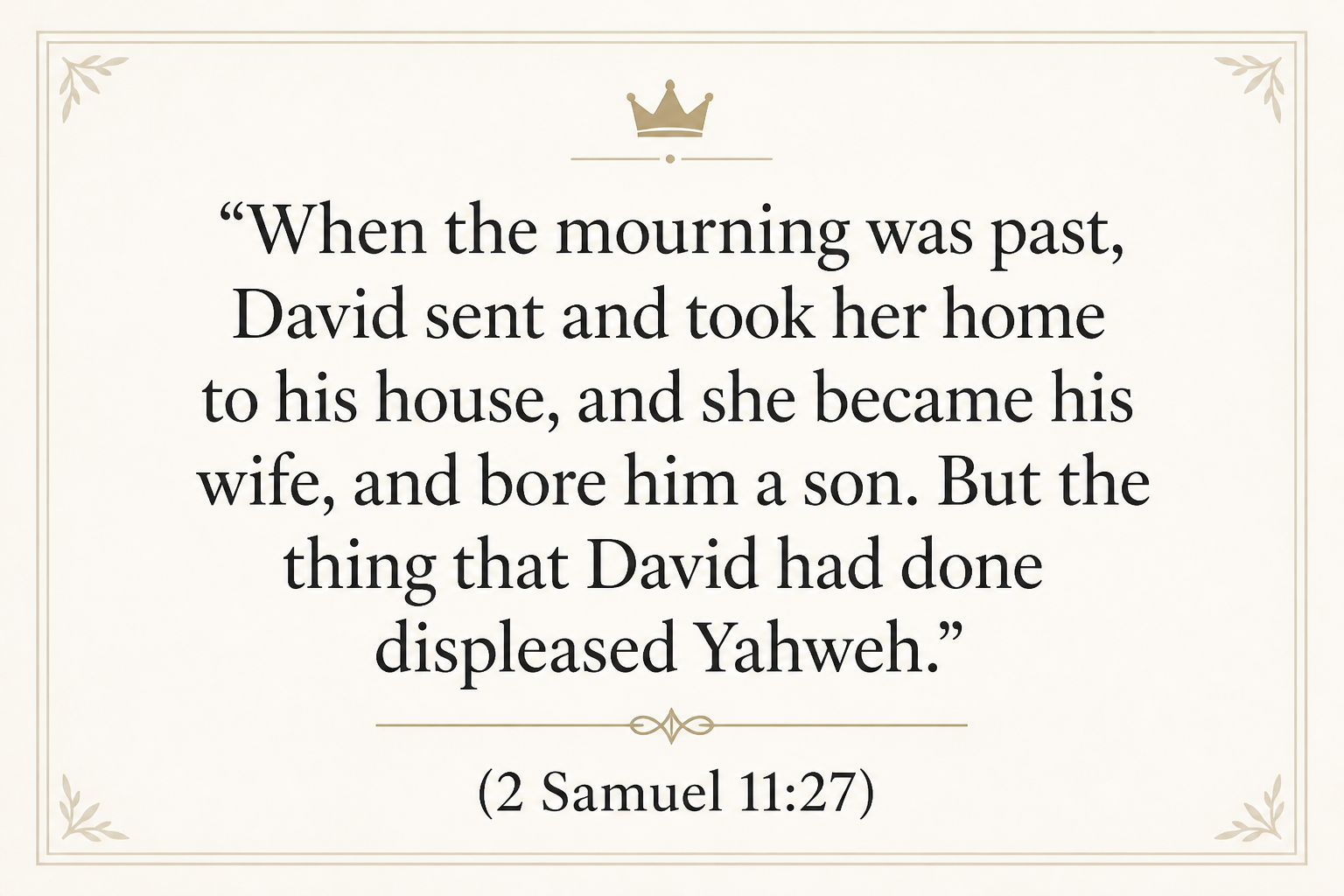
“When the mourning was past, David sent and took her home to his house, and she became his wife, and bore him a son. But the thing that David had done displeased Yahweh.” (2 Samuel 11:27)
Here “mourning” marks a defined period that comes to an end (“was past”). The term helps frame the timing of David’s actions—Bathsheba’s transition from bereavement to remarriage—and the verse closes by setting the whole sequence under divine displeasure. The word contributes the sense of a socially recognized interval of grief that can be observed and concluded.
“Joab sent to Tekoa, and brought a wise woman from there, and said to her, “Please act like a mourner, and put on mourning clothing, please, and don’t anoint yourself with oil, but be as a woman who has mourned a long time for the dead.” (2 Samuel 14:2)
“Mourning” is presented as a role that can be performed convincingly through outward signals: clothing, lack of oil, and the bearing of prolonged grief “for the dead.” The noun anchors the scene in recognizable practices, allowing Joab to instruct the woman to embody lamentation in a way others will read as genuine.
“The victory that day was turned into mourning among all the people; for the people heard it said that day, “The king grieves for his son.”” (2 Samuel 19:2)
The word describes a collective emotional reversal: what should have been celebration becomes communal lamentation “among all the people.” The reason is public knowledge of the king’s grief. Here “mourning” functions as a communal atmosphere that spreads through a populace in response to the sorrow of a leader.
“Therefore Yahweh, the God of Armies, the Lord, says: “Wailing will be in all the wide ways; and they will say in all the streets, ‘Alas! Alas!’ and they will call the farmer to mourning, and those who are skillful in lamentation to wailing.” (Amos 5:16)
In this prophetic announcement, lamentation becomes audible and public: wide ways and streets filled with cries. The verse portrays mourning as something that can be summoned (“call the farmer to mourning”) and even staffed by specialists (“those who are skillful in lamentation”). The noun thus sits within a picture of organized, citywide grief where ordinary work and trained lament give way to wailing.
“I will turn your feasts into mourning, and all your songs into lamentation; and I will make you wear sackcloth on all your bodies, and baldness on every head. I will make it like the mourning for an only son, and its end like a bitter day.” (Amos 8:10)
“Mourning” is the inverse of festivity: feasts become lamentation, and songs are transposed into expressions of grief. The verse connects the noun with bodily signs—sackcloth and baldness—showing lamentation as both inner sorrow and visible state. The comparison “like the mourning for an only son” intensifies the scene by drawing on the recognized extremity of such grief, and “its end like a bitter day” keeps the tone heavy from start to finish.
“The children of Israel wept for Moses in the plains of Moab thirty days, until the days of weeping in the mourning for Moses were ended.” (Deuteronomy 34:8)
This occurrence ties lamentation to a specific communal rite: Israel’s weeping continues “thirty days” and is described as “the mourning for Moses.” The noun helps define the event as a bounded national observance with a beginning, a duration, and an ending (“were ended”), while still conveying the depth of the people’s loss.
“It is better to go to the house of mourning than to go to the house of feasting; for that is the end of all men, and the living should take this to heart.” (Ecclesiastes 7:2)
Here the noun is used spatially: there is a “house of mourning,” set over against a “house of feasting.” Lamentation is not merely a feeling but an environment people enter, associated with death (“that is the end of all men”) and with reflection by “the living.” The word contributes a sober setting where human mortality presses itself on the mind.
“The heart of the wise is in the house of mourning; but the heart of fools is in the house of mirth.” (Ecclesiastes 7:4)
The “house of mourning” becomes a moral-intellectual location: wisdom’s “heart” is there. Lamentation is portrayed as the fitting context for seriousness, in contrast to the “house of mirth.” The noun thus carries an evaluative force in this proverb-like contrast, associating mourning with thoughtfulness rather than mere sadness.
“In every province, wherever the king’s commandment and his decree came, there was great mourning among the Jews, and fasting, and weeping, and wailing; and many lay in sackcloth and ashes.” (Esther 4:3)
“Great mourning” is the communal response to the spread of a royal decree. The verse clusters lamentation with fasting, weeping, wailing, and the physical posture of sackcloth and ashes. The noun therefore helps name a whole complex of grief-practices that take hold broadly (“in every province”) and are shared across a threatened people.
“as the days in which the Jews had rest from their enemies, and the month which was turned to them from sorrow to gladness, and from mourning into a good day; that they should make them days of feasting and gladness, and of sending presents of food to one another, and gifts to the needy.” (Esther 9:22)
This verse describes a reversal in time: a “month” is “turned” from sorrow to gladness and “from mourning into a good day.” Lamentation is treated as a prior season that can be decisively transformed, and its opposite is expressed not only in emotion but in concrete practices—feasting, exchanging food gifts, and giving to the needy. The noun thus helps articulate the before-and-after contrast that defines the community’s celebration.
“Sigh, but not aloud. Make no mourning for the dead. Bind your headdress on you, and put your sandals on your feet. Don’t cover your lips, and don’t eat mourner’s bread.” (Ezekiel 24:17)
Here “mourning” is prohibited: “Make no mourning for the dead.” The instruction specifies recognizable elements of lamentation by forbidding them or replacing them—keep the headdress and sandals on, do not cover the lips, and do not eat “mourner’s bread.” The noun functions as a label for customary bereavement behavior, so that the command’s force lies in the deliberate suspension of normal lamentation signs.
“Esau hated Jacob because of the blessing with which his father blessed him. Esau said in his heart, “The days of mourning for my father are at hand. Then I will kill my brother Jacob.”” (Genesis 27:41)
“The days of mourning for my father” are anticipated before the father has died, showing lamentation as an expected period tied to a parent’s death. The noun marks time (“days”) and signals a socially intelligible interval after which Esau plans to act. In the verse, mourning becomes part of Esau’s internal timeline: grief is assumed to come, and vengeance is postponed until that period arrives.
Sense and Usage
Across these passages, אֵבֶל (ebel) regularly names lamentation as something more than private emotion. It can be a measured span of time with a clear endpoint (as when mourning “was past” or “were ended”), and it can also be a public condition that alters communal life, turning victory, feasts, and songs into grief. The word frequently appears with outward expressions that make lamentation legible to others: special clothing, refraining from anointing with oil, sackcloth and ashes, and other customary signs. At the same time, the noun can define a social space (“house of mourning”), a setting where mortality is faced and where wisdom is portrayed as dwelling. In prophetic speech it can be summoned into streets and wide ways, extending from individual bereavement to citywide and nationwide sorrow; in narrative it can be anticipated, performed, shared, completed, forbidden, or reversed into gladness.
Imagery
The verses give lamentation a strong public texture: streets filled with “Alas! Alas!”, bodies marked with sackcloth, and households defined by mourning rather than feasting. Whether as the nation’s thirty-day grief for Moses, the Jews’ province-wide distress, or the king’s sorrow that reshapes a victory day, the word repeatedly evokes a world in which grief has visible rhythms, recognized places, and shared practices.
Sources: Lexical data from Strong’s Exhaustive Concordance and the Open Scriptures Hebrew Lexicon. Occurrence data from the Westminster Leningrad Codex with STEPBible reference data (CC BY). Scripture quotations from the World English Bible (public domain).