
Understanding the Meaning of Aichmalotos in Greek
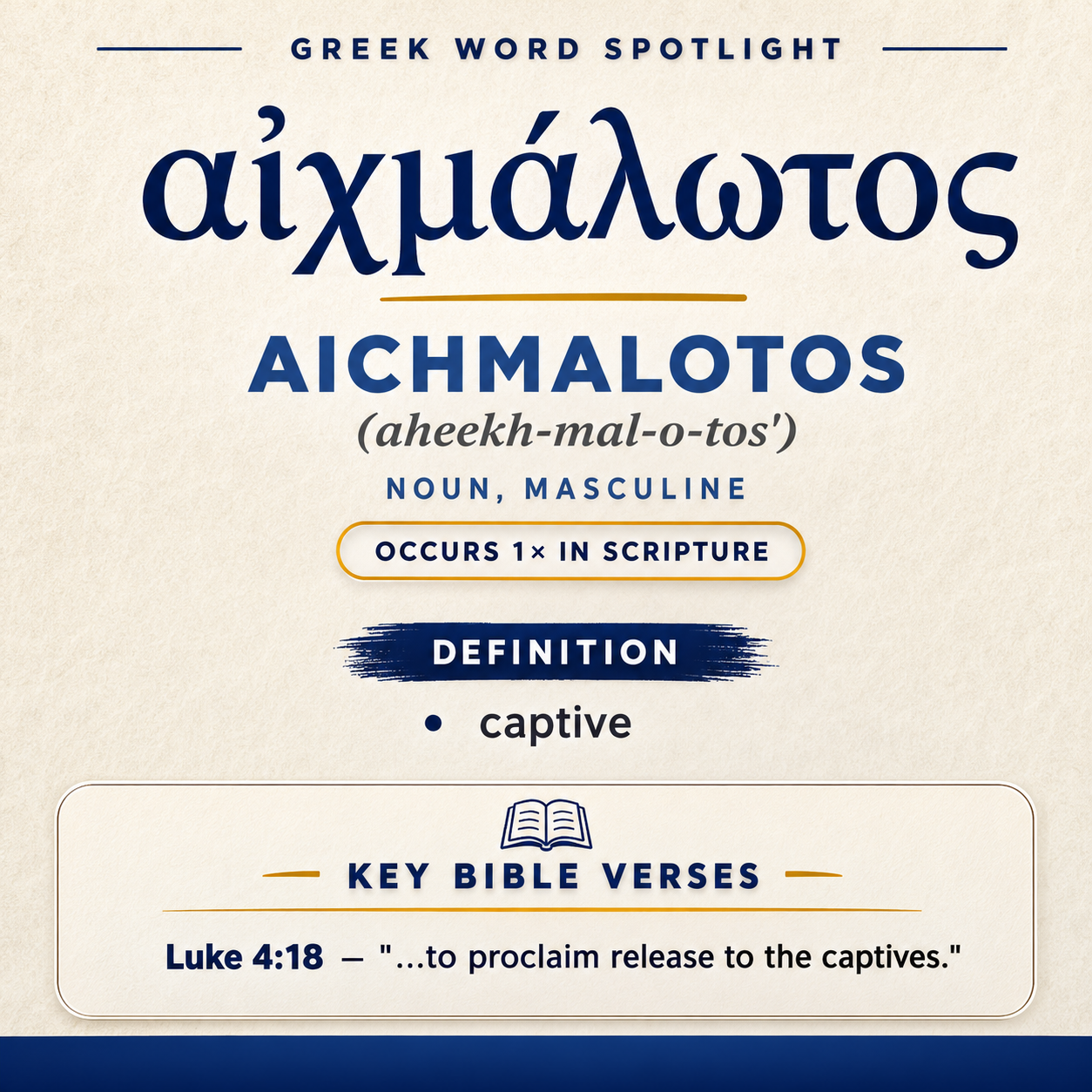
αἰχμάλωτος means “captive” and appears once in Scripture in Luke 4:18.
Scripture Occurrence
This Greek word occurs 1 time in Scripture. Its listed occurrence is in Luke 4:18.
Learn More →Verse Context
In Luke 4:18, the verse begins, “The Spirit of the Lord is on me…”. The text continues into “He has sent me to heal the…” in the provided excerpt.
Learn More →αἰχμάλωτος means “captive” and appears in a single New Testament setting where proclamation and deliverance are announced. In Luke 4:18 it is placed within a series of mission statements that describe what is being proclaimed and to whom.
Root and Related Words
αἰχμάλωτος is connected with ἅλωσις (halōsis), “capture” (Strong’s G259), a noun that names the act or event by which someone comes to be taken. The relationship highlights the conceptual link between an accomplished capture and the resulting state of those who have been taken.

Occurrences
“The Spirit of the Lord is on me, because he has anointed me to preach good news to the poor. He has sent me to heal the broken hearted, to proclaim release to the captives, recovering of sight to the blind, to deliver those who are crushed,” (Luke 4:18)
Here αἰχμάλωτος appears in a tightly structured list of people and conditions addressed by the speaker’s Spirit-anointed commission. The line “to proclaim release to the captives” places “captives” among the poor, the brokenhearted, the blind, and those who are crushed—groups portrayed as needing decisive intervention rather than mere information. Within the sentence, “proclaim” governs multiple direct objects: good news, release, recovering of sight, and deliverance. “Captives” are therefore not described in isolation; they belong to a cluster of afflictions for which the announcement itself is part of the saving action. The word contributes the image of persons held in a condition that calls for “release,” matching the verbal environment of sending, healing, proclaiming, recovering, and delivering.
The pairing of “release” with “captives” shapes the force of the term in this verse. A captive is someone for whom “release” is meaningful—someone who is not free. The text does not pause to explain the captives’ captor, location, or the mechanism of their confinement; instead it emphasizes the public declaration that release is now being announced as part of the anointed mission. In the logic of the list, the captives stand alongside those needing healing and deliverance, so the word functions as one facet of a broader portrayal of human need that is met by God’s Spirit-empowered initiative.
Sense and Usage
In Luke 4:18 αἰχμάλωτος (“captive”) is used for people defined by a condition of being held. The verse frames that condition as something that can be answered with “release,” just as blindness can be answered with “recovering of sight” and crushing can be answered with “deliver.” Because the term is embedded in a mission statement rather than a narrative description, its emphasis is less on the circumstances that produced captivity and more on the reality of captivity as a lived state that the proclamation addresses.
The immediate context also shows how the term participates in a set of parallel expressions. “To heal the broken hearted” identifies an internal wound; “recovering of sight to the blind” identifies a sensory lack; “to deliver those who are crushed” identifies an oppressive burden; “release to the captives” identifies restraint. In that series, αἰχμάλωτος contributes the notion of constrained persons for whom liberation is not metaphorical decoration but the stated aim of the sending and proclamation. The word’s placement after “heal the broken hearted” and before “recovering of sight to the blind” presents captivity as one of several concrete conditions targeted by the speaker’s work, and the coordinated infinitives (“to preach… to heal… to proclaim… recovering… to deliver…”) portray an integrated mission in which announcement and remedy belong together.
The connection to ἅλωσις (“capture”) also helps frame the word’s perspective: the captive is the person viewed from the outcome side of capture. Luke 4:18, however, does not dwell on the moment of capture; it spotlights the counter-movement—release. Thus, even while “captive” names a state of being taken, the verse uses the term within a forward-leaning declaration oriented toward freedom.
Imagery
The imagery carried by αἰχμάλωτος in Luke 4:18 is inseparable from the announcement that accompanies it: captives are the ones for whom “release” is proclaimed. The verse paints a scene of public, Spirit-backed proclamation aimed at people in binding conditions, setting “captives” within a wider portrait of need that is met by healing and deliverance.
Sources: Lexical data from Strong’s Exhaustive Concordance and the Translators Brief Lexicon of Extended Strongs for Greek (STEPBible, CC BY). Occurrence data from the Translators Amalgamated Greek New Testament (STEPBible, CC BY). Scripture quotations from the World English Bible (public domain).





