Understanding the Significance of Aidios in Greek
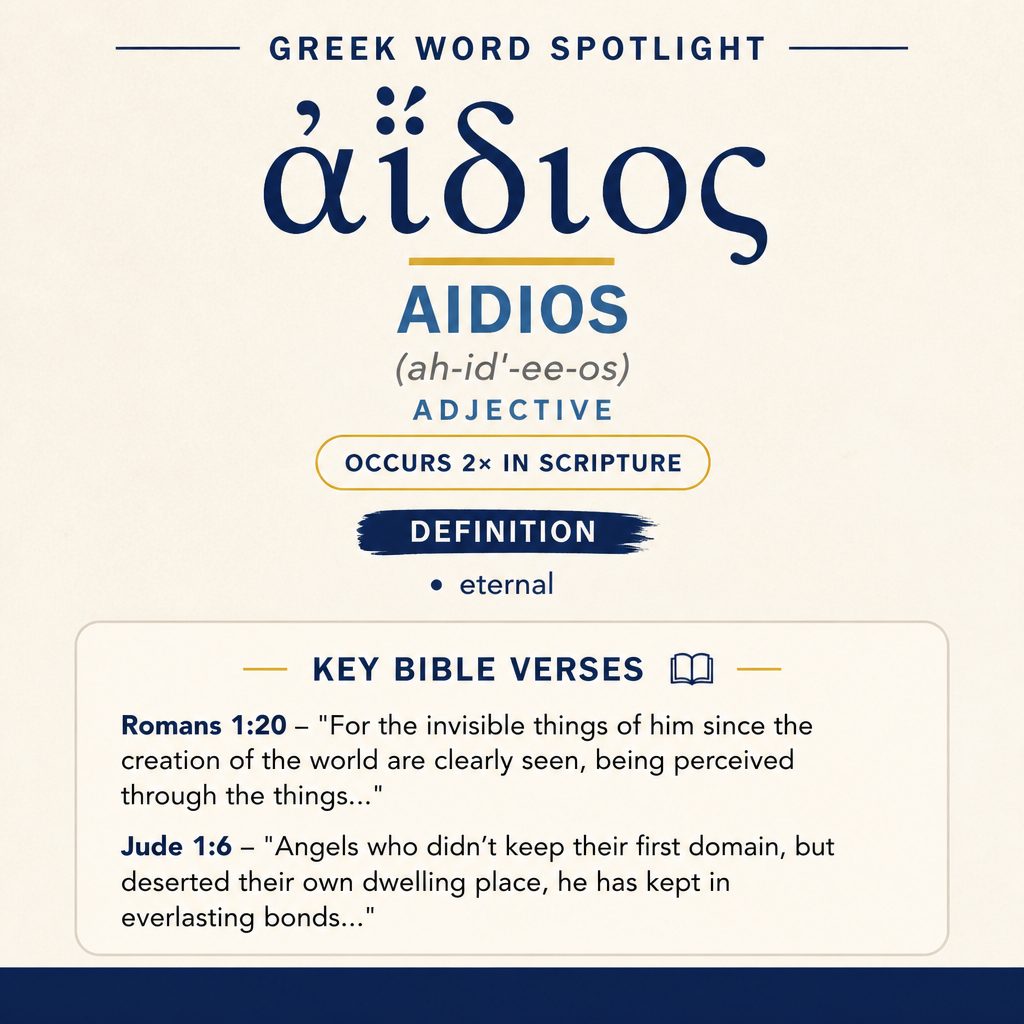
ἀΐδιος (Aidios) means “eternal” and appears in Romans 1:20 and Jude 1:6.
Verse Contexts
Romans 1:20 uses it of God’s invisible things since the world’s creation. Jude 1:6 uses it of everlasting bonds kept for angels.
Learn More →ἀΐδιος expresses what is eternal, focusing attention on what endures without end. In the New Testament it appears in two settings: Paul’s description of God’s power in creation (Romans 1:20) and Jude’s description of the confinement of rebellious angels (Jude 1:6).
Root and Related Words
ἀΐδιος is related to aei (ἀεί), “always” (Strong’s G104). This relationship highlights a link between the idea of “always” and language that marks what is eternal.

Occurrences
“For the invisible things of him since the creation of the world are clearly seen, being perceived through the things that are made, even his everlasting power and divinity, that they may be without excuse.” (Romans 1:20)
Here ἀΐδιος modifies “power,” describing God’s power as everlasting in a context where the created order serves as the medium of perception: “being perceived through the things that are made.” The verse sets “invisible things” alongside what can be “clearly seen,” and ἀΐδιος contributes by framing the divine “power” as belonging to the category of what is not limited to any moment within the world’s history. Because this perception is tied to “since the creation of the world,” the word strengthens the point that what creation discloses is not a temporary surge or a passing display; it is power characterized as enduring, constant in its reality and relevance. The concluding clause, “that they may be without excuse,” shows why the adjective matters in the argument: the quality of God’s power as ἀΐδιος supports the claim that such revelation is sufficient to ground accountability, because it concerns something stable rather than fleeting.
The placement alongside “divinity” further situates the adjective within theological description. Paul is not merely cataloging an attribute; he is describing what creation communicates about God—specifically a power that is not bounded by time. In this way, ἀΐδιος supports the logic that the created world bears ongoing witness: as long as the world exists for people to observe, what it communicates about God includes this enduring character of divine power.
“Angels who didn’t keep their first domain, but deserted their own dwelling place, he has kept in everlasting bonds under darkness for the judgment of the great day.” (Jude 1:6)
In Jude, ἀΐδιος modifies “bonds,” describing the restraints as everlasting. The verse presents a sequence of actions and reversals: the angels “didn’t keep their first domain,” they “deserted their own dwelling place,” and in response “he has kept” them. The adjective sharpens the nature of this keeping: the bonds are not pictured as provisional measures that might soon loosen, but as restraints marked by enduring permanence.
Two further phrases frame the force of ἀΐδιος here. First, the bonds are “under darkness,” which adds a spatial and experiential setting to the confinement. The adjective does not create the darkness, but it strengthens the impression of a confinement that is settled and unyielding. Second, the bonds are oriented “for the judgment of the great day.” Within the verse’s own terms, the everlasting character of the bonds underscores the certainty and fixedness of the present confinement as it stands in relation to the coming judgment. Jude’s language does not treat the confinement as a temporary corrective; it is described with the weight of something enduring, matching the gravity of the angels’ abandonment of their proper place.
Sense and Usage
Across these two passages, ἀΐδιος marks what is eternal in two very different domains: divine power and imposed restraint. In Romans 1:20 it qualifies God’s “power” in a way that supports an argument about revelation through creation. The adjective adds a time-transcending dimension to what is perceived: what creation discloses is not simply that God is powerful, but that this power is of a kind characterized by enduring permanence. That enduring quality fits the clause “since the creation of the world,” because the span of human observation is set within an order that has, from its beginning, been a theater for perceiving what is enduringly true about God.
In Jude 1:6 the same adjective attaches to “bonds,” showing that eternality language can also describe the durability of judgment-related restraint. The word does not itself name the judgment, darkness, or the angels’ desertion; rather, it fixes the bonds as enduring within that scene. The contrast is striking: in Romans, what is eternal belongs to God and is made perceptible through what exists; in Jude, what is eternal belongs to the conditions of custody imposed on those who abandoned their appointed sphere. In both cases the adjective lends firmness: in Romans, firmness of the reality being perceived; in Jude, firmness of the restraint being endured.
Because ἀΐδιος appears with concrete nouns (“power,” “bonds”), its force is not abstracted away from real effects. “Power” is presented as something with implications for knowledge and responsibility (“clearly seen… without excuse”). “Bonds” are presented as something with implications for confinement and accountability (“kept… for the judgment”). Thus the adjective’s contribution is not merely to stretch a timeline; it heightens the seriousness of what is described by placing it in the category of the eternal. In these passages, what is eternal is not peripheral—it bears directly on how the world is understood (Romans) and how divine governance is feared and respected (Jude).
Imagery
The imagery attached to ἀΐδιος in these verses moves between two poles: the enduring visibility of creation as a witness to God’s everlasting power (Romans 1:20), and the enduring darkness of confinement in everlasting bonds awaiting judgment (Jude 1:6). One scene looks outward across “the things that are made,” where the eternal is discerned through the world’s existence; the other looks inward to a custody “under darkness,” where the eternal is felt as fixed restraint. Together, they show how the eternal can be portrayed as both the steadfastness of divine reality and the unrelenting certainty of divine keeping.
Sources: Lexical data from Strong’s Exhaustive Concordance and the Translators Brief Lexicon of Extended Strongs for Greek (STEPBible, CC BY). Occurrence data from the Translators Amalgamated Greek New Testament (STEPBible, CC BY). Scripture quotations from the World English Bible (public domain).