
Exploring the Meaning of Azor in Greek
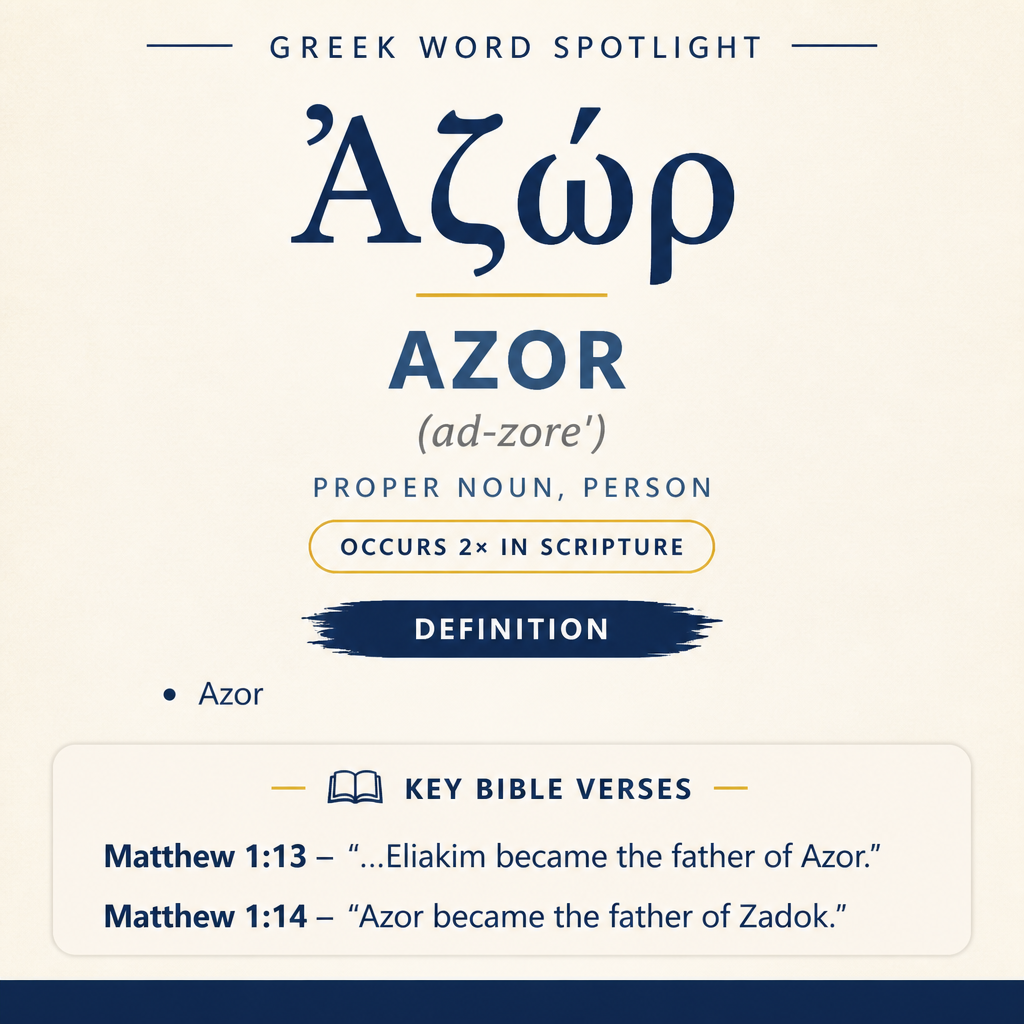
Ἀζώρ (Azor) means “Azor” and appears twice in Scripture, in Matthew 1:13–14.
Matthew Genealogy
In Matthew 1:13, Eliakim became the father of Azor. In Matthew 1:14, Azor became the father of Zadok.
Learn More →Scripture Occurrences
This name occurs 2 times in Scripture. Both occurrences are in Matthew 1.
Learn More →Azor is a personal name occurring in the genealogy at the opening of Matthew, where it functions to connect successive generations. In this setting it marks one link in a chain of “became the father of …” statements that move the lineage forward.
Occurrences
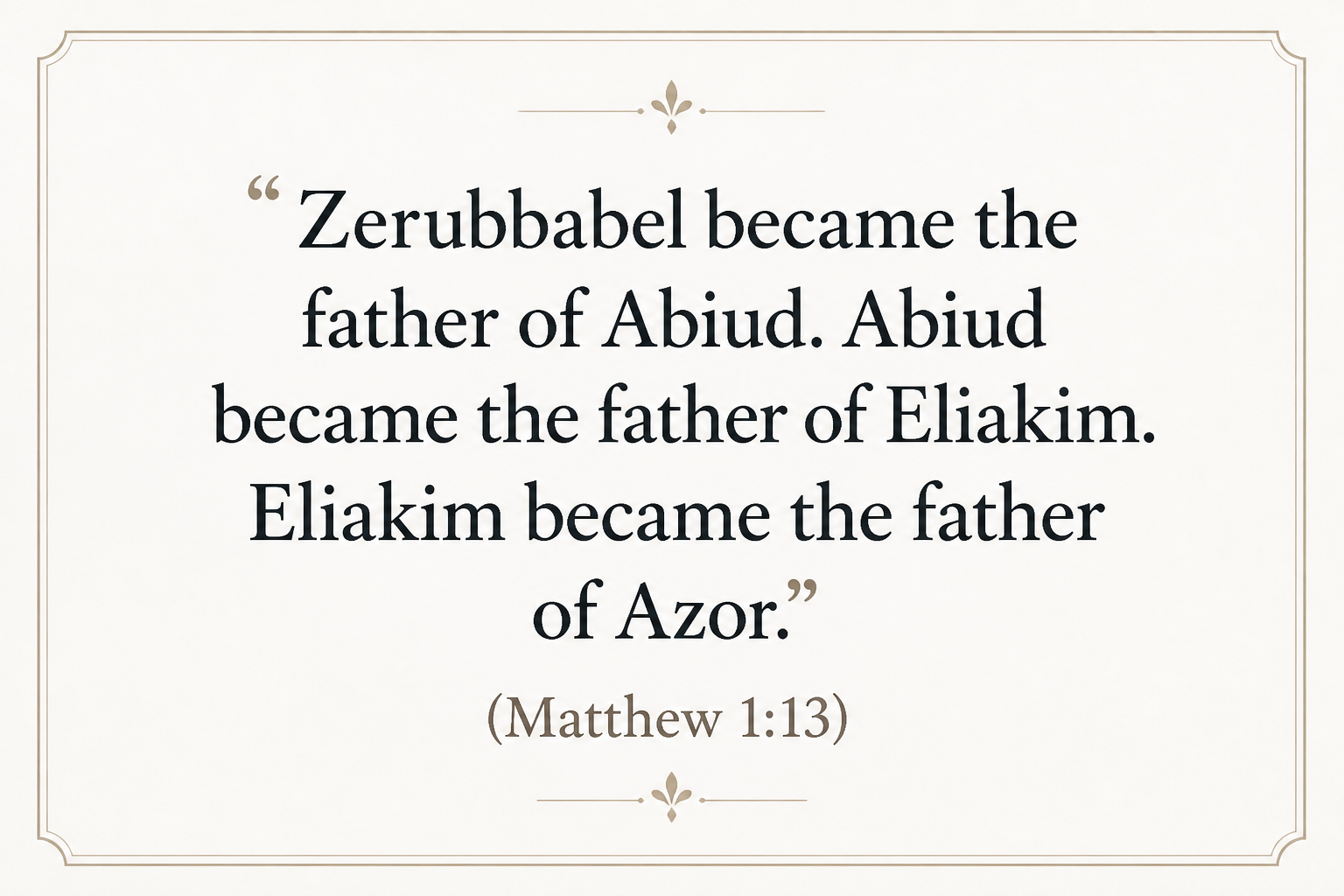
“Zerubbabel became the father of Abiud. Abiud became the father of Eliakim. Eliakim became the father of Azor.” (Matthew 1:13)
Here Azor appears as the culminating name in a triad of father-to-son transitions. The repeated clause “became the father of” gives the verse its steady rhythm, and Azor is the final point reached by that rhythm in this line: from Zerubbabel to Abiud to Eliakim to Azor. In the immediate wording, Azor’s role is defined entirely by relationship—he is presented as the son of Eliakim. The verse does not pause to describe Azor’s deeds, location, or character; instead, the name’s contribution is structural. It serves as the next handhold in the genealogy, allowing the sequence of descent to continue in the next line.
Within the verse’s compact design, each name is both an endpoint and a starting point: an endpoint because the reader arrives at it through stated parentage, and a starting point because it becomes the point from which the next generational step can be taken. In Matthew 1:13, Azor is introduced at the exact moment the narration needs a new anchor for the continuing list. The name is thus part of the passage’s method of establishing continuity—one generation becoming father to the next—without shifting into narrative or comment.
“Azor became the father of Zadok. Zadok became the father of Achim. Achim became the father of Eliud.” (Matthew 1:14)
In the following verse Azor stands at the head of the sentence and functions as the initiating father in a new set of three transitions. Having been introduced as a son in the previous verse, Azor is now identified as a father: “Azor became the father of Zadok.” This shift in position—moving from the end of Matthew 1:13 to the beginning of Matthew 1:14—shows how the genealogy uses each named person as a pivot between what comes before and what comes after. Azor’s name is the hinge that links two adjacent segments of the list: he is the conclusion of one chain and the commencement of the next.
The structure of the verse also highlights how the genealogy compresses time and family complexity into a simple verbal formula. “Became the father of” provides the only action, and the only context is the succession itself. In that scheme, Azor’s significance in the line is conveyed by his placement and by the immediate relationship stated: he is the one from whom Zadok proceeds. The name contributes a specific junction point, ensuring the reader can follow the lineage from one named figure to the next through explicit statements of descent.

Sense and Usage
As used in Matthew 1:13–14, Azor functions strictly as a proper name in a genealogical register. The two occurrences together portray Azor in paired relational roles: first as the child of a named father (“Eliakim became the father of Azor”), then as the parent of a named son (“Azor became the father of Zadok”). This pairing is one of the genealogy’s key techniques for maintaining coherence across a sequence of brief clauses. By introducing a person at the end of one verse and immediately making that same person the subject of the next, the list produces continuity without commentary.
The repeated formula “became the father of” governs how the reader is meant to understand each name. A proper name in this format does not operate as a label for an independent character profile; it operates as a relational marker within a linear descent. Azor’s usage therefore is not about describing Azor but about placing Azor. The name denotes a particular person whose identity in the passage is established by adjacency: Azor is identified through Eliakim and, in turn, identifies the next step through Zadok.
This genealogical usage also shapes the way the name “Azor” is encountered on the page. The name is surrounded by other names, each separated by short, repetitive clauses. That uniformity means the reader’s attention is directed less toward any single individual and more toward the orderly progression of the line. Within that progression, Azor’s occurrence at a verse boundary (end of Matthew 1:13; beginning of Matthew 1:14) makes the name function as a bridge between units of the list. The text’s organization thus grants Azor a clear role: sustaining the forward motion of the genealogy by carrying the line from one set of ancestors to the next.
Across both verses, Azor appears without titles, descriptors, or narrative elaboration. The effect is that the name remains fixed to the genealogical purpose of the passage. It contributes specificity—this descent passes through Azor rather than an unnamed link—while the formulaic framing keeps the focus on the continuity of fatherhood and succession. In this way, the usage of Azor is tightly controlled by genre: a name embedded in a sequence whose meaning is carried by the pattern of relations stated around it.
Genealogical Imagery
In Matthew 1:13–14 the imagery is that of an unbroken chain of begetting, expressed through steady repetition: “became the father of … became the father of … became the father of …” Azor is one link in that chain, placed so that the reader first meets him as the outcome of Eliakim’s fatherhood and then immediately sees him as the source of Zadok’s. The passages evoke continuity not by story but by structure, and Azor’s name participates in that continuity as the point where one segment of the lineage hands off to the next.
Sources: Lexical data from Strong’s Exhaustive Concordance and the Translators Brief Lexicon of Extended Strongs for Greek (STEPBible, CC BY). Occurrence data from the Translators Amalgamated Greek New Testament (STEPBible, CC BY). Scripture quotations from the World English Bible (public domain).





