
Exploring the Meaning of Su in Greek
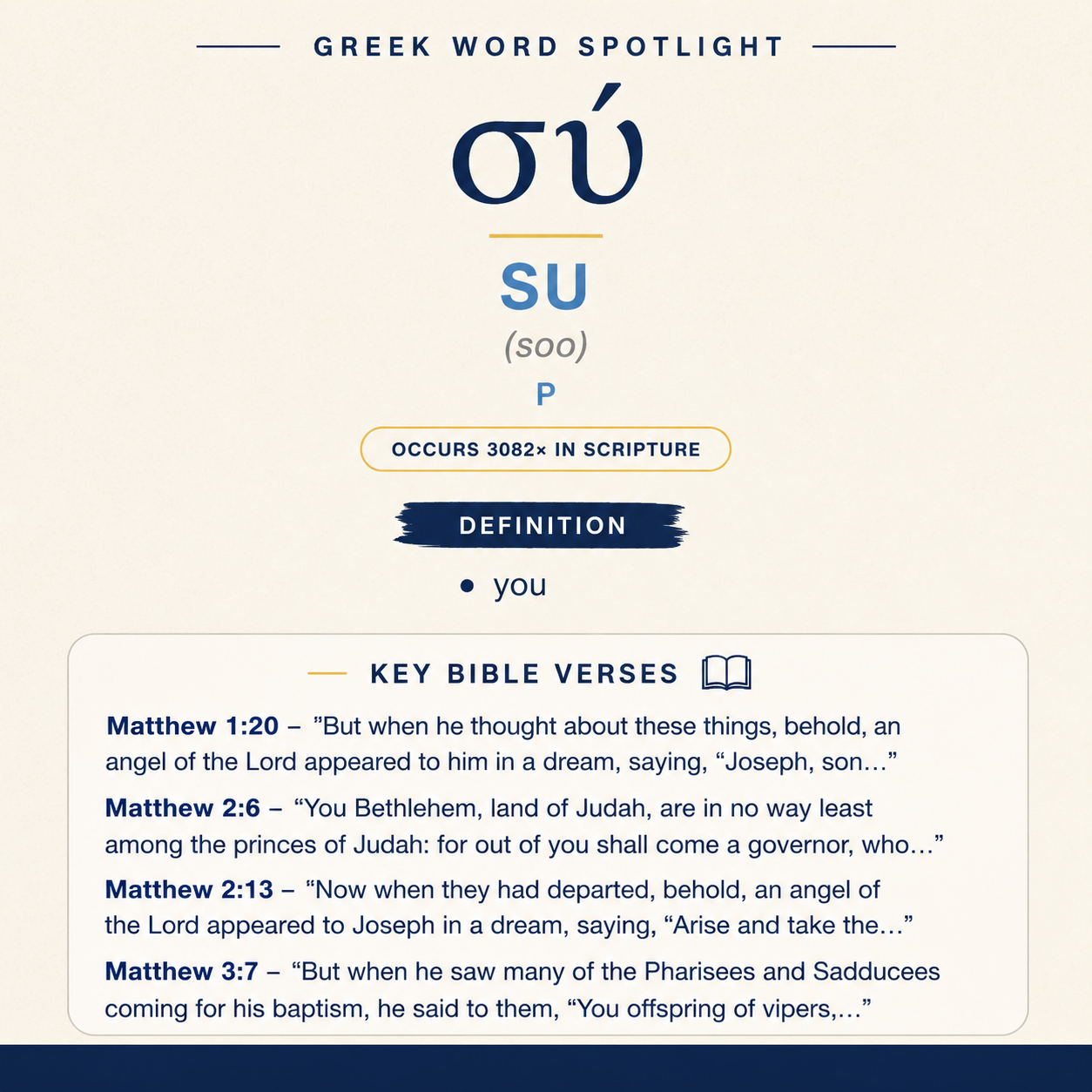
σύ means “you” in Greek and appears 3,082 times in Scripture, including passages in Matthew (e.g., 1:20; 2:6; 3:7; 4:6).
Meaning
σύ is defined as “you.” It functions as a direct form of address in the listed verses.
Learn More →Scripture Frequency
This word occurs 3,082 times in Scripture. It is one of the most frequently appearing terms.
Learn More →Matthew Examples
Examples include direct address in Matthew 1:20 ("Joseph, son of...") and Matthew 3:7 ("You offspring of vipers..."). Another example appears in Matthew 4:6 ("If you are the Son of God...").
Learn More →σύ means “you,” the direct form of address used when a speaker turns toward another person and speaks personally. In these Gospel scenes it appears in dream warnings, public rebuke, confessional humility, and direct confrontation, marking who is being addressed and held responsible in the moment.
Occurrences
Matthew 1:20 — “But when he thought about these things, behold, an angel of the Lord appeared to him in a dream, saying, “Joseph, son of David, don’t be afraid to take to yourself Mary, your wife, for that which is conceived in her is of the Holy Spirit.”
Here σύ anchors the angel’s direct address to Joseph. The instruction “don’t be afraid” is not general counsel but a personal word aimed at the one deliberating; the “you” makes the dream-message immediate and individually binding (“don’t be afraid to take to yourself Mary”).
Matthew 2:6 — “‘You Bethlehem, land of Judah, are in no way least among the princes of Judah: for out of you shall come a governor, who shall shepherd my people, Israel.’ ”
In this citation, σύ is used to speak to a place as if it were a hearer: “You Bethlehem.” The “you” functions as a rhetorical address that draws the location into the speech as a participant, setting Bethlehem in the spotlight as the one spoken about and, in the phrasing, spoken to.
Matthew 2:13 — “Now when they had departed, behold, an angel of the Lord appeared to Joseph in a dream, saying, “Arise and take the young child and his mother, and flee into Egypt, and stay there until I tell you, for Herod will seek the young child to destroy him.”
σύ again marks Joseph as the recipient of urgent commands: “Arise… flee… stay… until I tell you.” The “you” identifies who must wait for further instruction, and it tightens the relationship between the angel’s telling and Joseph’s compliance within the danger described (“Herod will seek the young child to destroy him”).
Matthew 3:7 — “But when he saw many of the Pharisees and Sadducees coming for his baptism, he said to them, “You offspring of vipers, who warned you to flee from the wrath to come?”
John’s rebuke is pointed by σύ: “You offspring of vipers.” The pronoun draws a line between speaker and hearers, making the accusation direct and the question personal (“who warned you to flee…”), forcing the addressed group to stand under the charge in their own hearing.
Matthew 3:9 — “Don’t think to yourselves, ‘We have Abraham for our father,’ for I tell you that God is able to raise up children to Abraham from these stones.”
Even where the wording is reflexive (“to yourselves”), σύ situates the admonition inside the hearers’ own inner speech. The “you” frames an internal posture (“Don’t think…”) as something the addressed people must govern, especially regarding their claim of ancestry.
Matthew 3:11 — “I indeed baptize you in water for repentance, but he who comes after me is mightier than I, whose sandals I am not worthy to carry. He will baptize you in the Holy Spirit.”
σύ here identifies the recipients of two contrasted actions: John’s baptism “in water” and the coming one’s baptism “in the Holy Spirit.” The “you” keeps the focus on what is done to the hearers; they are not spectators but the ones acted upon in the promised transition from one baptism to another.
Matthew 3:14 — “But John would have hindered him, saying, “I need to be baptized by you, and you come to me?”
In John’s protest, σύ highlights the perceived reversal in roles: “baptized by you… you come to me?” The “you” is emphatic in effect, distinguishing the one John considers greater and making the surprise hinge on who is addressing whom and who should receive baptism.
Matthew 4:6 — “and said to him, “If you are the Son of God, throw yourself down, for it is written, ‘He will command his angels concerning you,’ and, ‘On their hands they will bear you up, so that you don’t dash your foot against a stone.’ ”
The tempter’s challenge uses σύ to press identity and action onto the addressee: “If you are… throw yourself down.” Within the quoted lines, “concerning you” keeps the promise language directed to the one being tested, and the final clause (“so that you don’t dash…”) applies the supposed protection to the addressee’s body and risk.
Matthew 4:7 — “Jesus said to him, “Again, it is written, ‘You shall not test the Lord, your God.’ ”
Here σύ appears within a direct prohibition: “You shall not test.” The “you” makes the command confrontational and immediate, aimed at the one pressing the test. It also frames the action as something the addressee is responsible not to do toward “the Lord, your God.”
Matthew 4:9 — “He said to him, “I will give you all of these things, if you will fall down and worship me.”
σύ marks the proposed recipient of an offer and the one expected to perform the condition: “give you… if you will fall down.” The “you” focuses the temptation as a personal transaction between speaker and addressee, with the demanded act (“worship me”) laid directly on the addressed person.
Matthew 4:10 — “Then Jesus said to him, “Get behind me, Satan! For it is written, ‘You shall worship the Lord your God, and you shall serve him only.’ ”
In the rebuke “Get behind me,” the confrontation is direct; within the citation, σύ gives the directive its force as an address to the responsible party: “You shall worship… you shall serve.” The “you” sets worship and service as obligations that bind the one addressed, excluding the rival demand that has just been made.
Matthew 4:19 — “He said to them, “Come after me, and I will make you fishers for men.”
σύ identifies the ones being summoned and shaped by the speaker’s promise: “Come after me… I will make you…” The “you” holds together command and transformation: those addressed are the ones who must follow, and they are the ones who will become “fishers for men.”

Sense and Usage
Across these passages, σύ functions as the pivot of direct address: it points the speech-act at a specific hearer (Joseph; the Pharisees and Sadducees; Jesus; the disciples) or, in a rhetorical move, at a named place (“You Bethlehem”). Because “you” marks the addressee, it determines where the force of an imperative, warning, or accusation lands. In Matthew 1:20 and 2:13, the “you” of the angelic message makes the dream counsel and commands personal—Joseph is not overhearing; he is being instructed, and the instructions name the boundaries of his action (“stay there until I tell you”).
When the address is public and corrective (Matthew 3:7, 3:9), σύ tightens accountability. John’s language does not speak about the group at a distance but speaks to them in their hearing; even the command about thinking (“Don’t think to yourselves”) treats inner confidence as something the hearers themselves must answer for. In the baptism contrast (Matthew 3:11), “you” gathers the audience into the narrative of what is happening to them: they receive John’s water baptism, and they are the ones spoken of as recipients of a coming baptism “in the Holy Spirit.”
In Matthew 3:14, σύ works in a paired way (“by you… you come to me”), highlighting how the pronoun can sharpen a perceived mismatch of roles. The exchange hinges on who “you” is: the one whose presence reorders expectations. In the temptation scenes (Matthew 4:6–10), σύ becomes a contested pronoun. The tempter aims “you” at identity (“If you are the Son of God”) and at action (“throw yourself down”), then couches pressure in quoted promise-language “concerning you.” Jesus answers with a “you” that turns the matter into obligation and boundary (“You shall not test… You shall worship… you shall serve”), redirecting the address away from self-proving and toward rightful worship and service. In Matthew 4:19, σύ again marks the addressees of a summons, but now the address is constructive: those called are defined by a future shaped by the speaker (“I will make you fishers for men”).
Imagery in Context
Within these verses, σύ often stands at moments of movement and decision: fear giving way to obedience in a dream, flight to Egypt under threat, crowds facing a prophet’s searching question, and a wilderness confrontation where commands and counter-commands collide. The pronoun’s simplicity carries the immediacy of being spoken to: “you” is the grammatical point where warning, temptation, prohibition, and calling meet the person (or place) addressed.
Sources: Lexical data from Strong’s Exhaustive Concordance and the Translators Brief Lexicon of Extended Strongs for Greek (STEPBible, CC BY). Occurrence data from the Translators Amalgamated Greek New Testament (STEPBible, CC BY). Scripture quotations from the World English Bible (public domain).




