Exploring the Meaning of Toi in Greek
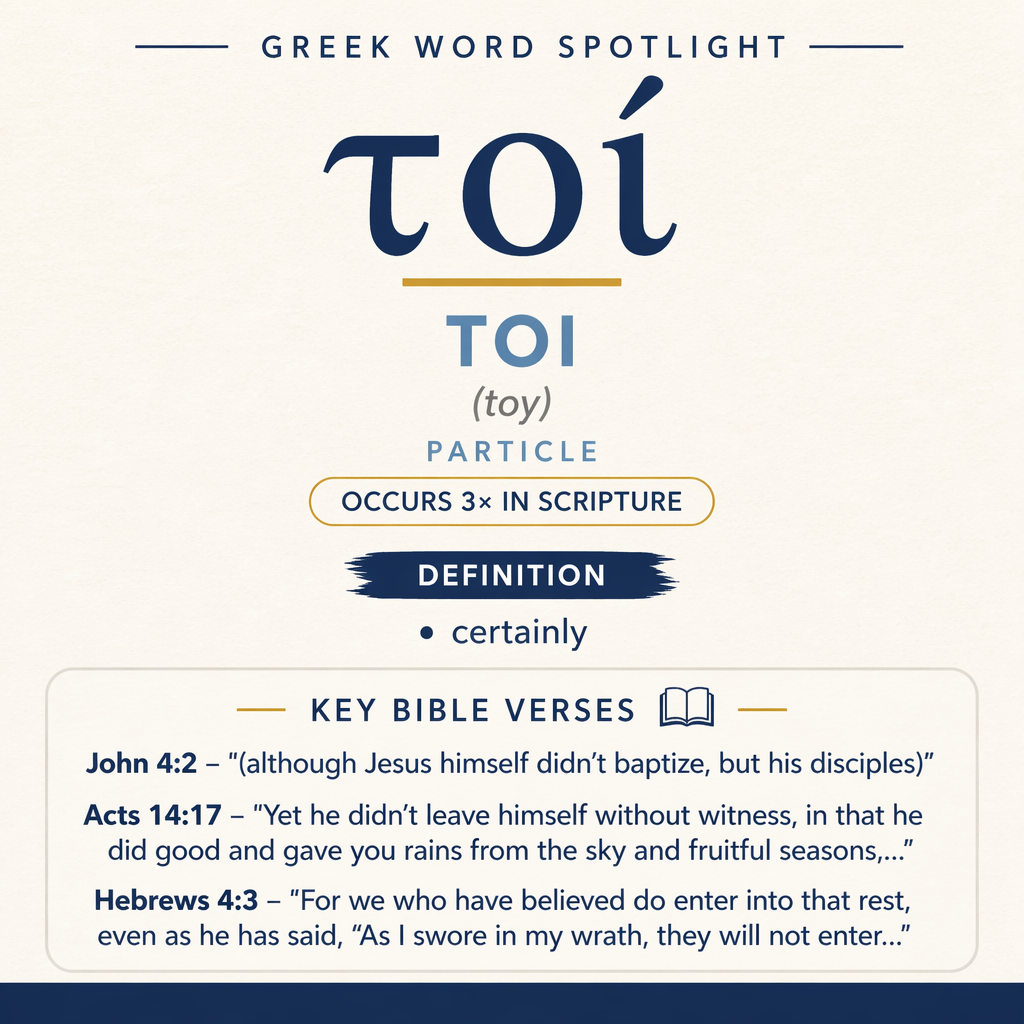
τοί means “certainly” and occurs three times in Scripture: John 4:2, Acts 14:17, and Hebrews 4:3.
Context Snapshots
In John 4:2 it occurs in a parenthetical clarification; in Acts 14:17 and Hebrews 4:3 it appears within explanatory statements.
Learn More →τοί expresses certainty, adding a firm, unambiguous tone to a statement. It appears in three New Testament contexts: a narrative clarification about baptism, a speech about God’s beneficence in nature, and an argument about entering God’s rest.
Root and Related Words
τοί is linked to the article ho (ὁ), “the/this/who” (Strong’s G3588), from which it derives.

Occurrences
John 4:2 — “(although Jesus himself didn’t baptize, but his disciples),”
In John 4:2 the word occurs within a parenthetical clarification. The line distinguishes Jesus’ own direct action from that of “his disciples,” and τοί supports the force of that clarification: the writer is not merely adding a casual aside, but making a definite point that guards how the reader understands what is being attributed to Jesus. The statement has the shape of a correction—what might be assumed is set aside in favor of what is certain—so τοί serves the narrative aim of precision, ensuring that the reader’s picture of events is firmly anchored to the specified detail.
Acts 14:17 — “Yet he didn’t leave himself without witness, in that he did good and gave you rains from the sky and fruitful seasons, filling our hearts with food and gladness.”
In Acts 14:17 the word stands within a public declaration about God’s self-disclosure through beneficence. The sentence argues that God has given “witness” of himself, and it supports this claim with a chain of concrete actions: “he did good,” “gave you rains from the sky,” provided “fruitful seasons,” and brought an inner effect—“filling our hearts with food and gladness.” In that setting, τοί strengthens the speaker’s assertion that this witness is real and dependable. The clause is not speculative; it presses the point that the audience can treat these gifts as a sure sign of God’s activity. By reinforcing certainty, τοί helps the sentence read as testimony anchored in shared experience—rains, seasons, food, gladness—rather than as a tentative inference.
Hebrews 4:3 — “For we who have believed do enter into that rest, even as he has said, “As I swore in my wrath, they will not enter into my rest;” although the works were finished from the foundation of the world.”
In Hebrews 4:3 the word occurs in a tightly reasoned theological claim: “we who have believed do enter into that rest.” The sentence then connects that claim to a scriptural quotation—“As I swore in my wrath, they will not enter into my rest;”—and adds a further concessive statement: “although the works were finished from the foundation of the world.” Here τοί lends firmness to the author’s affirmation about believers entering rest. The argument is constructed to carry weight: it is introduced with “For,” set in the present reality of those who “have believed,” and then framed against a solemn oath (“As I swore in my wrath”). In that rhetorical environment, τοί supports the author’s intention to present the conclusion as settled rather than tentative, even as the verse holds together two ideas that might seem to pull in different directions: the certainty of entering rest for believers, and the reality of a sworn exclusion for others, alongside the statement about finished works.
Sense and Usage
Across these three passages, τοί functions as a marker of assuredness, giving statements a definite, settled character within their immediate discourse. In John 4:2, that certainty serves a clarifying purpose: a potential misunderstanding is fenced off by a firm specification about who performed the baptizing. In Acts 14:17, certainty underwrites a witness-claim built from observable goods—rains, seasons, food, gladness—so that the testimony is pressed as dependable and publicly accessible. In Hebrews 4:3, certainty supports an argument meant to stand under the weight of a divine oath and a larger claim about God’s completed works; the author speaks with the confidence of someone drawing a conclusion that is meant to be received as secure.
These scenes also show that τοί can strengthen different kinds of discourse. It can reinforce a narrative correction (John), a testimonial appeal grounded in shared experience (Acts), and a doctrinal inference tied to quotation and oath (Hebrews). In each case, the particle’s contribution is not additional content but increased force: it hardens the line between what is asserted as definite and what might otherwise be left as an impression, a mere report, or a soft claim. The result is a tone of decisiveness that matches the needs of each context—accurate narration, persuasive public witness, and confident theological reasoning.
Imagery
Though τοί is a small word, the passages where it appears are rich in concrete scenes: the practical division of actions between Jesus and his disciples (John 4:2), the cycle of “rains from the sky and fruitful seasons” that supplies “food and gladness” (Acts 14:17), and the solemn language of an oath about entering—or not entering—“that rest” (Hebrews 4:3). In each setting, τοί quietly presses these claims as sure: the clarification is firm, the witness is reliable, and the promise-and-oath framework is treated as weighty and settled.
Sources: Lexical data from Strong’s Exhaustive Concordance and the Translators Brief Lexicon of Extended Strongs for Greek (STEPBible, CC BY). Occurrence data from the Translators Amalgamated Greek New Testament (STEPBible, CC BY). Scripture quotations from the World English Bible (public domain).