
Exploring the Meaning of Opheleo in Greek
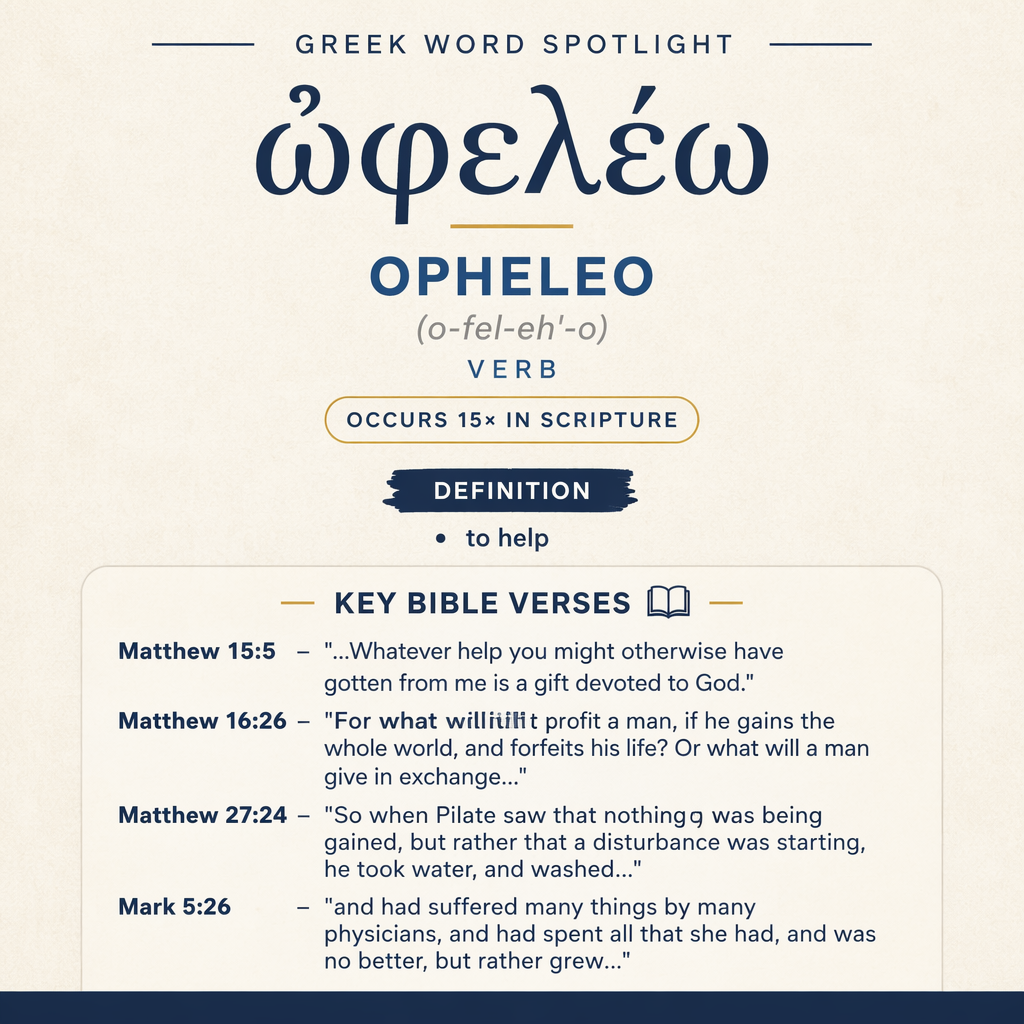
ὠφελέω (Opheleo) means “to help” and occurs 15 times in Scripture, including Matthew, Mark, Luke, and John.
Core Meaning
ὠφελέω is defined as “to help.” In several listed contexts it is expressed as “profit” or “being gained.”
Learn More →Gospel Occurrences
It appears in Matthew 15:5; 16:26; 27:24 and Mark 5:26; 7:11; 8:36. It also occurs in Luke 9:25 and John 6:63.
Learn More →Usage Themes
In Matthew, Mark, and Luke it is used in questions about what it “profits” someone. In John 6:63 it states, “The flesh profits nothing.”
Learn More →ὠφελέω means “to help.” In the passages where it appears, it is used to measure whether an action, possession, practice, or speech actually gives help, and it often does so by contrasting apparent advantage with real benefit.
Occurrences
Matthew 15:5 — “But you say, ‘Whoever may tell his father or his mother, “Whatever help you might otherwise have gotten from me is a gift devoted to God,””
Here ὠφελέω is tied to concrete, expected assistance within the family. The speaker imagines help that parents “might otherwise have gotten” from their child, then shows that this help is being withheld by reclassifying it as “a gift devoted to God.” The verb highlights what is being lost: not an abstract good intention, but practical help that would have reached “his father or his mother.”

Matthew 16:26 — “For what will it profit a man, if he gains the whole world, and forfeits his life? Or what will a man give in exchange for his life?”
In this saying, ὠφελέω frames profit as a form of help that should count in the most serious evaluation of a person’s course. “Gain” is set beside “forfeits,” and the question presses whether worldly acquisition can truly help when it is paired with losing “his life.” The verb drives the logic: something can look like success (“gains the whole world”) and still not be help.
Matthew 27:24 — “So when Pilate saw that nothing was being gained, but rather that a disturbance was starting, he took water, and washed his hands before the multitude, saying, “I am innocent of the blood of this righteous person. You see to it.””
Here ὠφελέω is used in the negative (“nothing was being gained”) to describe a situation where efforts are failing to produce any helpful outcome. The scene is public and volatile: instead of progress, “a disturbance was starting.” The verb captures the futility Pilate perceives—no help is coming from continuing the attempt to manage the crowd’s direction—leading to his symbolic handwashing and the transfer of responsibility: “You see to it.”
Mark 5:26 — “and had suffered many things by many physicians, and had spent all that she had, and was no better, but rather grew worse,”
In this description of prolonged illness, ὠφελέω expresses the hoped-for help of medical treatment by many physicians. The outcome is measured by change in condition: despite expense (“spent all that she had”) and hardship (“suffered many things”), the treatment did not help—“was no better”—and the situation deteriorated: “rather grew worse.” The verb thus marks the gap between attempted remedies and actual help.
Mark 7:11 — “But you say, ‘If a man tells his father or his mother, “Whatever profit you might have received from me is Corban,” ’ ” that is to say, given to God,”
This occurrence parallels the family context of Matthew 15:5, again focusing on help that would ordinarily come to parents. ὠφελέω points to “profit” as the tangible benefit parents “might have received.” The quotation introduces a declaration (“is Corban”) that redefines available resources as “given to God,” and in doing so, it treats the help itself as something that can be redirected away from parental need.
Mark 8:36 — “For what does it profit a man, to gain the whole world, and forfeit his life?”
As in Matthew 16:26, ὠφελέω probes whether “gain” is truly helpful when it is accompanied by irreversible loss (“forfeit his life”). The verb is the hinge of the rhetorical question, forcing the evaluation of benefit: whatever is “the whole world,” it fails to help if it comes at the cost of life itself.
Luke 9:25 — “For what does it profit a man if he gains the whole world, and loses or forfeits his own self?”
Luke’s form uses ὠφελέω to raise the same evaluative question, but the loss is phrased as “loses or forfeits his own self.” The verb continues to function as a test of real help: the apparent help of “gains the whole world” is weighed against the damage of losing oneself. By placing “profit” beside personal loss, the verb emphasizes that not all advantage is help.
John 6:63 — “It is the spirit who gives life. The flesh profits nothing. The words that I speak to you are spirit, and are life.”
Here ὠφελέω is used categorically: “The flesh profits nothing.” The scene contrasts what gives life with what does not help at all, and the verb expresses the non-benefit of “the flesh” in relation to life. The statement that Jesus’ “words” are “spirit, and are life” sets the domain of true help in what “gives life,” and the verb marks “the flesh” as incapable of providing that help.
John 12:19 — “The Pharisees therefore said among themselves, “See how you accomplish nothing. Behold, the world has gone after him.””
In this remark, ὠφελέω describes a failed attempt to achieve a helpful result: “you accomplish nothing.” The immediate context is frustration and perceived momentum elsewhere: “the world has gone after him.” The verb conveys that their actions are not helping their cause; their efforts yield no beneficial effect, and the statement intensifies the sense of being outpaced by events.
Romans 2:25 — “For circumcision indeed profits, if you are a doer of the law, but if you are a transgressor of the law, your circumcision has become uncircumcision.”
Here ὠφελέω is applied to a religious practice, but its helpfulness is conditional: “profits, if you are a doer of the law.” The verb helps Paul argue that the same external marker can be evaluated in two opposite ways depending on conduct. If one “is a transgressor of the law,” then what might have been helpful is rendered void in effect: “has become uncircumcision.” ὠφελέω thus assesses benefit in terms of lived obedience, not mere possession of a sign.
1 Corinthians 13:3 — “If I give away all my goods to feed the poor, and if I give my body to be burned, but don’t have love, it profits me nothing.”
In this intense personal example, ὠφελέω measures the helpful outcome of extreme generosity and self-sacrifice from the actor’s perspective: “it profits me nothing.” The deeds are described in maximal terms (“all my goods,” “my body to be burned”), yet the absence of “love” negates any resulting help for the giver. The verb therefore marks a distinction between outwardly costly actions and actions that actually yield benefit.
1 Corinthians 14:6 — “But now, brothers, if I come to you speaking with other languages, what would I profit you, unless I speak to you either by way of revelation, or of knowledge, or of prophesying, or of teaching?”
Here ὠφελέω is explicitly relational: “what would I profit you.” The question evaluates speech by its capacity to help the listeners. Speaking “with other languages” is treated as potentially unhelpful unless it arrives in forms that communicate substance—“revelation,” “knowledge,” “prophesying,” or “teaching.” The verb thus frames intelligibility and edification as the measure of whether speech is truly helpful to others.

Sense and Usage
Across these contexts, ὠφελέω functions as a practical test: does something actually bring help, and to whom? The verb is repeatedly placed alongside outcomes that expose the difference between apparent advantage and real benefit. In the family sayings (Matthew 15:5; Mark 7:11), it marks the concrete help parents “might otherwise have gotten” or “might have received,” and its force lies in showing how a verbal designation can divert help away from those who would normally receive it. In the sayings about gaining the world (Matthew 16:26; Mark 8:36; Luke 9:25), it evaluates profit on the largest scale, treating “gain” as useless help when it is bought at the cost of “life” or “his own self.”
Several occurrences emphasize the experience of failure or futility. Mark 5:26 portrays repeated attempts that do not help and instead worsen the condition; Matthew 27:24 and John 12:19 portray efforts that “accomplish nothing,” either because the situation escalates into “a disturbance” or because events move decisively in another direction. In John 6:63, the verb is used to draw a sharp boundary between what can and cannot help: “The flesh profits nothing,” set against what “gives life.” Romans 2:25 applies the same evaluative logic to a practice that may be helpful under one condition but loses its effective benefit under another, demonstrating that ὠφελέω can weigh the real impact of a sign or status. Finally, the Corinthian passages use the verb to examine motives and communication: sacrificial acts without “love” yield no helpful return to the giver (1 Corinthians 13:3), and speech that does not convey “revelation…knowledge…prophesying…teaching” fails to help the hearers (1 Corinthians 14:6). Throughout, ὠφελέω presses beyond appearance to the actual delivery of help in lived relationships, moral evaluation, and communal life.
Imagery
The scenes tied to ὠφελέω often picture help in measurable terms: resources withheld from parents, a life weighed against “the whole world,” treatments that leave a sufferer “no better,” and words assessed by whether they bring understanding. Even when the verb appears as “nothing was being gained” or “profits nothing,” it keeps the focus on outcomes—what actions and words truly do for someone in the moment described.
Sources: Lexical data from Strong’s Exhaustive Concordance and the Translators Brief Lexicon of Extended Strongs for Greek (STEPBible, CC BY). Occurrence data from the Translators Amalgamated Greek New Testament (STEPBible, CC BY). Scripture quotations from the World English Bible (public domain).




