
Exploring the Meaning of Chronizo in Greek
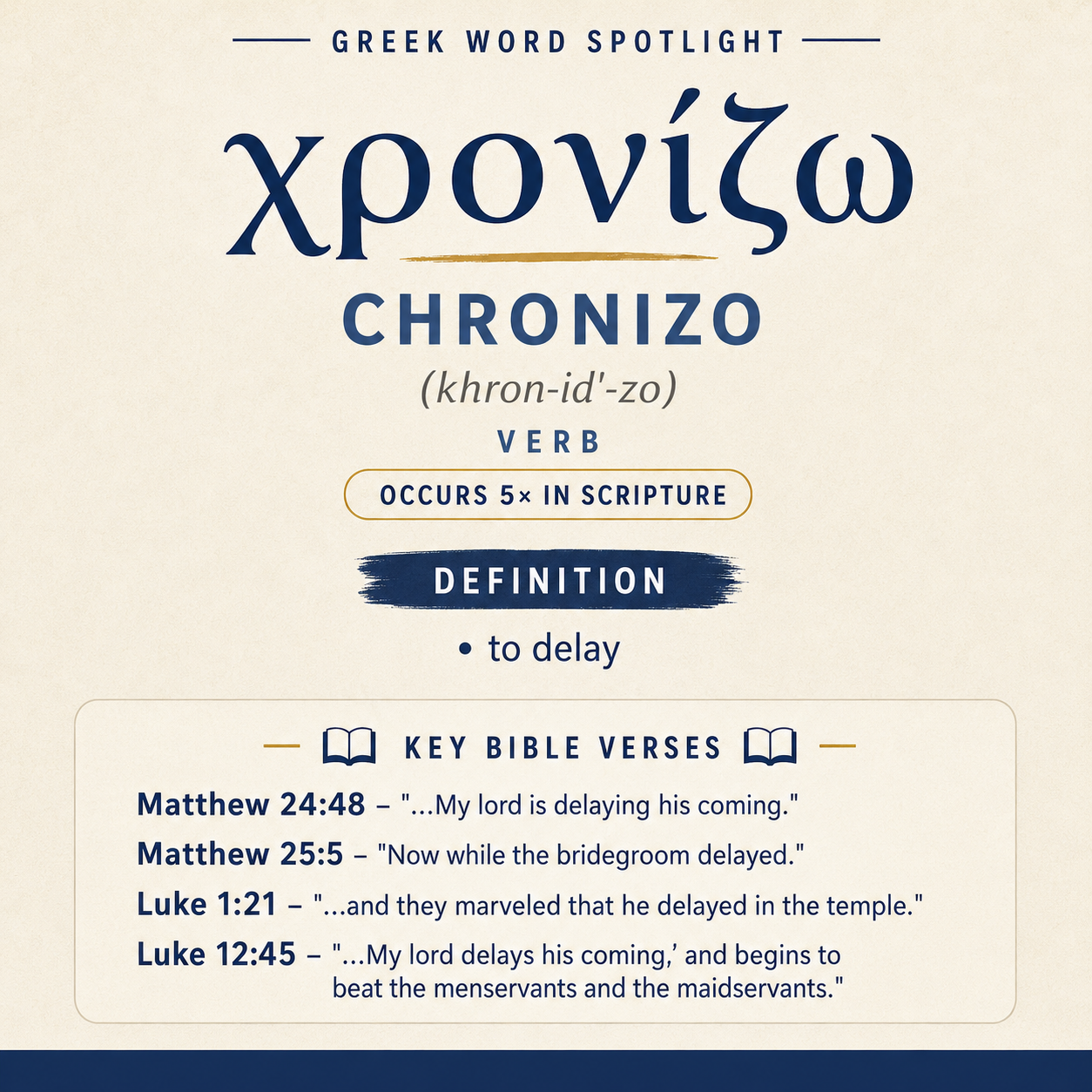
χρονίζω means “to delay” and occurs five times in Scripture: Matthew 24:48; 25:5; Luke 1:21; 12:45; Hebrews 10:37.
Core Meaning
χρονίζω means “to delay.” It is used of a person delaying or being delayed.
Learn More →Gospel Contexts
In Matthew 24:48 and Luke 12:45, a servant says, “My lord delays his coming.” In Matthew 25:5, the bridegroom delayed; in Luke 1:21, Zacharias delayed in the temple.
Learn More →Hebrews Emphasis
Hebrews 10:37 contrasts delay with certainty: “he who comes will come, and will not wait.” This occurrence states that the coming one will not delay.
Learn More →χρονίζω describes delay—time stretching beyond what is expected in a given situation. In the New Testament it appears in scenes of waiting: a servant interpreting his master’s timing, attendants nodding off as they linger, worshipers outside the sanctuary, and a promise that the coming one “will not wait.”
Root and Related Words
χρονίζω is related to chronos (χρόνος), “time” (Strong’s G5550).

Occurrences
Matthew 24:48: “But if that evil servant should say in his heart, ‘My lord is delaying his coming,’”
Here delay is not a neutral fact of scheduling but a conclusion drawn “in his heart.” The servant’s inner claim—“My lord is delaying his coming”—frames the master’s absence as extended, creating a perceived window in which accountability seems remote. χρονίζω thus functions as the servant’s interpretation of time: the coming is thought to be postponed, and that thought becomes the premise for what follows in the broader warning of the passage.

Matthew 25:5: “Now while the bridegroom delayed, they all slumbered and slept.”
In this wedding scene, the delay is the reason the group’s vigilance collapses into ordinary human fatigue: “they all slumbered and slept.” χρονίζω marks the interval long enough to change behavior from alert waiting to unconscious rest. The word contributes the sense that time is not merely passing but passing beyond the point at which preparedness feels urgent.
Luke 1:21: “The people were waiting for Zacharias, and they marveled that he delayed in the temple.”
Delay here is observed externally. The people have an expectation of how long Zacharias should be “in the temple,” and his extended absence becomes remarkable: “they marveled that he delayed.” χρονίζω highlights a mismatch between communal expectation and actual duration; the waiting crowd measures the time indirectly, by how long the priest remains out of sight.
Luke 12:45: “But if that servant says in his heart, ‘My lord delays his coming,’ and begins to beat the menservants and the maidservants, and to eat and drink, and to be drunken,”
This occurrence parallels the inner reasoning of Matthew 24:48 but expands the behavioral fallout within the sentence itself. The servant’s heart-level conclusion—“My lord delays his coming”—is immediately linked to a breakdown of conduct: violence toward “the menservants and the maidservants,” self-indulgence, and intoxication. χρονίζω contributes the idea of a perceived extension of time that weakens restraint; the servant treats the master’s arrival as distant enough to ignore, and the delay becomes the imagined cover for exploitation and excess.
Hebrews 10:37: ““In a very little while, he who comes will come, and will not wait.”
In this quotation, the emphasis is the opposite of extended absence: “will not wait.” Against the pressure that waiting can place on endurance, the line compresses the time horizon—“In a very little while”—and denies any further postponement. χρονίζω here stands in the negative: the coming one’s arrival is portrayed as not subject to delay, countering the expectation that fulfillment might be pushed back.
Sense and Usage
Across these passages, χρονίζω consistently works within the social and moral dynamics of waiting. It can be something concluded inwardly (“say in his heart”) or something noticed by others (“they marveled”), but in each case the delay is meaningful because it interacts with expectation. In Matthew 25:5 the effect is broadly human—sleep overtakes everyone once the wait extends. In Luke 1:21 the effect is communal perception—those outside register that the time inside has run long. In the servant sayings (Matthew 24:48; Luke 12:45), the effect becomes ethical: the servant’s assumption of delay becomes the mental condition that loosens faithfulness into abuse and indulgence. Hebrews 10:37 responds to the same experiential pressure point from the other direction, insisting that the anticipated coming will not be drawn out.
The word therefore marks more than the mere passing of minutes. It flags a stretch of time long enough to force a decision: whether to keep watch, to interpret what is happening, or to act as though return and reckoning are far off. The repeated phrasing about a master’s “coming” shows how delay can be perceived as absence, and how the perceived length of absence reshapes conduct. Even where the setting differs—a temple court, a wedding wait, a household under a steward—the scenarios share a common tension: delay tests what people do when expectations are not met on their timetable.
Imagery
χρονίζω carries the imagery of doors that have not yet opened and figures who have not yet emerged: a bridegroom not yet arrived, a priest not yet returned, a lord not yet come. The word gathers up the atmosphere of waiting crowds and waiting servants—time felt as an extension that invites either drowsiness, wonder, or moral drift—until the counter-assertion in Hebrews 10:37 presses the opposite picture, a coming that “will not wait.”
Sources: Lexical data from Strong’s Exhaustive Concordance and the Translators Brief Lexicon of Extended Strongs for Greek (STEPBible, CC BY). Occurrence data from the Translators Amalgamated Greek New Testament (STEPBible, CC BY). Scripture quotations from the World English Bible (public domain).




