
Exploring the Meaning of Chole in Greek
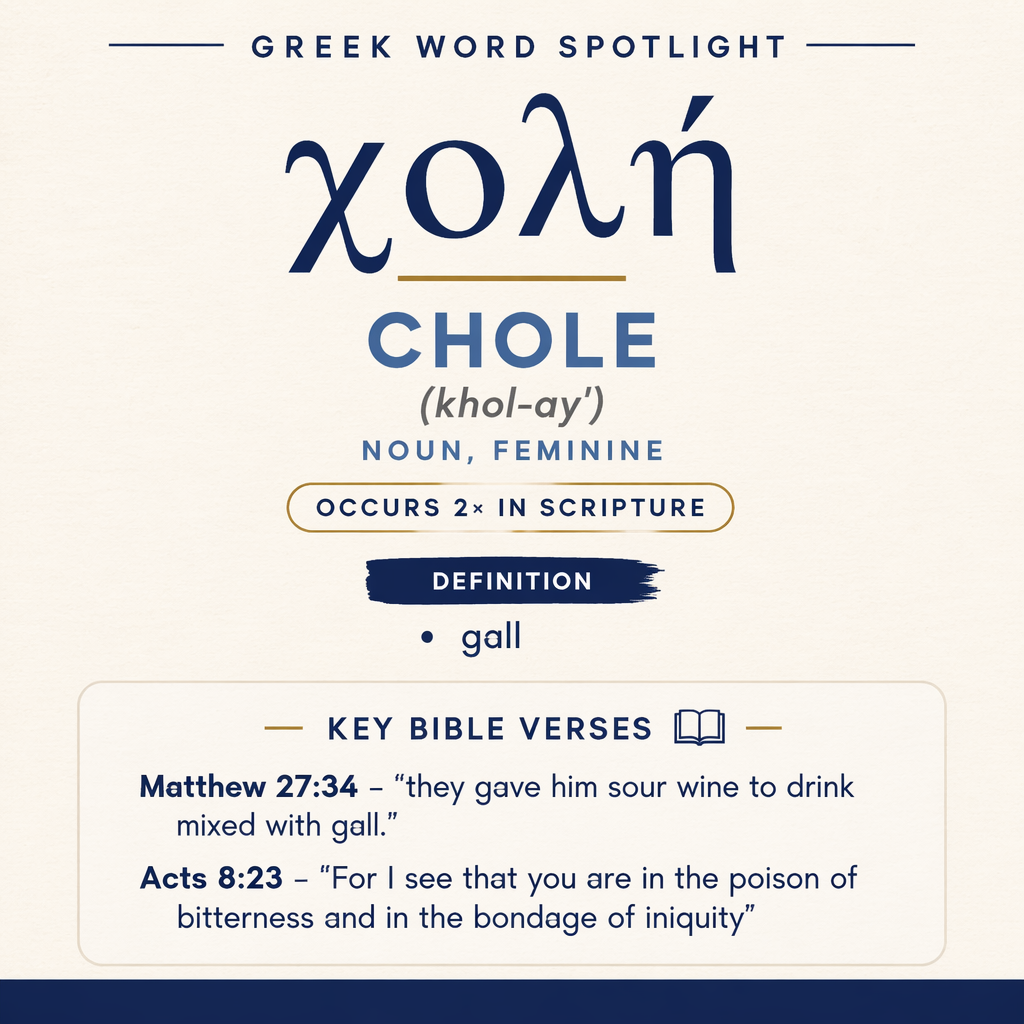
χολή means “gall” and appears twice in Scripture: Matthew 27:34 and Acts 8:23.
Gospel Scene
In Matthew 27:34, sour wine is given to Jesus mixed with gall, and He refuses to drink after tasting it.
Learn More →Figurative Use
In Acts 8:23, it describes being in the “poison of bitterness” and in the bondage of iniquity.
Learn More →χολή means “gall,” and it appears in two New Testament settings: a literal mixture offered to Jesus during the crucifixion scene and a figurative description within Peter’s rebuke of Simon. In both passages, the word carries a sharp, repellent association that fits the immediate action or moral diagnosis being made.
Occurrences
“they gave him sour wine to drink mixed with gall. When he had tasted it, he would not drink.” (Matthew 27:34)
In this scene χολή names an added ingredient in a drink: “sour wine … mixed with gall.” The word functions concretely, describing what has been blended into what is offered. The narrative then highlights Jesus’ response: he “tasted it” but “would not drink.” Within the verse itself, the presence of χολή helps explain the refusal after tasting: the mixture is presented as something that can be sampled, evaluated, and rejected. The action turns on sensory encounter—offered, tasted, refused—and χολή supplies part of the reason the drink is not simply taken down as refreshment. It is not merely liquid placed in his reach; it is a prepared mixture whose contents matter.
The verse is also careful to separate tasting from drinking. χολή belongs to what is tasted, and the refusal follows the tasting. That sequence allows χολή to color the offer as something that cannot be accepted as a straightforward act of receiving drink. In a short line, the word thus contributes to the harshness of the crucifixion moment: what is offered is not a neutral kindness but a mixture with an element that makes it objectionable once its character is known by taste.
“For I see that you are in the poison of bitterness and in the bondage of iniquity.” (Acts 8:23)
Here χολή appears inside Peter’s direct address: “For I see that you are in the poison of bitterness and in the bondage of iniquity.” The word works metaphorically within a diagnostic statement about Simon’s condition. Rather than naming a substance placed into a cup, it names a “poison” that belongs to “bitterness.” The construction binds χολή to an inner moral-spiritual reality: Simon is described as being “in” it, as though surrounded by it or caught within it, not merely touching it from the outside.
The imagery joins two parallel phrases. First is “the poison of bitterness,” where χολή intensifies “bitterness” by giving it a more dangerous cast. Second is “the bondage of iniquity,” which shifts from taste imagery to captivity language. Together, the pair gives Peter’s rebuke a twofold force: what is inside is not only distasteful (bitterness) but harmful (poison), and what is happening to the person is not merely an attitude but an enslaving condition (bondage). χολή therefore does more than label an emotion; it supplies the language that frames bitterness as a contaminating, injuring reality rather than a passing mood.

Sense and Usage
As “gall,” χολή denotes a bitter, unpleasant substance, and these two contexts show how that concrete sense can be used in two different ways without changing the word’s core reference. In Matthew 27:34, the word stays close to the physical realm: something is mixed into sour wine, tasted, and refused. The narrative depends on χολή as a real component of a real drink, and its effect is implied through the sequence of offering, tasting, and refusal. The word’s contribution is immediate and sensory—gall belongs to what the mouth encounters.
In Acts 8:23, the same noun is carried into a figurative register: not a substance in a cup, but “the poison of bitterness.” Even there, the word keeps its concrete force by bringing with it the idea of something noxious and unfit—something that can corrupt and harm. The verse does not treat bitterness as merely unpleasant; it portrays it as a poisonous environment in which a person can be found. χολή is thus well suited to rebuke and moral exposure because it paints the inner state in terms that evoke contamination and danger.
Taken together, the occurrences show a consistent association between χολή and what is repellent to ingest, whether literally or by analogy. Matthew gives the reader an outward scene where gall is a mixed ingredient; Acts gives an inward scene where gall is a condition described as poison linked to bitterness. The shift from mixture to metaphor is guided by the same underlying suitability of the image: gall belongs to what people do not properly receive as life-giving, and in Acts that physical intuition is applied to a human disposition and the bondage that accompanies it.
The two passages also place χολή in relational speech: in Matthew, “they gave him” a drink mixed with it; in Acts, “I see that you are in” it. One is an act done to someone else, the other is a judgment spoken to a person about himself. Yet both uses share a common communicative purpose: χολή helps define the moral texture of what is happening—either the harshness of what is offered to Jesus, or the severity of what Peter perceives in Simon.
Imagery
Across these verses χολή carries a strong taste-image that supports the larger moment. In Matthew 27:34 it sits in the cup: sour wine “mixed with gall,” something tasted and refused. In Acts 8:23 it is no longer in a drink but in a person’s situation: “the poison of bitterness,” paired with “the bondage of iniquity.” In both, the word evokes something that does not belong among wholesome things—either an additive that makes an offered drink unacceptable, or a poisonous bitterness that marks a life as compromised and constrained.
Sources: Lexical data from Strong’s Exhaustive Concordance and the Translators Brief Lexicon of Extended Strongs for Greek (STEPBible, CC BY). Occurrence data from the Translators Amalgamated Greek New Testament (STEPBible, CC BY). Scripture quotations from the World English Bible (public domain).





