Exploring the Meaning of Choiros in Greek
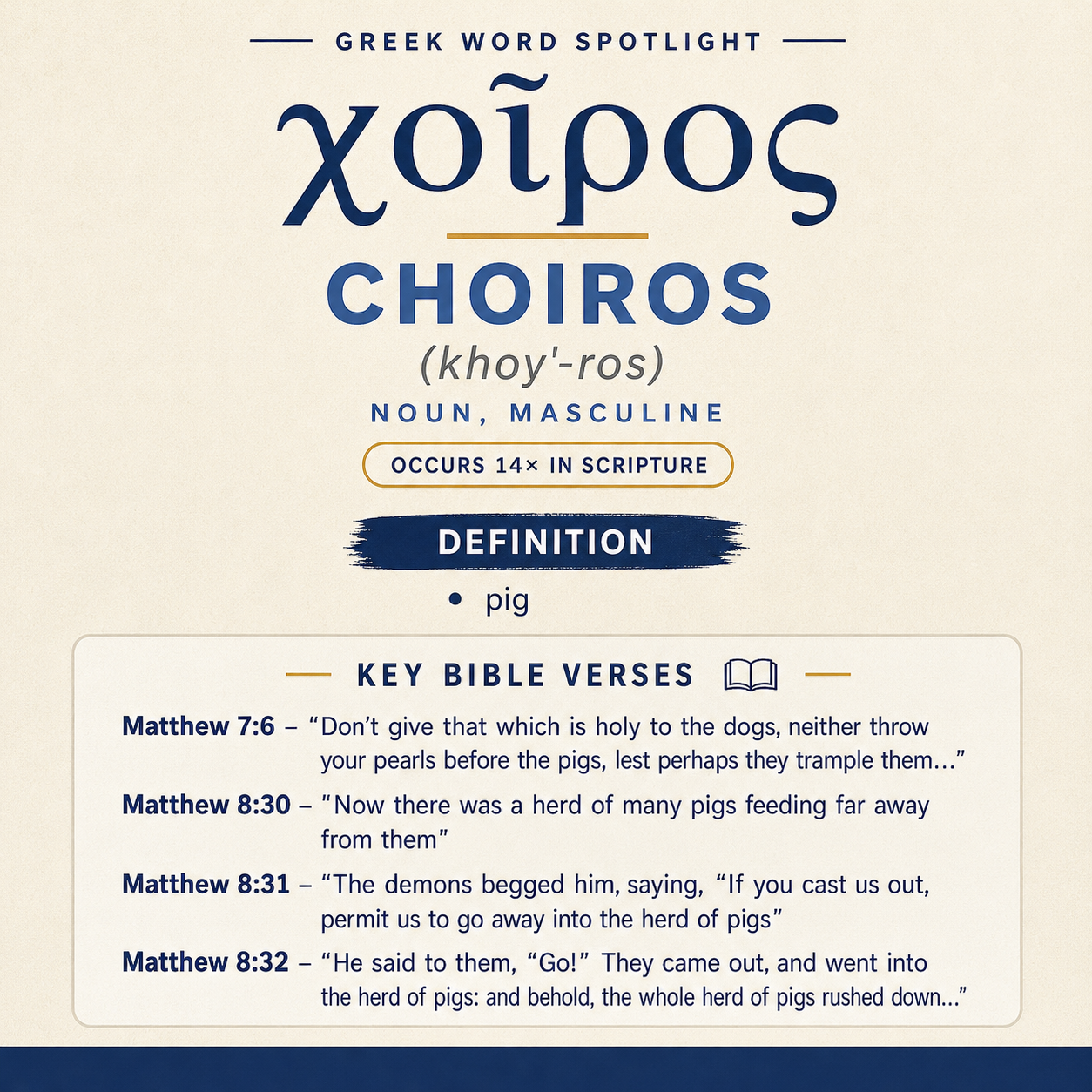
χοῖρος (Choiros) means “pig” and appears 14 times in Scripture, including in Matthew 7–8 and Mark 5.
Gospel Occurrences
It appears in Matthew 7:6 and repeatedly in Matthew 8:30–32 and Mark 5:11–14.
Learn More →Scene Context
In Matthew 8 and Mark 5, χοῖρος refers to herds of pigs in the narrative setting.
Learn More →χοῖρος refers to a pig, and it appears in Jesus’ teaching and in narrative scenes involving herds of pigs and their keepers, as well as in a parable where feeding pigs marks a person’s low point. Across these passages, the word evokes the animal itself—sometimes as a figure in an analogy, and often as a concrete herd whose movement and fate drive the action.
Occurrences
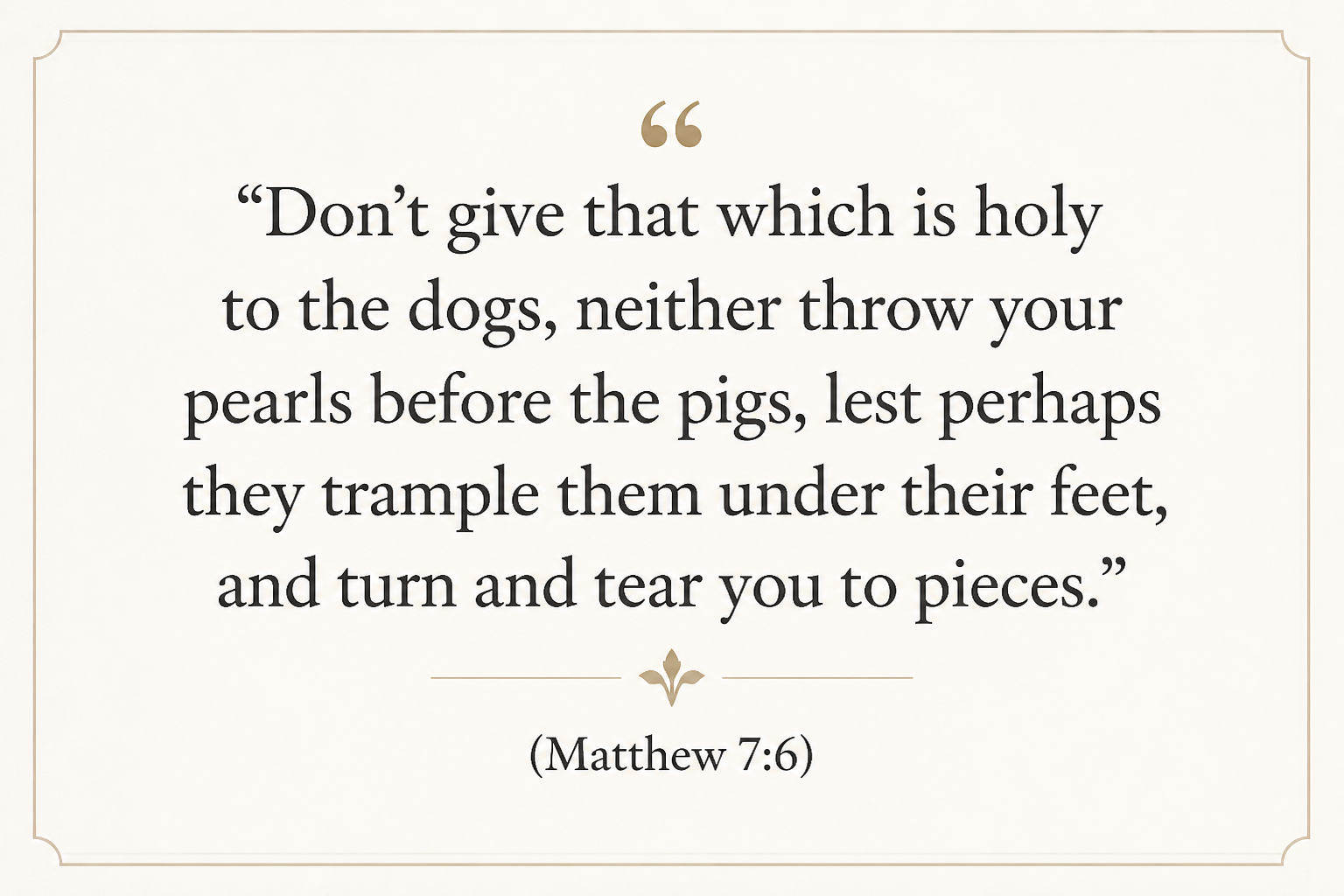
“Don’t give that which is holy to the dogs, neither throw your pearls before the pigs, lest perhaps they trample them under their feet, and turn and tear you to pieces.” (Matthew 7:6)
Here “pigs” are paired with “dogs” in a warning framed by vivid actions: trampling and then turning to attack. The pig functions as the animal in a scenario where something valuable (“your pearls”) is wasted and then becomes the occasion for danger; the image is physical and forceful—pearls on the ground, feet trampling, and an abrupt reversal from giving to being harmed.
Now there was a herd of many pigs feeding far away from them. (Matthew 8:30)
“Pigs” introduces a concrete detail in the setting: a large herd at a distance, engaged in feeding. The word anchors the scene in ordinary pastoral activity and prepares a specific destination that will matter for what follows.
The demons begged him, saying, “If you cast us out, permit us to go away into the herd of pigs.” (Matthew 8:31)
The “herd of pigs” becomes the requested host for the demons if they are expelled. The pig is not merely background livestock; it is the location sought “into” which the demons want to go, so the animal herd is treated as a collective body that can be entered.
He said to them, “Go!” They came out, and went into the herd of pigs: and behold, the whole herd of pigs rushed down the cliff into the sea, and died in the water. (Matthew 8:32)
“Pigs” now marks the dramatic outcome of the permission given: the demons “went into the herd,” and “the whole herd” reacts as a unit, rushing down a cliff into the sea and dying. The repeated wording keeps the pigs at the center of the chain of events—from entry into them, to their collective stampede, to their death—so the animal herd becomes the visible, material consequence within the narrative.
Now on the mountainside there was a great herd of pigs feeding. (Mark 5:11)
As in Matthew’s account, “pigs” situate the action with a specific feature of the landscape: a “great herd” on “the mountainside,” actively feeding. The detail of place (“mountainside”) and activity (feeding) makes the herd an observable element in the scene rather than a passing mention.
All the demons begged him, saying, “Send us into the pigs, that we may enter into them.” (Mark 5:12)
Here “pigs” is the direct object of the request: “Send us into the pigs.” The phrasing “enter into them” emphasizes the pigs as recipients of entry, reinforcing their role as the immediate target for the demons’ relocation.
At once Jesus gave them permission. The unclean spirits came out and entered into the pigs. The herd of about two thousand rushed down the steep bank into the sea, and they were drowned in the sea. (Mark 5:13)
“Pigs” again are the animals entered, and the narrative adds scale: “about two thousand.” The pigs are not isolated animals but a counted herd whose mass movement—rushing down a steep bank—ends in drowning. The word thus carries both the notion of individual animals being entered (“entered into the pigs”) and the collective force of the herd acting together.
Those who fed them fled, and told it in the city and in the country. The people came to see what it was that had happened. (Mark 5:14)
Although “pigs” is not repeated in this sentence, the referent of “them” is the herd just described as being fed. The feeders’ flight and their report show that the pigs are part of an economic and social setting: there are people responsible for feeding the animals, and the event surrounding the herd is significant enough to be announced widely.
Those who saw it declared to them what happened to him who was possessed by demons, and about the pigs. (Mark 5:16)
“Pigs” are one of two main points of testimony: witnesses report both what happened to the demon-possessed man and what happened “about the pigs.” The word therefore marks the herd’s fate as a notable component of the event—something that must be explained alongside the man’s deliverance.
Now there was there a herd of many pigs feeding on the mountain, and they begged him that he would allow them to enter into those. Then he allowed them. (Luke 8:32)
“Pigs” appear as “a herd of many,” located “on the mountain” and feeding. The demons’ request focuses on entry “into those,” with “those” pointing back to the pigs; the animals serve as the specifically identified group into which entry is sought and granted.
The demons came out of the man, and entered into the pigs, and the herd rushed down the steep bank into the lake, and were drowned. (Luke 8:33)
“Pigs” again are the animals entered, and the result is a herd rushing into water—here “the lake”—and drowning. The sequence is tightly connected: exit from the man, entry into pigs, and the herd’s lethal plunge. The pig herd is the immediate stage upon which the visible collapse of the episode occurs.
He went and joined himself to one of the citizens of that country, and he sent him into his fields to feed pigs. (Luke 15:15)
In this parable, “pigs” appear in a work assignment: the man is sent “into his fields to feed pigs.” The word identifies the livestock whose feeding defines his labor, placing him in a role tied to the care of these animals and highlighting the setting as fields belonging to “one of the citizens of that country.”

Sense and Usage
Across these passages, χοῖρος functions in two primary ways: (1) as literal livestock in narrative scenes where a herd is present, feeding, being entered by demons, and then rushing into water; and (2) as a vivid element in speech, where pigs provide a concrete picture in both warning and parable.
In the narrative accounts (Matthew 8:30–32; Mark 5:11–13, 16; Luke 8:32–33), pigs are consistently portrayed as a herd—“many,” “great,” even “about two thousand”—and their herd nature is essential to the portrayal. The word is bound to collective movement (“the whole herd of pigs rushed”; “the herd rushed”) and to a public aftermath: there are people who feed them, people who flee, and people who come to see and hear reports that include what happened “about the pigs.” The pig, in these texts, is thus not only an animal but an animal embedded in a managed setting (a herd with feeders) whose sudden destruction becomes a reportable event.
In Matthew 7:6, pigs serve an illustrative role: the image depends on what pigs do in the scenario—trampling what is thrown before them—and then, in the same breath, the picture turns violent (“turn and tear you to pieces”). The pig is not described in pastoral terms here; it is an animal in an analogy meant to sharpen the listener’s sense of risk and misplacement. In Luke 15:15, pigs mark a kind of work that frames the parable’s situation: the man is sent out to feed them in the fields of a local citizen, so pigs become a concrete indicator of the man’s circumstances and dependence.
Imagery
The word repeatedly summons strong physical scenes: pigs feeding on a mountainside, a herd rushing down a steep bank, and water closing over them; pearls lying on the ground before pigs; a worker in fields feeding pigs. Whether used in teaching or narrative, χοῖρος carries imagery that is tangible—animals, herds, terrain, and movement—so that the listener or reader can picture the stakes of the moment in material terms.
Sources: Lexical data from Strong’s Exhaustive Concordance and the Translators Brief Lexicon of Extended Strongs for Greek (STEPBible, CC BY). Occurrence data from the Translators Amalgamated Greek New Testament (STEPBible, CC BY). Scripture quotations from the World English Bible (public domain).