Exploring the Meaning of Choikos in Greek
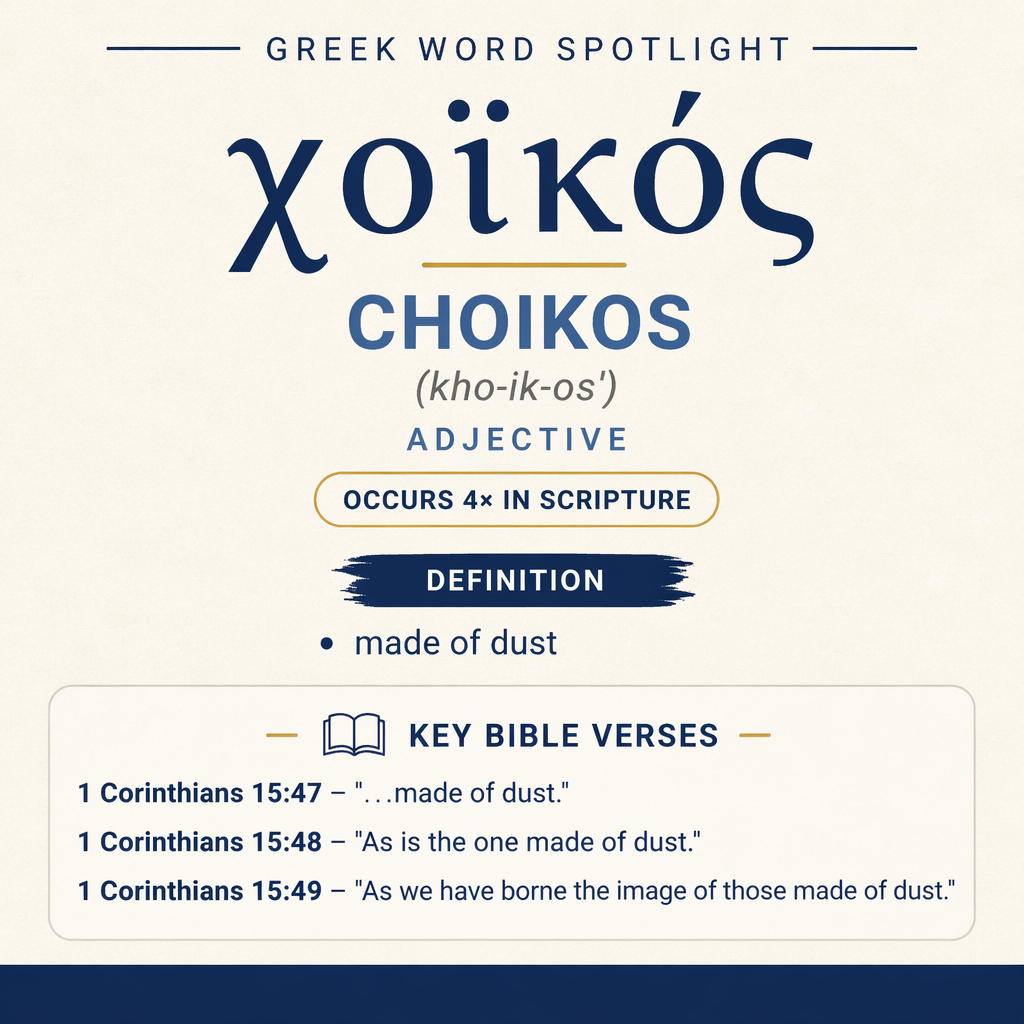
χοϊκός means “made of dust” and appears four times in Scripture, including in 1 Corinthians 15:47–49.
Scripture Occurrences
It occurs four times in Scripture. It is used in 1 Corinthians 15:47–49.
Learn More →Paul’s Contrast
In 1 Corinthians 15:47, the first man is “of the earth, made of dust,” contrasted with “the Lord from heaven.” In 1 Corinthians 15:48–49, it describes those “made of dust” and their image.
Learn More →χοϊκός describes what is “made of dust” and is used in Paul’s discussion of the first man and those who share his likeness, set over against “the heavenly.” It appears in a tightly linked sequence in 1 Corinthians 15:47–49, where it helps draw out a contrast between earthly origin and heavenly origin.
Root and Related Words
χοϊκός is related to choos (χόος), “dust” (Strong’s G5522). The connection anchors the adjective’s imagery in the concrete substance “dust,” which the passages then use to speak about what the first man is and what those aligned with him are like.

Occurrences
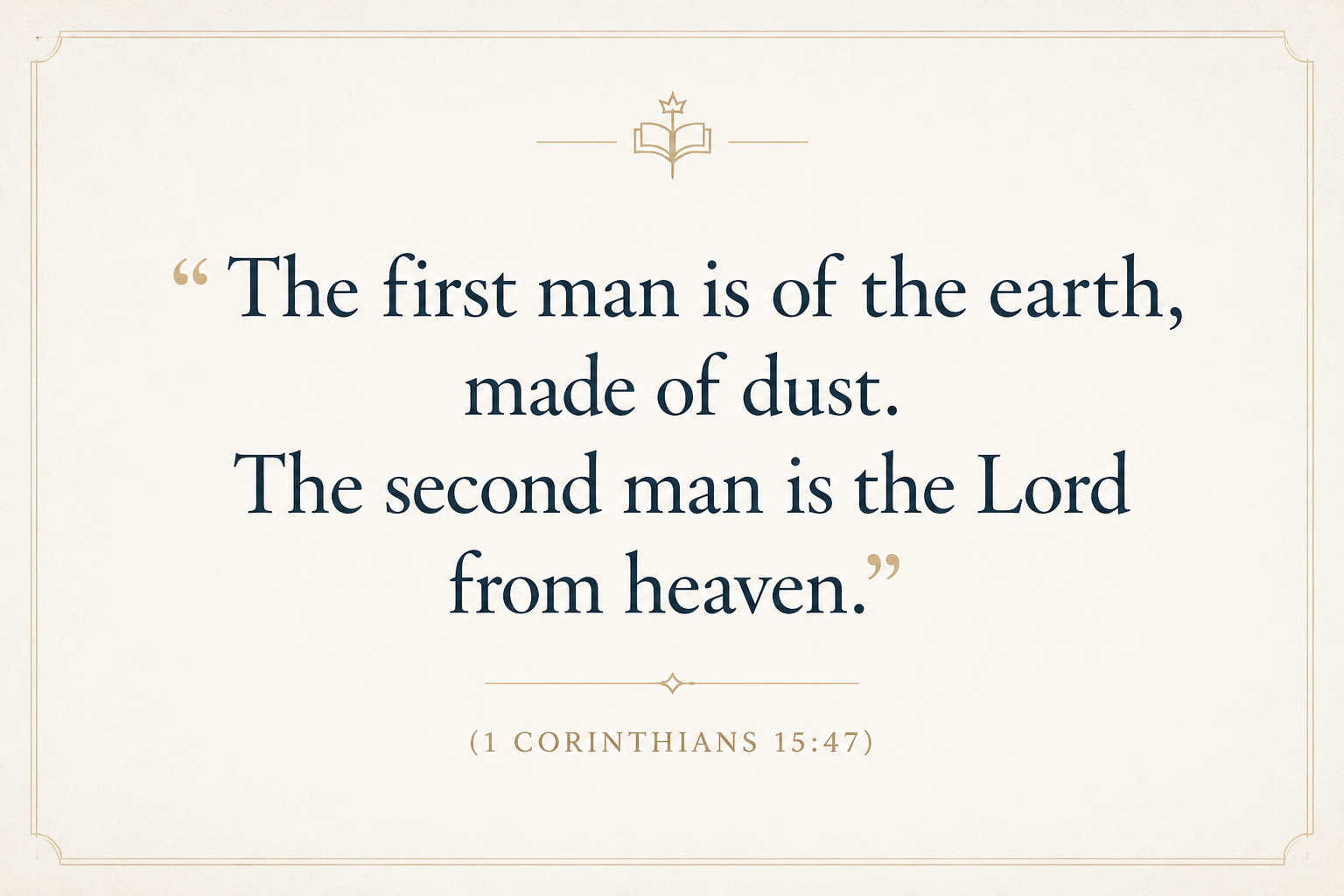
“The first man is of the earth, made of dust. The second man is the Lord from heaven.” (1 Corinthians 15:47)
Here χοϊκός marks the first man’s constitution and origin in a compact description: he is “of the earth, made of dust.” The clause ties “earth” to “dust” as a way of characterizing what kind of being the first man is in this comparison. Within the same verse, the contrast is sharpened by the next statement: “The second man is the Lord from heaven.” In that juxtaposition, “made of dust” functions as the earthbound counterpart to “from heaven,” making the adjective a key term in Paul’s twofold framework—one figure defined by earth and dust, the other by heaven.
“As is the one made of dust, such are those who are also made of dust; and as is the heavenly, such are they also that are heavenly.” (1 Corinthians 15:48)
In this line, χοϊκός is no longer restricted to “the one” but becomes a pattern that reaches outward: “As is the one made of dust, such are those who are also made of dust.” The adjective supplies the shared descriptor that links an original individual to a wider group who correspond to him. The parallel structure of the verse is crucial: the statement about those “made of dust” is matched by an analogous statement about “the heavenly” and those who are “heavenly.” Within this symmetrical comparison, “made of dust” works as a category label for a kind of humanity, describing what they are like by associating them with dust as their defining material reference point.
“As we have borne the image of those made of dust, let’s also bear the image of the heavenly.” (1 Corinthians 15:49)
In 1 Corinthians 15:49, χοϊκός enters the language of “image”: “As we have borne the image of those made of dust….” The adjective characterizes the source of the image that has already been borne—an image belonging to “those made of dust.” The phrase brings the earlier comparison into personal and communal experience (“we have borne”), implying that “made of dust” is not only a descriptive label for the first man but also an identity-image that has been carried. The second half of the verse presents the corresponding aspiration or imperative: “let’s also bear the image of the heavenly.” In that forward-looking pairing, “made of dust” frames what the “image” has been up to this point, setting it in deliberate contrast with the “image of the heavenly” that is to be borne.
Sense and Usage
Across these verses, χοϊκός consistently functions as an adjective of material characterization: it marks a subject as belonging to the realm defined by dust. The term is not used in isolation but placed within a repeated contrast between two kinds of description—earth/dust on the one side and heaven/heavenly on the other. Because the word attaches to “man,” “the one,” and “those,” it moves from a statement about a representative figure (“The first man”) to a statement about a class of people (“those who are also made of dust”), and then to a statement about lived identity (“we have borne the image”).
Within the logic of the sequence, “made of dust” has a narrowing effect: it specifies “of the earth” by naming the earth as dust, and it specifies likeness by giving the likeness a tangible reference. The repetition in 1 Corinthians 15:48—“made of dust… made of dust”—reinforces that the category is meant to be stable and recognizable, not a passing description. When 1 Corinthians 15:49 speaks of “the image of those made of dust,” the adjective’s force is carried into the notion of resemblance: the dust-marked condition is not merely a background detail but something that can be borne as an “image,” shaping how people are understood in relation to the first man.
The contrastive setting also guides how χοϊκός is heard: its meaning is concrete (“dust”), but it is used to construct a conceptual pairing where origin (“of the earth”) and destiny (“from heaven,” “heavenly”) are set side by side. In that framework, “made of dust” signals an earthly mode of existence precisely because it is opposed in the immediate context to what is “from heaven” and “heavenly.” The word’s contribution, therefore, is to give Paul’s comparison a grounded, physical image—dust—as the defining marker of the first side of the comparison.
Imagery
The imagery of χοϊκός in these passages is deliberately plain: dust evokes the earth in its most reduced, elemental form. In 1 Corinthians 15:47–49, that dust-imagery is used to describe the first man, to extend his likeness to others who share that description, and to speak of an “image” already borne. Set against the repeated mention of “heaven” and “the heavenly,” the dust imagery carries the weight of contrast: it portrays one side of humanity’s story in the language of earth and dust, while pointing to another side in the language of heaven.
Sources: Lexical data from Strong’s Exhaustive Concordance and the Translators Brief Lexicon of Extended Strongs for Greek (STEPBible, CC BY). Occurrence data from the Translators Amalgamated Greek New Testament (STEPBible, CC BY). Scripture quotations from the World English Bible (public domain).