
Exploring the Meaning of Charax in Greek
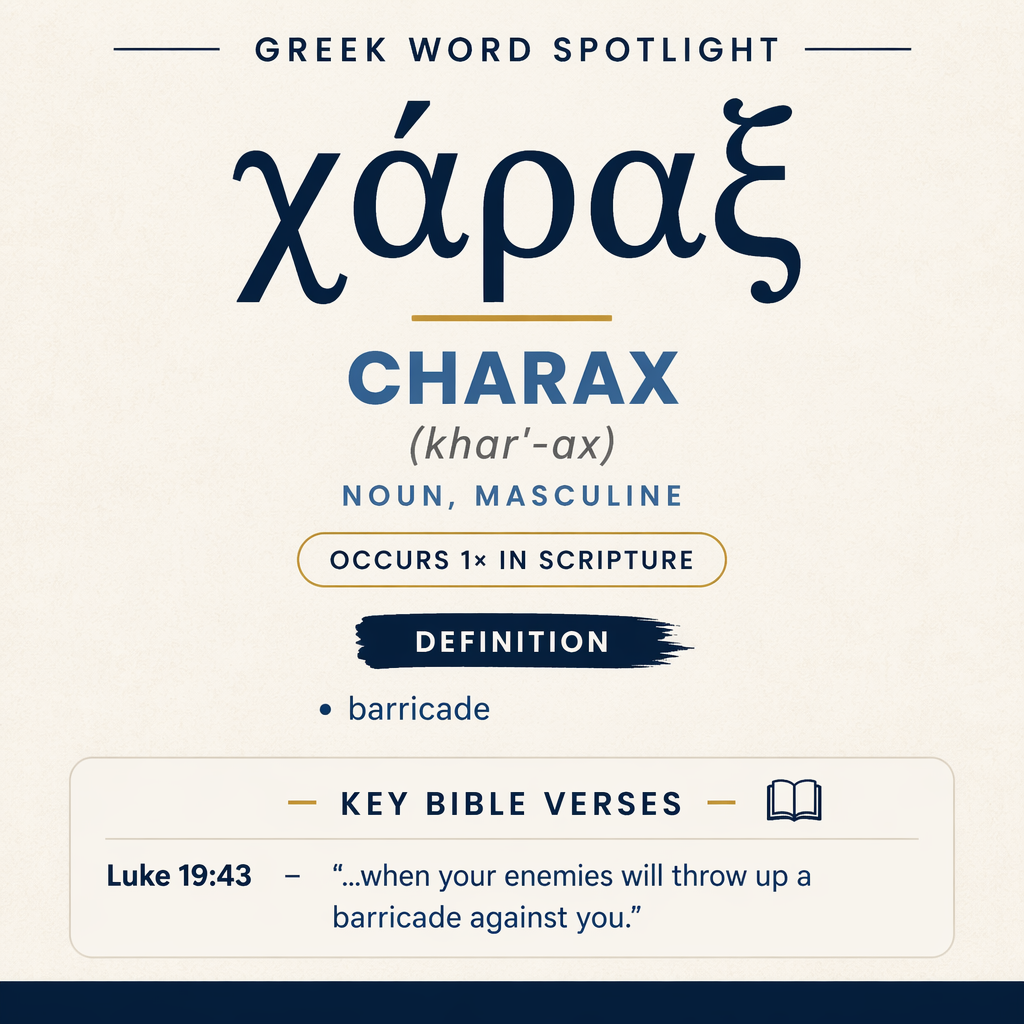
χάραξ (Charax) means “barricade” and appears once in Scripture, in Luke 19:43.
Scripture Occurrence
This word occurs 1 time in Scripture. Its single occurrence is in Luke 19:43.
Learn More →Luke 19:43 Context
In Luke 19:43, enemies “throw up a barricade,” then surround and hem in their target.
Learn More →χάραξ names a “barricade” in a scene of impending siege. It appears in Luke 19:43 within a warning about enemies closing in and tightening their hold from every side.
Occurrences
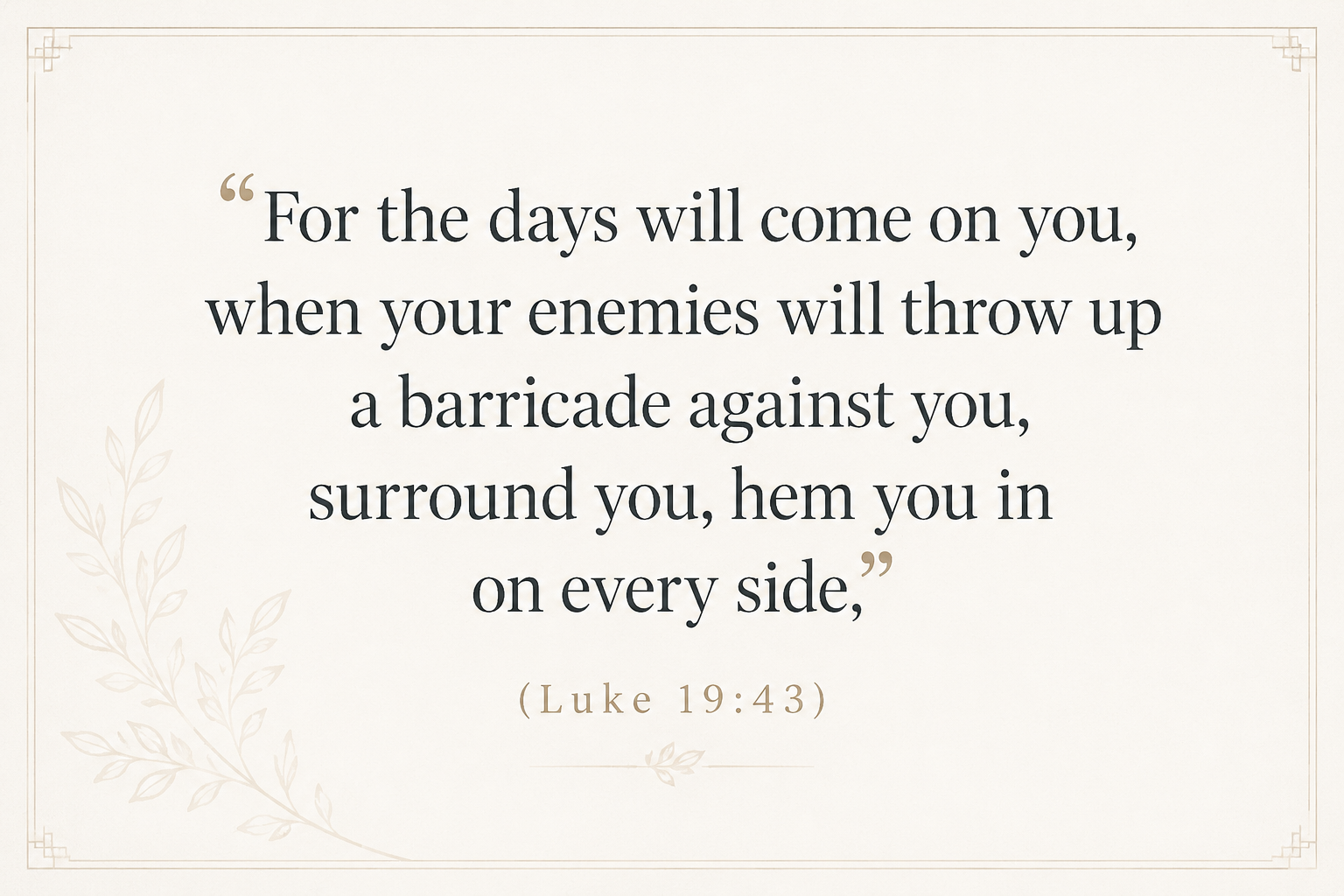
“For the days will come on you, when your enemies will throw up a barricade against you, surround you, hem you in on every side,” (Luke 19:43)
Here χάραξ is something the enemies actively construct: they “will throw up a barricade against you.” The verb phrase presents it as an engineered obstacle, not a naturally occurring feature. Within the same sentence the barricade works in concert with two further actions—“surround you” and “hem you in on every side”—so the word contributes the image of deliberate confinement. It is not merely that opponents arrive; they reshape the space around their target by building a structure “against you,” turning approach routes into blocked lines and open ground into controlled ground. In the logic of the warning, the barricade is part of a sequence that compresses freedom of movement: first a built barrier is raised, then a ring is formed, and finally pressure is applied from all directions.
The placement of χάραξ at the beginning of the chain of hostile actions gives it a kind of initiating force. A barricade marks the start of a new environment: an area that can be sealed, watched, and tightened. Thus, even before the verbs “surround” and “hem in” unfold the full picture, the word cues the reader to a scenario where control is established by physical construction, not by mere numbers or presence. The warning is future-oriented (“the days will come on you”), and the barricade belongs to that coming crisis as a concrete, visible sign that the threat has advanced from intention to implementation.

Sense and Usage
As used in Luke 19:43, χάραξ denotes a “barricade” as a built measure of constraint. The definition fits the immediate context precisely: it is something “thrown up” and set “against” the one addressed, and it functions alongside surrounding and hemming-in. This interplay shows that the barricade is not an end in itself but a means—an instrument that helps enemies impose restriction and pressure. The sentence does not isolate χάραξ as a detached object; it embeds it in a tactical sequence in which construction leads to encirclement and encirclement to compression. The word therefore carries an inherently relational force in this verse: it exists because there is an “against you,” a target that it is designed to oppose.
The language of direction also shapes the sense. A barricade can be thought of abstractly as “something in the way,” but here it is oriented: “against you.” That phrasing pulls the noun into the field of conflict and makes its function personal and adversarial. It is a structure whose purpose is to act upon its object—blocking, restricting, and enabling the surrounding forces to close their net. In this usage, the barricade is not described for its materials or form, but for what it accomplishes within the enemies’ strategy as the situation tightens.
Because the verse links χάραξ with being “surround[ed]” and “hem[med] in,” the barricade contributes to an image of space being taken away. The three actions together depict a progressive loss: avenues narrow, boundaries are enforced, and escape becomes harder. χάραξ is the tangible manifestation of that process: something raised up that changes access and movement. It is a boundary imposed from outside, and its construction signals that opposition has moved beyond confrontation to containment.
The verse’s future tense also gives χάραξ a prophetic weight within the warning: it points to a time when what is currently open will be cut off. The barricade, in that sense, is an emblem of a coming reversal—where those addressed will face enemies who can build, position, and press in. Yet the verse does not dwell on the barricade as a static fixture; the focus is on the act of throwing it up. The word therefore sits at the intersection of object and event: a barricade as a thing, but also as a step in an unfolding assault.
Imagery
Luke 19:43 frames χάραξ with verbs of enclosure, so the word carries an imagery of narrowing space and tightening control. The barricade stands as the visible line where opposition becomes unavoidable: once raised, it marks a change in the environment from ordinary movement to pressured confinement, with enemies positioned to “surround” and “hem…in on every side.”
Sources: Lexical data from Strong’s Exhaustive Concordance and the Translators Brief Lexicon of Extended Strongs for Greek (STEPBible, CC BY). Occurrence data from the Translators Amalgamated Greek New Testament (STEPBible, CC BY). Scripture quotations from the World English Bible (public domain).





