
Exploring the Meaning of Chalkolibanon in Greek
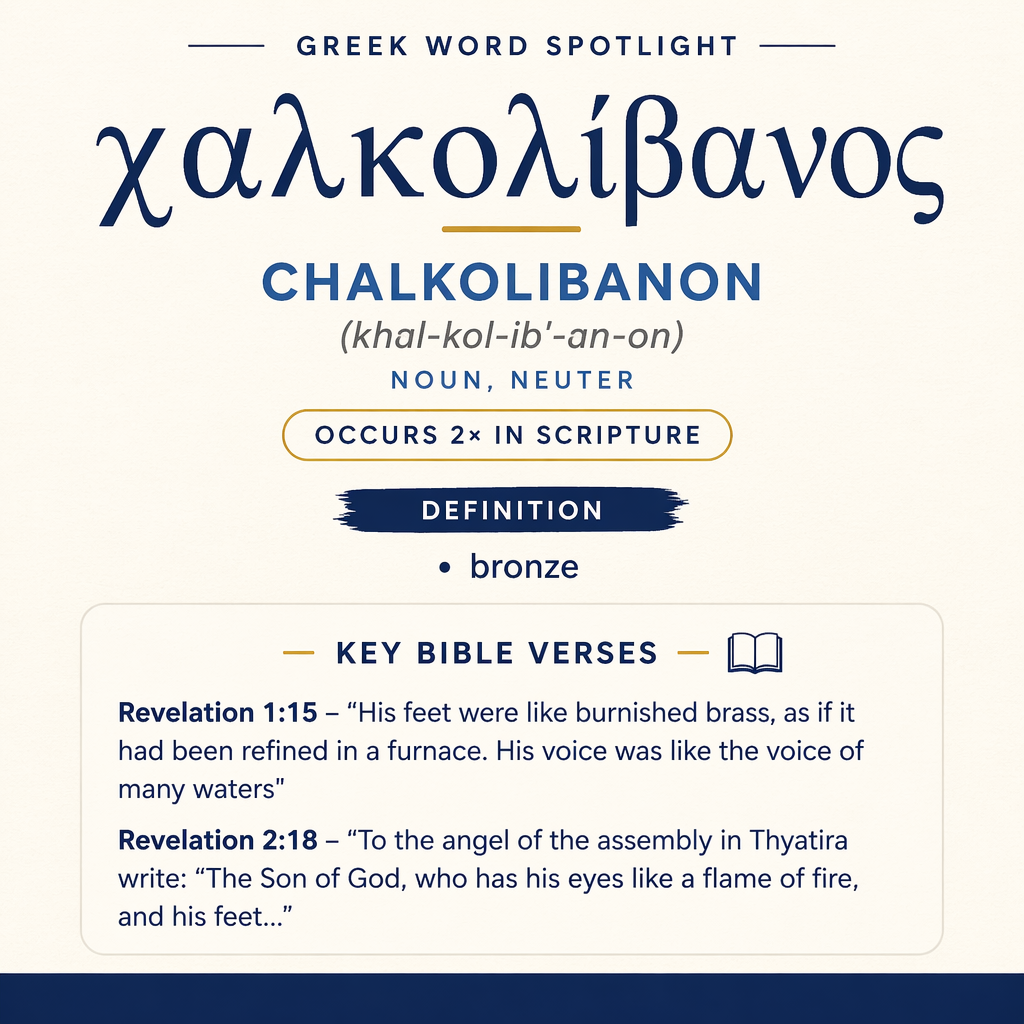
χαλκολίβανος means “bronze” and appears twice in Scripture, in Revelation 1:15 and Revelation 2:18.
Scripture Occurrences
It occurs two times in Scripture: Revelation 1:15 and Revelation 2:18.
Learn More →Revelation Context
In Revelation 1:15, it describes His feet as like burnished brass refined in a furnace. In Revelation 2:18, it appears in the description of the Son of God’s feet.
Learn More →χαλκολίβανος denotes “bronze” and is used in Revelation to describe the feet of the exalted Son of God. It appears only in two closely related visionary descriptions, each pairing the metal imagery with other sensory language of glory and power.
Root and Related Words
Chalkolibanon (χαλκολίβανος) is connected with chalkos (χαλκός), “copper/bronze/coin” (Strong’s G5475), and with libanos (λίβανος), “frankincense” (Strong’s G3030). The form of the word itself invites the reader to hear these associations together as part of its distinctive sound and texture.

Occurrences
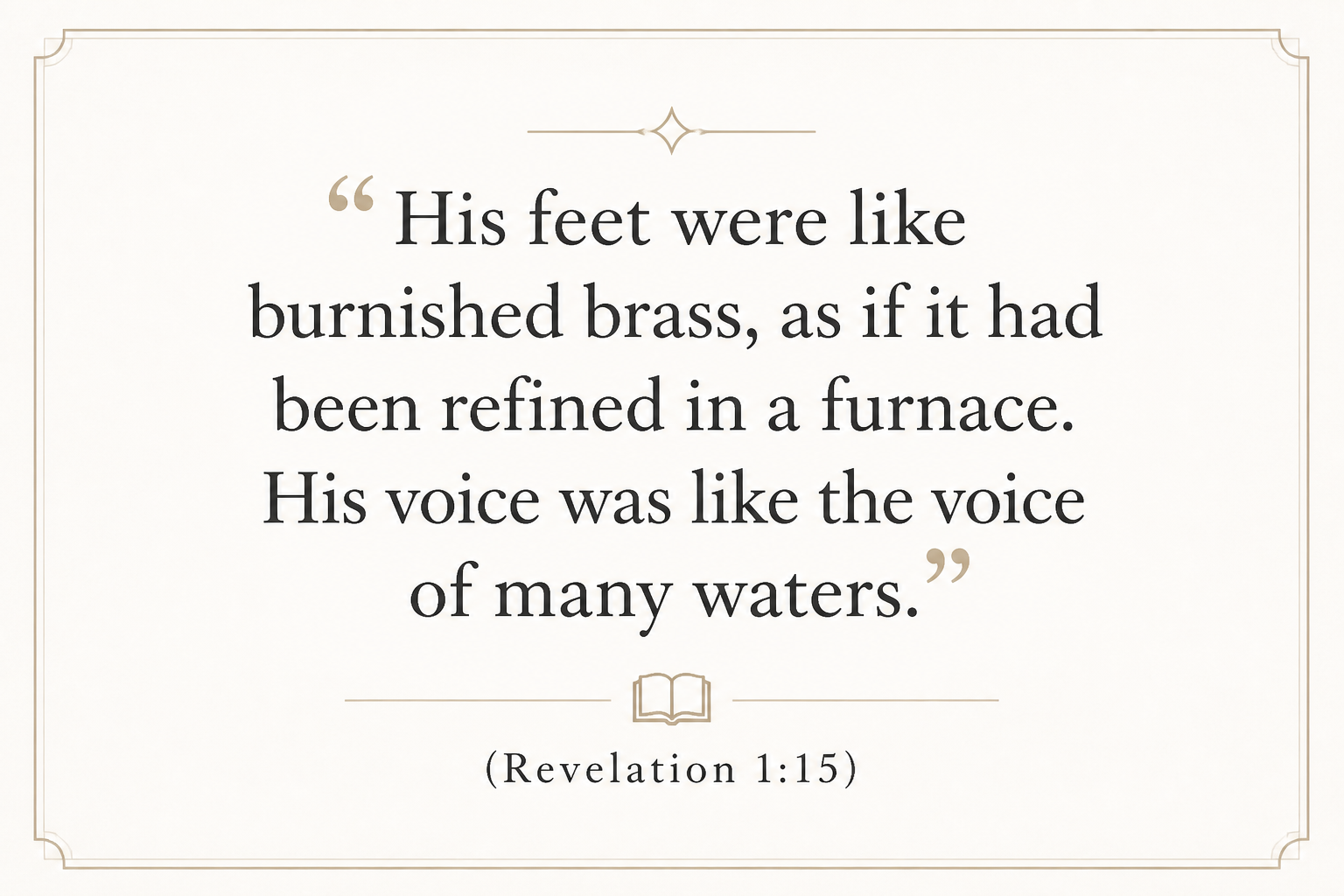
“His feet were like burnished brass, as if it had been refined in a furnace. His voice was like the voice of many waters.” (Revelation 1:15)
Here the word stands within a string of comparisons that present the figure in overwhelming sensory terms. The focus on “His feet” brings attention to the stability and weight of his presence: the image is not airy or distant, but grounded. Bronze, described as “burnished” and pictured “as if it had been refined in a furnace,” contributes a sense of intense brightness and hardness; the comparison presses the reader to imagine metal brought to a high purity and sheen through fire. The surrounding line about his voice—“like the voice of many waters”—reinforces the same effect: the scene is constructed to exceed ordinary categories of sight and sound. Within that structure, χαλκολίβανος supplies the concrete, material element: the vision is not only luminous and loud; it is solid, durable, and formidable from the ground up.
The furnace language also shapes how the bronze is perceived. The comparison does not merely point to a metal surface; it points to a metal surface associated with refining heat. That heat is not narrated as a past event but as a quality carried in the appearance itself (“as if it had been refined”). Thus, the word participates in the broader portrayal of a figure whose very features communicate strength and intensity without a spoken explanation.
“To the angel of the assembly in Thyatira write: “The Son of God, who has his eyes like a flame of fire, and his feet are like burnished brass, says these things:” (Revelation 2:18)
In this second occurrence the same image is set inside a formal address: a message is to be written, and the speaker is introduced with identifying descriptors before he speaks. The phrase “The Son of God” frames the description as authoritative; the imagery that follows functions like a visionary “signature.” Within that signature, the eyes are “like a flame of fire,” and the feet are “like burnished brass.” The bronze comparison therefore works alongside fire imagery, but in a distinct way: the fire is directly tied to the gaze (“eyes”), while the bronze is tied to the stance (“feet”). Together they communicate a presence that both sees with penetrating intensity and stands with unyielding firmness.
Because this introduction leads immediately into “says these things,” the bronze description does more than color the scene; it sets a tone for the words that will follow. Before any content is reported, the hearer is confronted with a speaker whose appearance signals majesty and resolve. The feet “like burnished brass” suggest a stable footing for judgment and pronouncement: the message comes from one who does not totter or hesitate. The metal is not an ornament; it is a descriptive vehicle for the seriousness of the coming speech.
Sense and Usage
Across both uses, χαλκολίβανος functions as a visionary material term applied to the same bodily feature—“feet”—and modified by the same descriptive idea—“burnished.” This repeated pairing anchors the word’s sense in a consistent picture: bronze as seen in an intensified state of brightness, as if brought to a refined finish by furnace heat. The word’s contribution is therefore not merely to specify a substance but to evoke a particular kind of bronze: lustrous, hardened, and visually striking, suitable for a depiction meant to overwhelm the ordinary imagination.
The immediate co-text in each verse also guides how the reader feels the image. In Revelation 1:15, the bronze feet appear in parallel with a voice compared to “many waters,” placing the metal image within a cascade of awe-inducing comparisons. In Revelation 2:18, the bronze feet stand beside eyes “like a flame of fire” in an introduction of the speaker, giving the metal image a rhetorical function: it establishes the weight of the one who “says these things.” In both settings, bronze is not presented as a neutral detail but as part of a crafted portrayal that communicates strength through sensory intensity.
The restriction of the word to these two places also makes its effect sharper: it is a specialized descriptor reserved for a specific portrayal. Readers encounter it as a marked choice—an uncommon term used to hold attention and to make the description memorable. The repeated imagery of burnished bronze feet becomes a stable element of the Revelation portrait, reinforcing that the speaker’s authority is not only asserted by title (“The Son of God”) but also conveyed through the kind of presence the vision depicts.
Imagery
The bronze imagery in these passages is inseparable from the broader sensory field of fire, furnace, and rushing waters. In Revelation 1:15, the furnace-refined brightness of the feet and the thunderous “many waters” voice combine to portray a figure whose appearance and sound convey irresistible force. In Revelation 2:18, the same burnished bronze feet accompany eyes “like a flame of fire,” so that the listener is prepared to receive speech that carries the gravity of the one speaking. In both verses, χαλκολίβανος supports the vision’s aim: to present an authoritative, steadfast figure whose very stance is depicted in enduring, radiant metal.
Sources: Lexical data from Strong’s Exhaustive Concordance and the Translators Brief Lexicon of Extended Strongs for Greek (STEPBible, CC BY). Occurrence data from the Translators Amalgamated Greek New Testament (STEPBible, CC BY). Scripture quotations from the World English Bible (public domain).





