
Exploring the Meaning of Chalkedon in Greek
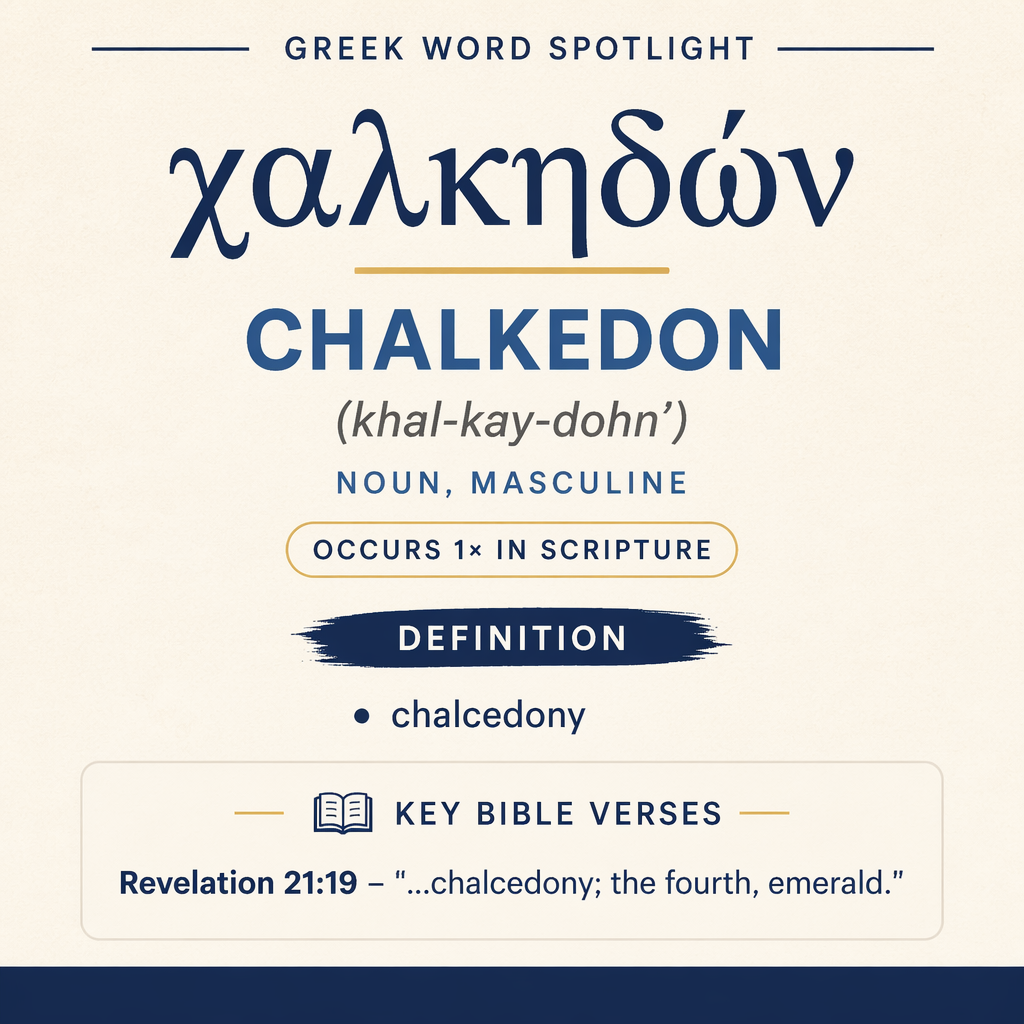
χαλκηδών means “chalcedony” and appears once in Scripture, in Revelation 21:19.
Biblical Usage
It occurs one time in Scripture. Its single occurrence is in Revelation 21:19.
Learn More →Revelation Context
In Revelation 21:19, it appears in a list of precious stones adorning the city’s foundations.
Learn More →Chalkedon means “chalcedony.” It appears in the description of the New Jerusalem’s foundations, where it is named among the precious stones adorning the city’s wall.
Root and Related Words
Chalkedon is associated with eidos (εἶδος), “appearance” (Strong’s G1491), and with chalkos (χαλκός), “copper/bronze/coin” (Strong’s G5475).

Occurrences
“The foundations of the city’s wall were adorned with all kinds of precious stones. The first foundation was jasper; the second, sapphire; the third, chalcedony; the fourth, emerald;” (Revelation 21:19)
Here chalkedon functions as one item in a carefully ordered catalog of foundation stones. The verse presents the city’s wall as having “foundations” that are not merely structural but also “adorned,” and the adornment is specified as “all kinds of precious stones.” Within that framing, chalkedon contributes a concrete, material detail: it names one particular precious stone used in the third foundation. Its placement in an enumerated sequence (“the first… the second… the third… the fourth…”) makes it part of a deliberate architecture of description, in which each foundation level is distinguished by its own stone.
The immediate literary effect of naming chalkedon is precision. The verse does not speak generally of beauty or value; it achieves its portrayal through a list in which each stone is individually identified. Chalkedon therefore serves the broader picture of an adorned wall by intensifying the specificity of the scene: the foundations are envisioned as visibly differentiated, each course marked by a distinct precious stone. In the flow of the sentence, “chalcedony” stands alongside “jasper,” “sapphire,” and “emerald,” strengthening the impression that the city’s construction is both lavish and carefully composed.
Sense and Usage
Because chalkedon occurs in a foundation list, its sense is anchored to the physical world of stones and building materials, even though the scene itself is visionary. The term identifies a particular precious stone as part of a city’s wall foundations, so its meaning is carried through imagery of permanence (foundations), craftsmanship (a wall built with multiple foundation layers), and ornament (adorned with precious stones). In this setting, the word does not stand alone as a general category; it is one member of “all kinds of precious stones,” contributing variety within a unified whole.
The single attestation shows chalkedon operating as a naming word: it labels the material of “the third” foundation. That labeling matters to the way the verse communicates. By tying each foundation course to a distinct stone, the description invites the reader to imagine an ordered, multi-layered structure where beauty is not accidental but built into the very base of the city’s wall. Chalkedon participates in that architectural vision by being one of the stones that make the foundations both foundational and ornamental at the same time.
Imagery
In Revelation 21:19, chalkedon contributes to an image of a city whose strength and splendor are fused: the wall’s foundations are described not only as the base of a defensive structure but as a display of precious stones. Naming chalcedony as “the third” foundation stone situates it in a layered panorama of color and value embedded in the city’s construction.
Sources: Lexical data from Strong’s Exhaustive Concordance and the Translators Brief Lexicon of Extended Strongs for Greek (STEPBible, CC BY). Occurrence data from the Translators Amalgamated Greek New Testament (STEPBible, CC BY). Scripture quotations from the World English Bible (public domain).




