
Exploring the Meaning of Phosphoros in Greek
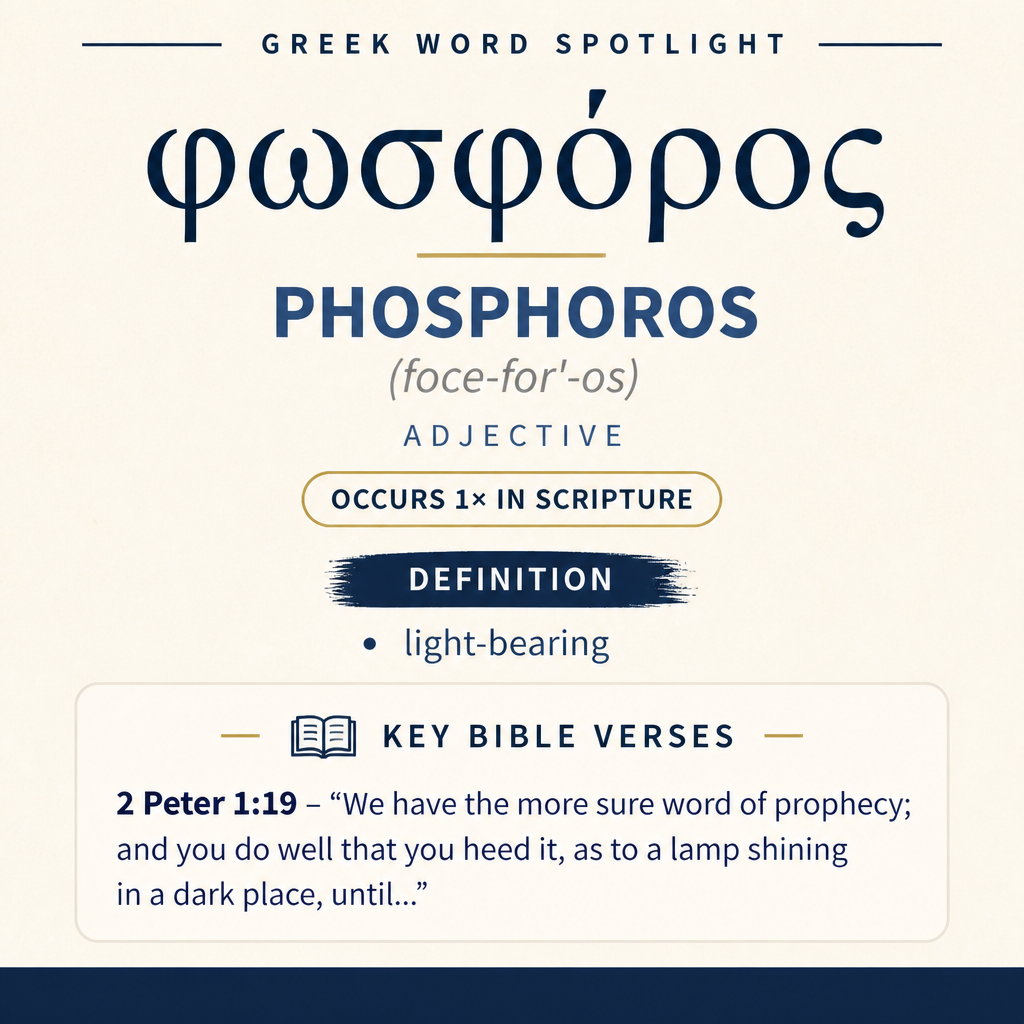
φωσφόρος means “light-bearing” and appears once in Scripture, in 2 Peter 1:19.
Verse Context
In 2 Peter 1:19, it appears in a sentence about heeding prophecy like a lamp shining in a dark place.
Learn More →φωσφόρος describes something as “light-bearing,” and it appears once in the New Testament, in 2 Peter 1:19. In that verse it belongs to a cluster of images about illumination and the coming of day within a setting of darkness.
Root and Related Words
φωσφόρος is connected with two Greek words that supply its components. The verb φέρω (phero), “to bear/lead” (Strong’s G5342), contributes the idea of bearing or carrying. The noun φῶς (phos), “light” (Strong’s G5457), supplies the element of light itself. Taken together, these related words frame φωσφόρος as a term that characterizes something by its relationship to light as something carried or brought.

Occurrences
“We have the more sure word of prophecy; and you do well that you heed it, as to a lamp shining in a dark place, until the day dawns, and the morning star arises in your hearts:” (2 Peter 1:19)
In 2 Peter 1:19, φωσφόρος is translated as “morning star” within an extended comparison about guidance and illumination. The sentence begins with “the more sure word of prophecy,” and the reader is commended for heeding it “as to a lamp shining in a dark place.” That first image establishes a present situation: darkness, with a lamp providing real but limited light. The verse then sets a boundary to that situation with “until the day dawns,” moving from lamplight to daylight—an image of a fuller, more pervasive illumination. Within that movement, φωσφόρος belongs to the climactic moment: “and the morning star arises in your hearts.” The word functions as the descriptive title of what “arises,” marking the turning point from night toward day in the inner realm (“in your hearts”), not merely in the external environment (“a dark place”).

Because the verse is shaped by successive light-images (“lamp,” “day dawns,” “morning star”), φωσφόρος helps intensify the progression. The lamp is something one “heeds” by; it is associated with attention and guidance in the present. The dawn and the rising of the morning star express arrival and transition—language that signals an end to the conditions in which only a lamp is needed. Within the comparison, φωσφόρος therefore carries the sense of a light that is not merely held up against darkness but appears as part of the coming day, and it is linked with an inward arising that corresponds to the reader’s reception of “the word of prophecy.”
Sense and Usage
The definition “light-bearing” fits the way φωσφόρος is placed at the far end of an illumination sequence. The verse does not introduce the term in isolation; it is embedded in a sentence where light is doing work: a lamp shines, day dawns, and something described as the “morning star” arises. In this setting, “light-bearing” is not presented as a mere quality like brightness in the abstract, but as an attribute tied to movement and arrival—something that comes on the scene and brings light with it. The reader is urged to “heed” prophecy in the same practical way one relies on a lamp, but the verse then points beyond that provisional condition to a time marked by dawning and rising. φωσφόρος belongs to that latter horizon, where the image is no longer a hand-held source of light in darkness but an appearing light associated with the approach of day.
The immediate grammar of the line also guides how “light-bearing” is heard. φωσφόρος is connected with the verb “arises,” and the location of that arising is “in your hearts.” This locates the word’s force in an inward transformation of perspective or awareness, expressed through the imagery of light coming. The word “until” indicates a temporal movement: the heedful attention to prophecy corresponds to the lamp-in-darkness phase; the dawning day and the rising “morning star” correspond to the completion or fulfillment of that phase. In that movement, φωσφόρος contributes a vivid portrayal of light not simply present, but borne into the heart as something that rises there.
Within the single attested usage, φωσφόρος also helps bind together the verse’s two arenas: the external (“a dark place”) and the internal (“your hearts”). A lamp shines in an external darkness; the “morning star” rises inwardly. The definition “light-bearing” thus plays out as a bridge between guidance offered from outside (a lamp one can follow) and illumination that becomes internal (light that arises within). The verse’s imagery treats light as something that can be attended to, awaited, and experienced as it comes—so φωσφόρος, in its lone occurrence, serves the portrayal of light arriving with the dawning of day in the heart’s domain.
Imagery
The word’s lone context uses ordinary, concrete phenomena—lamp, darkness, dawn, rising—to describe how prophecy is to be treated and what is anticipated. φωσφόρος sits at the point where the imagery becomes most expansive: the scene moves from a small circle of lamplight in “a dark place” to the larger transition of “the day” and to a rising light within “your hearts.” The combined images portray a movement from reliance on a lamp toward the arrival of a light-bearing dawn, expressed in a way that is both temporal (“until”) and inward (“in your hearts”).
Sources: Lexical data from Strong’s Exhaustive Concordance and the Translators Brief Lexicon of Extended Strongs for Greek (STEPBible, CC BY). Occurrence data from the Translators Amalgamated Greek New Testament (STEPBible, CC BY). Scripture quotations from the World English Bible (public domain).





