Exploring the Meaning of Phos in Greek
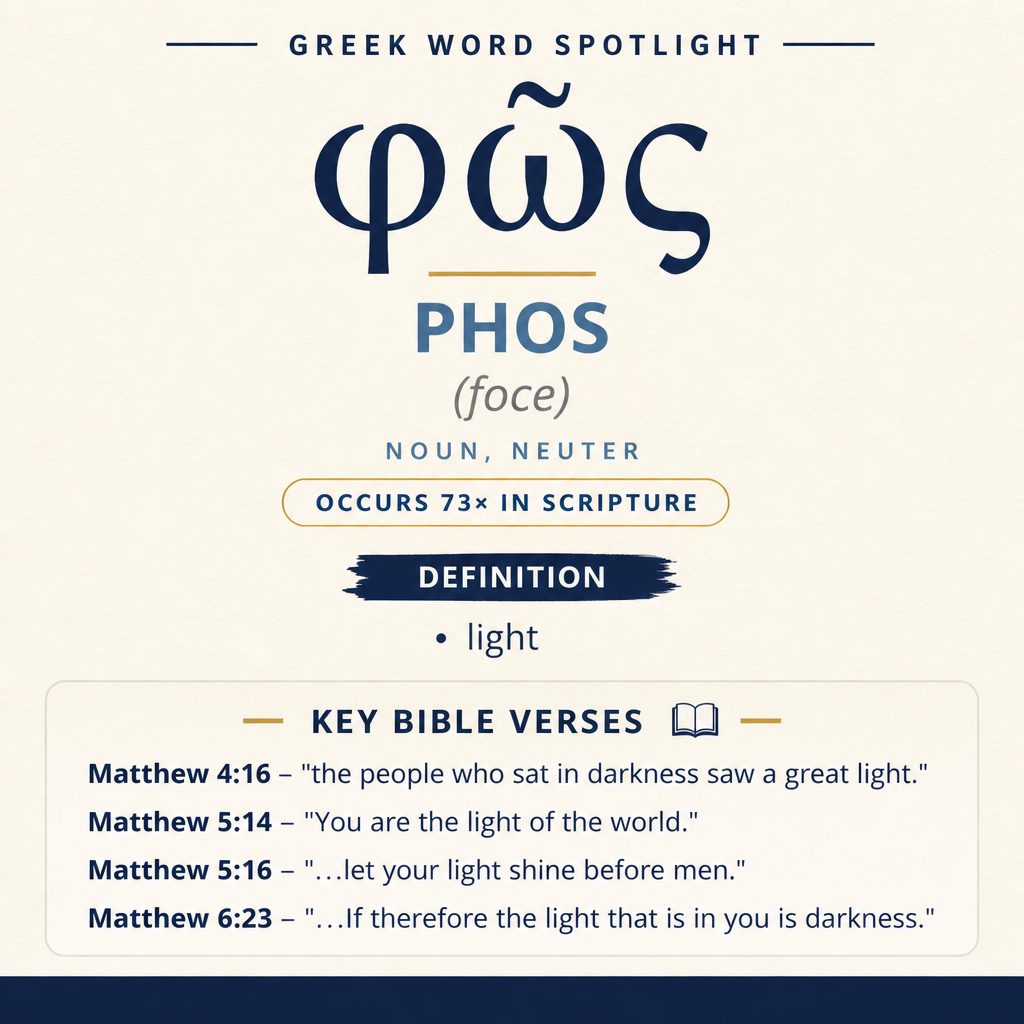
φῶς (Phos) means “light” in Greek and occurs 73 times in Scripture, including Matthew 4:16; 5:14–16; 6:23; 10:27; 17:2; Luke 2:32.
Scripture References
It occurs 73 times in Scripture. Listed examples include Matthew 4:16; 5:14–16; 6:23; 10:27; 17:2; Mark 14:54; and Luke 2:32.
Learn More →Usage in Context
In Matthew 5:14–16, Jesus calls his followers “the light of the world” and urges their light to shine before men. In Luke 2:32, it is “a light for revelation to the nations.”
Learn More →φῶς means “light,” a concrete image that the Gospels use for seeing, disclosure, guidance, and visible radiance. In the passages below it ranges from literal illumination (a fire, a lamp) to light as a public, observable reality contrasted with darkness.
Occurrences
Matthew 4:16 — “the people who sat in darkness saw a great light, to those who sat in the region and shadow of death, to them light has dawned.”
Here φῶς stands over against “darkness” and the “shadow of death.” The language of “saw” and “has dawned” frames light as an arrival that changes what a sitting people can perceive: where there was a shadowed region, there is now a “great light” that breaks in like daybreak.
Matthew 5:14 — “You are the light of the world. A city located on a hill can’t be hidden.”
In this saying, φῶς is applied to “You” and set in the widest possible public space, “the world.” The accompanying image of an unhideable hilltop city clarifies what “light” does in this scene: it is inherently visible and located so as to be noticed rather than concealed.
Matthew 5:16 — “Even so, let your light shine before men; that they may see your good works, and glorify your Father who is in heaven.”
φῶς is something that can “shine before men,” producing a chain of effects in the verse: others “see your good works” and respond by glorifying “your Father who is in heaven.” Light functions as the outward, observable aspect of a life that is meant to be seen, not as spectacle, but as a visibility that directs attention beyond the person to God.
Matthew 6:23 — “But if your eye is evil, your whole body will be full of darkness. If therefore the light that is in you is darkness, how great is the darkness!”
This occurrence brings φῶς into the inner life: “the light that is in you.” The eye is treated as the gateway that affects the body’s condition, and light/darkness become the vocabulary for that condition. The startling phrase “light … is darkness” uses the image of light to expose the severity of inner confusion: what should illuminate instead becomes part of the darkness filling the person.
Matthew 10:27 — “What I tell you in the darkness, speak in the light; and what you hear whispered in the ear, proclaim on the housetops.”
φῶς is the setting for open speech. Darkness corresponds to private instruction (“tell you in the darkness,” “whispered in the ear”), while light corresponds to public declaration (“speak in the light,” “proclaim on the housetops”). Light here is not described as a substance but as the environment where things are exposed and can be heard and tested in public.
Matthew 17:2 — “He was changed before them. His face shone like the sun, and his garments became as white as the light.”
In this scene, φῶς provides the comparison for the brightness of garments: “as white as the light.” Alongside “His face shone like the sun,” light is presented as a benchmark for visible brilliance. The word supports the description of an overwhelming radiance that is seen “before them,” anchoring the moment in sensory perception.
Mark 14:54 — “Peter had followed him from a distance, until he came into the court of the high priest. He was sitting with the officers, and warming himself in the light of the fire.”
Here φῶς is literal illumination: “the light of the fire.” The verse places Peter in a defined space (“the court of the high priest”), in company (“with the officers”), engaged in a physical action (“warming himself”). Light belongs to the fire’s glow, the small, localized brightness that makes nighttime activity possible and renders Peter’s presence observable in that courtyard.
Luke 2:32 — “a light for revelation to the nations, and the glory of your people Israel.”
φῶς is framed as “for revelation,” linking light with disclosure and recognition. Its reach is expansive (“to the nations”) and paired with “glory” in relation to “your people Israel.” In this line, light is not merely what is seen but what makes revelation possible—an illumination that allows what was hidden or unclear to be made known.
Luke 8:16 — ““No one, when he has lit a lamp, covers it with a container, or puts it under a bed; but puts it on a stand, that those who enter in may see the light.”
φῶς is what a lamp produces and what entrants are meant to “see.” The actions in the verse—lighting, covering, hiding under a bed, placing on a stand—treat light as purposive: it is meant to be set up in a way that benefits others in the room, especially “those who enter in.” Light here is the shared visibility that a household lamp provides when it is not obstructed.
Luke 11:33 — ““No one, when he has lit a lamp, puts it in a cellar or under a basket, but on a stand, that those who come in may see the light.”
This repeats the lamp imagery with different hiding places (“in a cellar or under a basket”), again defining φῶς by its intended public usefulness. The point is not simply that light exists, but that its placement either enables or prevents its function: set “on a stand,” it becomes accessible to “those who come in,” who then “may see the light.”
Luke 11:35 — “Therefore see whether the light that is in you isn’t darkness.”
φῶς returns to the inward dimension: “the light that is in you.” The imperative “see whether” treats inner light as something requiring examination. As in Matthew 6:23, the contrast with “darkness” presses the image into moral and perceptual territory: a person may assume inner illumination while actually being in a state best described as darkness.
Luke 12:3 — “Therefore whatever you have said in the darkness will be heard in the light. What you have spoken in the ear in the inner rooms will be proclaimed on the housetops.”
φῶς again marks the sphere of disclosure: what is said “in the darkness” will be “heard in the light.” Private speech (“in the ear,” “in the inner rooms”) is set on a trajectory toward public proclamation (“on the housetops”). Light functions as the condition under which hidden words become audible and exposed.

Sense and Usage
Across these passages, φῶς consistently operates as the opposite of “darkness,” and that contrast shapes its force. In Matthew 4:16, the movement is from sitting in darkness to seeing light that “has dawned,” so light conveys a decisive change of condition. In the lamp sayings (Luke 8:16; Luke 11:33), light is defined by its visibility and its ability to be blocked: a container, bed, cellar, or basket can render it ineffective. The repeated logic assumes that light is meant to be placed where it can do what light does—enable sight for others who enter.
Other occurrences extend the image from the room to the public square. In Matthew 10:27 and Luke 12:3, “in the light” is the arena where speech becomes open, heard, and proclaimed. Light here is not merely illumination for the eyes; it is the condition of openness where things cannot remain merely whispered. The same contrast undergirds the ethical warnings about interior perception (Matthew 6:23; Luke 11:35): light can be spoken of as “in you,” and yet the person must evaluate whether that supposed light has been compromised into “darkness.” The imagery makes inner life describable in terms of illumination: clarity versus obscurity, truthfulness versus self-deception, openness versus concealment—without leaving the basic picture of light and dark.
Finally, φῶς can denote striking radiance. Matthew 17:2 uses light as a standard for whiteness: garments become “as white as the light,” paired with a face shining “like the sun.” Light there is experienced as visible brilliance rather than the gentle usefulness of a lamp. Mark 14:54 keeps to the simplest physical sense—“the light of the fire”—showing how ordinary illumination frames a tense, watchful scene in a courtyard, where warmth and visibility come from the same flame.
Imagery
The passages repeatedly picture light as something that cannot honestly remain hidden: a hilltop city “can’t be hidden” (Matthew 5:14), a lamp is not meant to be covered (Luke 8:16; Luke 11:33), and whispered words do not stay in “inner rooms” but move toward hearing “in the light” and proclamation “on the housetops” (Luke 12:3). Whether as dawn breaking over a shadowed region (Matthew 4:16), a lamp set on a stand (Luke 8:16), or garments made dazzlingly white (Matthew 17:2), φῶς carries an insistence on visibility—light makes things seen, and in these scenes it also makes life and speech answerable in the open.
Sources: Lexical data from Strong’s Exhaustive Concordance and the Translators Brief Lexicon of Extended Strongs for Greek (STEPBible, CC BY). Occurrence data from the Translators Amalgamated Greek New Testament (STEPBible, CC BY). Scripture quotations from the World English Bible (public domain).