
Exploring the Meaning of Phobos in Greek
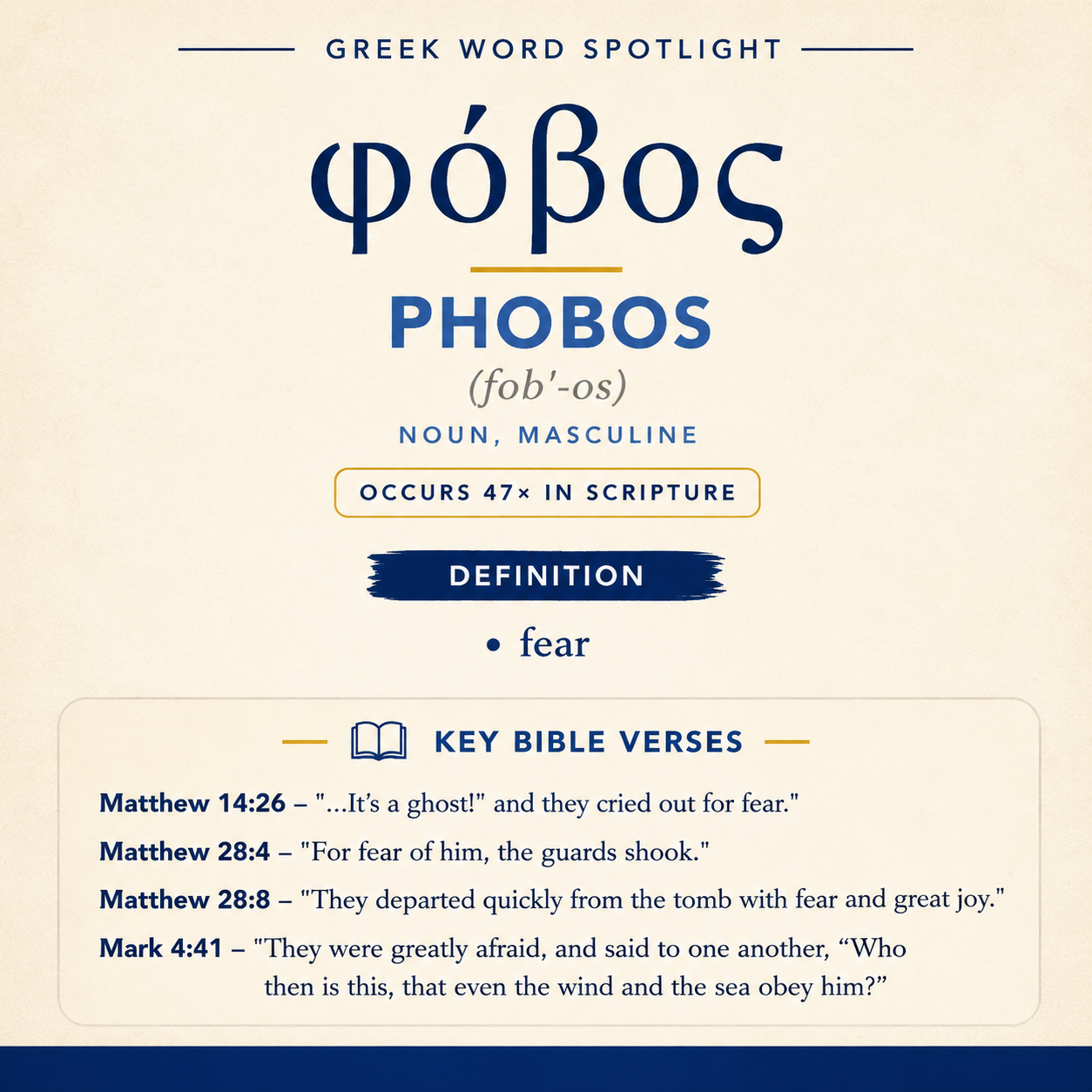
φόβος (Phobos) means “fear” in Greek and occurs 47 times in Scripture, including Matthew, Mark, and Luke.
Meaning
φόβος is defined as “fear.” It appears in Scripture in situations of alarm, trembling, and awe.
Learn More →Gospel Scenes
In Matthew 14:26 the disciples cry out “for fear” when they think they see a ghost. In Mark 4:41 they are “greatly afraid” after the wind and sea obey Jesus.
Learn More →Responses to Events
In Luke 1:12 fear falls on Zacharias when he sees an angel, and in Luke 2:9 the shepherds are terrified as the Lord’s glory shines around them.
Learn More →φόβος (Phobos) means “fear.” In the passages quoted below, it names the immediate human response to perceived danger, overpowering events, or social pressure, ranging from startled alarm to an awed reaction that accompanies worship and public talk.
Occurrences
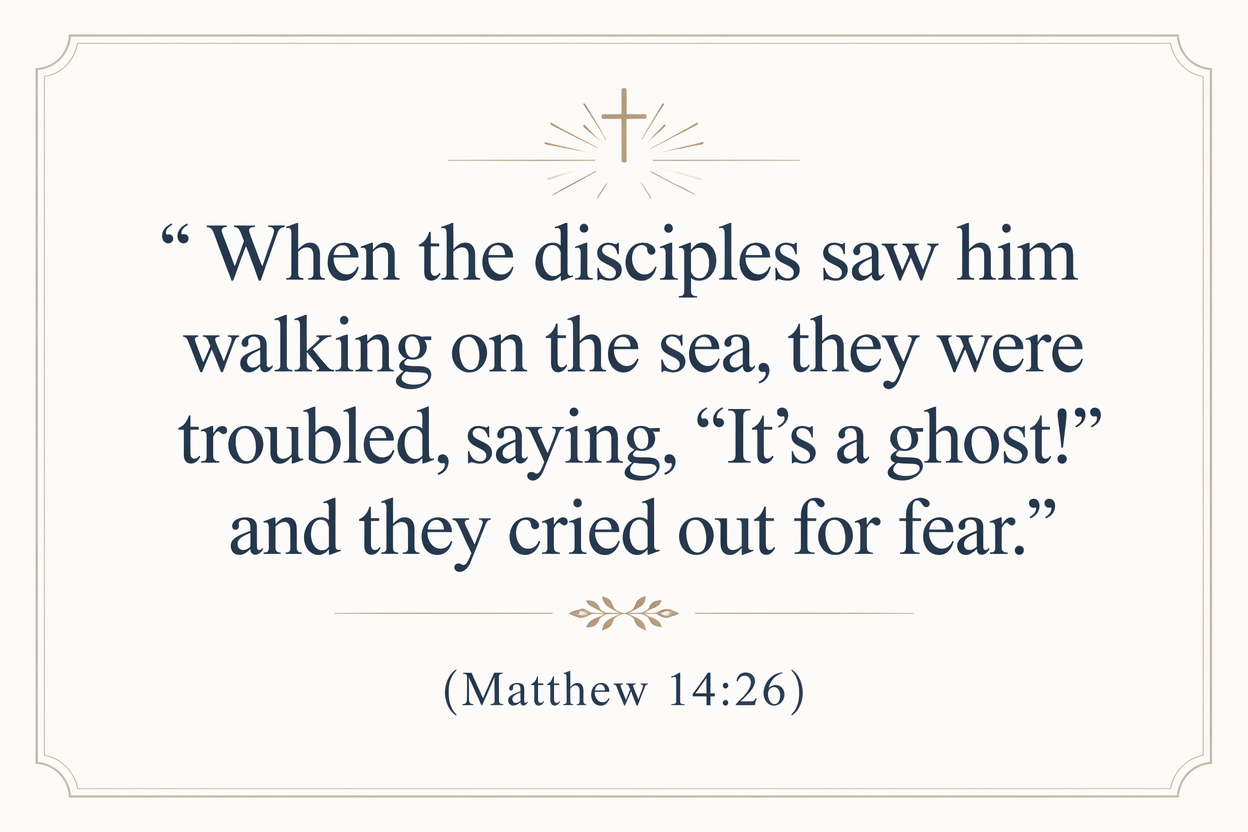
“When the disciples saw him walking on the sea, they were troubled, saying, “It’s a ghost!” and they cried out for fear.” (Matthew 14:26)
Here φόβος is the reason for a sudden cry. The setting is unstable and startling—someone is seen “walking on the sea,” and the disciples interpret the sight as a “ghost.” Fear supplies the emotional force behind their outcry, presenting their reaction as immediate and uncontrolled, driven by what they think they are seeing.
“For fear of him, the guards shook, and became like dead men.” (Matthew 28:4)
Fear is portrayed as so intense it produces bodily collapse. The guards “shook” and “became like dead men,” and φόβος explains this paralysis as a direct response “of him,” locating fear’s cause in the presence of the one who confronts them in the scene.
“They departed quickly from the tomb with fear and great joy, and ran to bring his disciples word.” (Matthew 28:8)
φόβος appears alongside “great joy,” showing fear coexisting with an urgent, purposeful response. The women leave “quickly,” and their running to report what has happened is energized by a mixed emotional state: fear does not prevent action but accompanies rapid obedience to the task of carrying “word.”
“They were greatly afraid, and said to one another, “Who then is this, that even the wind and the sea obey him?”” (Mark 4:41)
Fear follows an event that overturns normal expectations: “even the wind and the sea obey him.” φόβος here is intensified (“greatly afraid”) and becomes the emotional doorway into a question of identity—“Who then is this…?” Fear marks the disciples’ recognition that they are in the presence of an authority they cannot easily categorize.
“Zacharias was troubled when he saw him, and fear fell upon him.” (Luke 1:12)
φόβος is described as something that “fell upon” Zacharias, as though fear arrives and settles over him. The verse links two reactions—being “troubled” at what he sees and then being overtaken by fear—so that fear is not merely a thought but an encompassing response to the sight before him.
“Fear came on all who lived around them, and all these sayings were talked about throughout all the hill country of Judea.” (Luke 1:65)
Fear spreads through a community: it “came on all who lived around them.” φόβος is not confined to one individual’s private experience but becomes a shared atmosphere. The result is sustained public conversation—“all these sayings were talked about”—so fear here is tied to communal memory and widespread reporting.
“Behold, an angel of the Lord stood by them, and the glory of the Lord shone around them, and they were terrified.” (Luke 2:9)
In this scene, fear arises from a sudden heavenly appearance and overwhelming brightness: an angel “stood by them,” and “the glory of the Lord shone around them.” φόβος captures the shepherds’ instinctive reaction to an extraordinary intrusion into ordinary nighttime surroundings, presenting terror as a fitting first response to unexpected glory.
“Amazement took hold on all, and they glorified God. They were filled with fear, saying, “We have seen strange things today.”” (Luke 5:26)
Fear here is paired with amazement and with worship: the crowd “glorified God” even as they were “filled with fear.” φόβος becomes the emotional register for encountering “strange things,” functioning as a response to an event that feels beyond normal explanation and that prompts both reverence (“glorified God”) and trembling unease.
“Fear took hold of all, and they glorified God, saying, “A great prophet has arisen among us!” and, “God has visited his people!”” (Luke 7:16)
Again fear “took hold of all,” a phrase that portrays fear as gripping an entire group. Yet the reaction is not silence or flight; it becomes doxological speech. φόβος accompanies acclaim—“A great prophet has arisen among us!”—and the conviction that “God has visited his people,” so fear is intertwined with public recognition of divine activity.
“All the people of the surrounding country of the Gadarenes asked him to depart from them, for they were very much afraid. Then he entered into the boat and returned.” (Luke 8:37)
Here φόβος directly motivates a request for distance: they ask him “to depart from them.” Fear is described as severe (“very much afraid”) and produces avoidance rather than worship or inquiry. The narrative outcome—he “entered into the boat and returned”—shows fear shaping community decisions and leading to separation.
“men fainting for fear, and for expectation of the things which are coming on the world: for the powers of the heavens will be shaken.” (Luke 21:26)
Fear is linked with physical collapse (“men fainting”) and with anticipation of coming upheaval. φόβος is paired with “expectation” as people face “the things which are coming on the world,” and it is grounded in cosmic disturbance: “the powers of the heavens will be shaken.” Fear here is eschatological in setting—directed toward an approaching, world-shaking horizon.
“Yet no one spoke openly of him for fear of the Jews.” (John 7:13)
φόβος functions as social restraint. The verse does not depict trembling at a miraculous sight but guarded silence: “no one spoke openly of him.” Fear defines the boundaries of public speech and creates an atmosphere where discretion is safer than open confession, because the feared party (“the Jews”) is perceived as carrying consequences for candid talk.

Sense and Usage
Across these scenes, fear is consistently portrayed as a force that acts on people rather than a mere internal feeling they calmly manage. It “fell upon” one person (Luke 1:12), “came on” a whole neighborhood (Luke 1:65), “took hold” of crowds (Luke 7:16), and leaves some “filled” with it (Luke 5:26). Such phrasing frames fear as something that arrives, spreads, and grips.
The triggers of fear in these passages vary, and that variety shows how φόβος covers multiple fear-provoking situations while remaining the same basic response. Some fear comes from misperception and immediate danger—seeing a figure on the sea and concluding “It’s a ghost!” (Matthew 14:26). Some is fear before overwhelming manifestations that render people powerless, as guards shake and collapse (Matthew 28:4) or as shepherds are terrified by angelic presence and surrounding glory (Luke 2:9). Some fear is aroused by events that inspire interpretation and theological speech, where crowds glorify God and speak of prophetic greatness and divine visitation (Luke 5:26; Luke 7:16). Other fear drives avoidance and withdrawal, where a population asks for departure (Luke 8:37) or where people choose silence rather than open discussion (John 7:13). Still other fear is connected with looming, large-scale upheaval, where anticipation of what is “coming on the world” causes fainting (Luke 21:26).
Fear also interacts with other responses without being erased by them. It can coexist with joy and urgency (Matthew 28:8), with amazement and worship (Luke 5:26), and with questioning that seeks to understand authority (Mark 4:41). In such contexts, φόβος does not simply depict panic; it names the emotional weight of confronting something that seems beyond ordinary control—whether that confrontation leads to praise, flight, silence, or inquiry.
Imagery
The recurring imagery tied to fear is bodily and communal: people cry out (Matthew 14:26), shake and collapse (Matthew 28:4), hurry and run (Matthew 28:8), faint (Luke 21:26), and clamp down on speech (John 7:13). Fear moves through groups (“all who lived around them,” “all,” “all the people of the surrounding country”) and shapes what a community says—or refuses to say. In these quotations, φόβος is the felt pressure that accompanies encounters with what is startling, authoritative, or consequential.
Sources: Lexical data from Strong’s Exhaustive Concordance and the Translators Brief Lexicon of Extended Strongs for Greek (STEPBible, CC BY). Occurrence data from the Translators Amalgamated Greek New Testament (STEPBible, CC BY). Scripture quotations from the World English Bible (public domain).





