Exploring the Meaning of Phanerosis in Greek
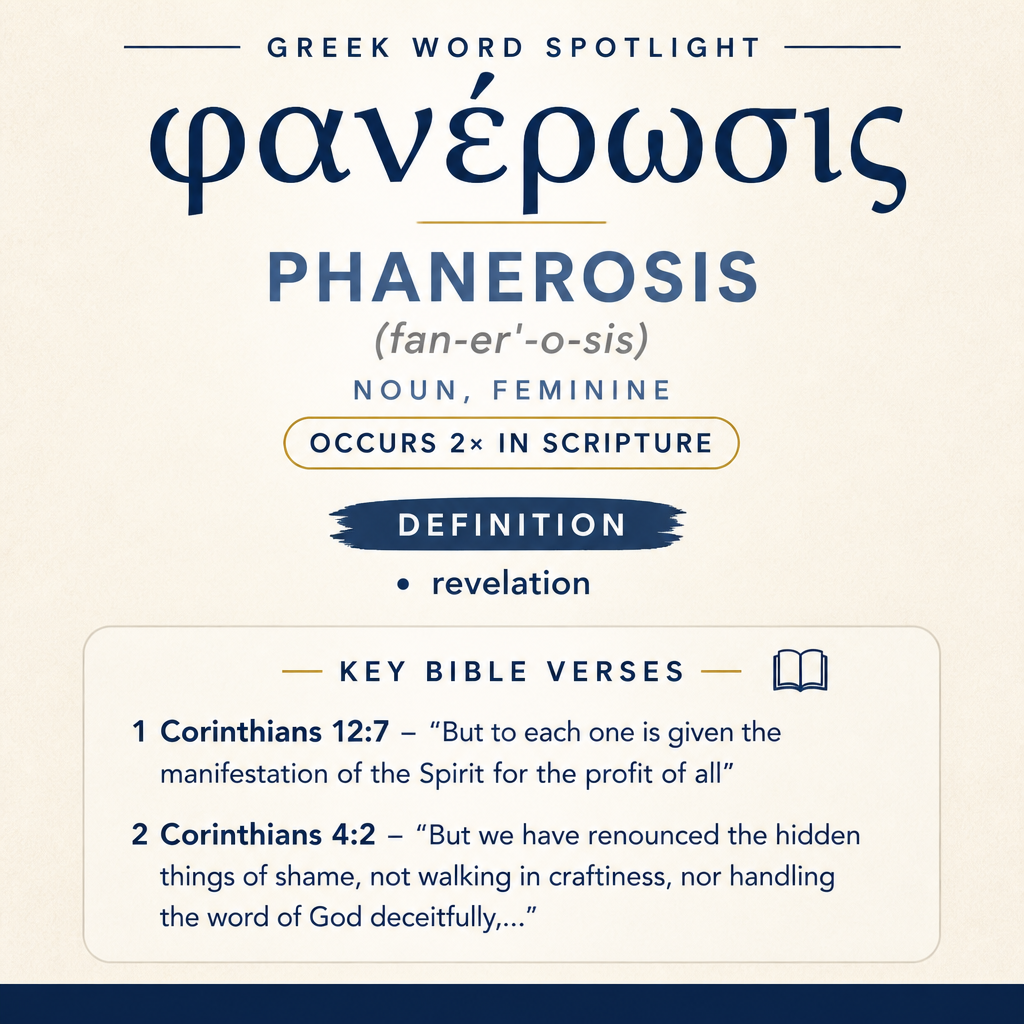
φανέρωσις (Phanerosis) means “revelation” and occurs twice in Scripture: 1 Corinthians 12:7 and 2 Corinthians 4:2.
New Testament Occurrences
It occurs two times in Scripture, in 1 Corinthians 12:7 and 2 Corinthians 4:2.
Learn More →Verse Contexts
In 1 Corinthians 12:7 it appears in the phrase “manifestation of the Spirit.” In 2 Corinthians 4:2 it appears in a context rejecting deceitful handling of God’s word.
Learn More →φανέρωσις denotes “revelation,” a bringing-to-light that stands in contrast to what is hidden. In the New Testament it appears in two Pauline contexts, one describing the Spirit’s work among believers and the other describing open, truthful ministry before God.
Root and Related Words
φανέρωσις is related to the verb phaneroō (φανερόω), “to reveal” (Strong’s G5319). The noun focuses on the revealed outcome—the disclosure itself—rather than the act described by the verb.

Occurrences
“But to each one is given the manifestation of the Spirit for the profit of all.” (1 Corinthians 12:7)
Here φανέρωσις belongs to the shared life of the community: something is “given” to “each one,” and what is given is described as “the manifestation of the Spirit.” The wording presents revelation as an observable disclosure of the Spirit in the life of an individual, yet not for private gain. The verse immediately frames its purpose: it is “for the profit of all.” In this scene, the word’s contribution is to connect Spirit-gifted activity with visibility and intelligibility within the congregation—what the Spirit provides is not merely inward or hidden, but comes to expression in a way that benefits the whole body. The term also guards the direction of the gift: because it is a revelation “for the profit of all,” its measure is communal good rather than personal status.

“But we have renounced the hidden things of shame, not walking in craftiness, nor handling the word of God deceitfully, but by the manifestation of the truth commending ourselves to every man’s conscience in the sight of God.” (2 Corinthians 4:2)
In this verse φανέρωσις is placed in deliberate contrast with concealment and deception. Paul speaks of “renounced the hidden things of shame,” and then adds a series of negations: “not walking in craftiness, nor handling the word of God deceitfully.” Against those rejected modes of ministry, he sets a positive means: “by the manifestation of the truth.” Here revelation is not primarily about receiving a private disclosure; it is the open display of “the truth” in the conduct and speech of ministry. The effect is relational and moral: it “commending ourselves to every man’s conscience,” and the arena of that commendation is explicitly theological, “in the sight of God.” φανέρωσις therefore functions as a public, conscience-addressing exposure of truth, an openness that counters craftiness and deceit. The verse portrays revelation as clarity that stands up under scrutiny—visible not only to people (“every man’s conscience”) but also before God.
Sense and Usage
Across its two occurrences, φανέρωσις (“revelation”) carries the idea of disclosure as something that becomes evident within a discernible setting. The term does not float as an abstract concept; it is anchored in concrete relationships—within a community that is meant to be built up, and within a public ministry that aims to persuade conscience.
In 1 Corinthians 12:7, revelation is explicitly “given,” and the giver is implied by the phrase “of the Spirit.” This frames φανέρωσις as a bestowed disclosure: it comes as a grant rather than an achievement. The verse also supplies a criterion of proper orientation: “for the profit of all.” Revelation, in this setting, is not an end in itself. Its value is measured by how it serves the common good. The word thus sits comfortably with the dynamics of shared life: each individual receives something that, when manifested, becomes beneficial beyond the individual.
In 2 Corinthians 4:2, revelation is set within ethical transparency. The surrounding language sketches two competing patterns: hidden shame and deceitful handling on one side, and manifest truth on the other. φανέρωσις is the hinge that turns ministry outward into the open. The verse attaches revelation to “truth” in a way that makes disclosure a matter of integrity. It is not merely that truth exists; it is manifested—brought into the open so that it can be recognized and can appeal to conscience. The phrase “commending ourselves” shows that this revelation has an evidential quality: it supports credibility, not by manipulation, but by open truthfulness before both human conscience and divine presence.
Together, these usages show φανέρωσις operating along two complementary axes. First, it can describe a disclosure associated with the Spirit’s work that is distributed among individuals with a communal purpose. Second, it can describe a disclosure associated with truth that characterizes transparent conduct and speech, standing in opposition to what is hidden and deceitful. In both passages, revelation is not a private possession; it is oriented toward others—either “all” who profit from the Spirit’s manifestation, or “every man’s conscience” addressed by the manifestation of truth. The word’s force in context is therefore social and public: revelation is something that comes into view, that can be recognized, and that is meant to have an effect on a community’s wellbeing or on an audience’s moral awareness.
Imagery and Contrast
The two passages also frame φανέρωσις with imagery of exposure versus concealment. In 1 Corinthians 12:7, the emphasis is positive: what the Spirit gives becomes manifest for shared benefit. In 2 Corinthians 4:2, the emphasis is sharpened by explicit contrast: “hidden things of shame” are renounced, “craftiness” and “deceitfully” are rejected, and revelation is expressed as “the manifestation of the truth.” The result is a picture of revelation as light cast into the open spaces of communal life and public ministry—disclosure that can be tested before conscience and carried out “in the sight of God.”
Sources: Lexical data from Strong’s Exhaustive Concordance and the Translators Brief Lexicon of Extended Strongs for Greek (STEPBible, CC BY). Occurrence data from the Translators Amalgamated Greek New Testament (STEPBible, CC BY). Scripture quotations from the World English Bible (public domain).