Exploring the Meaning of Phaino in Greek
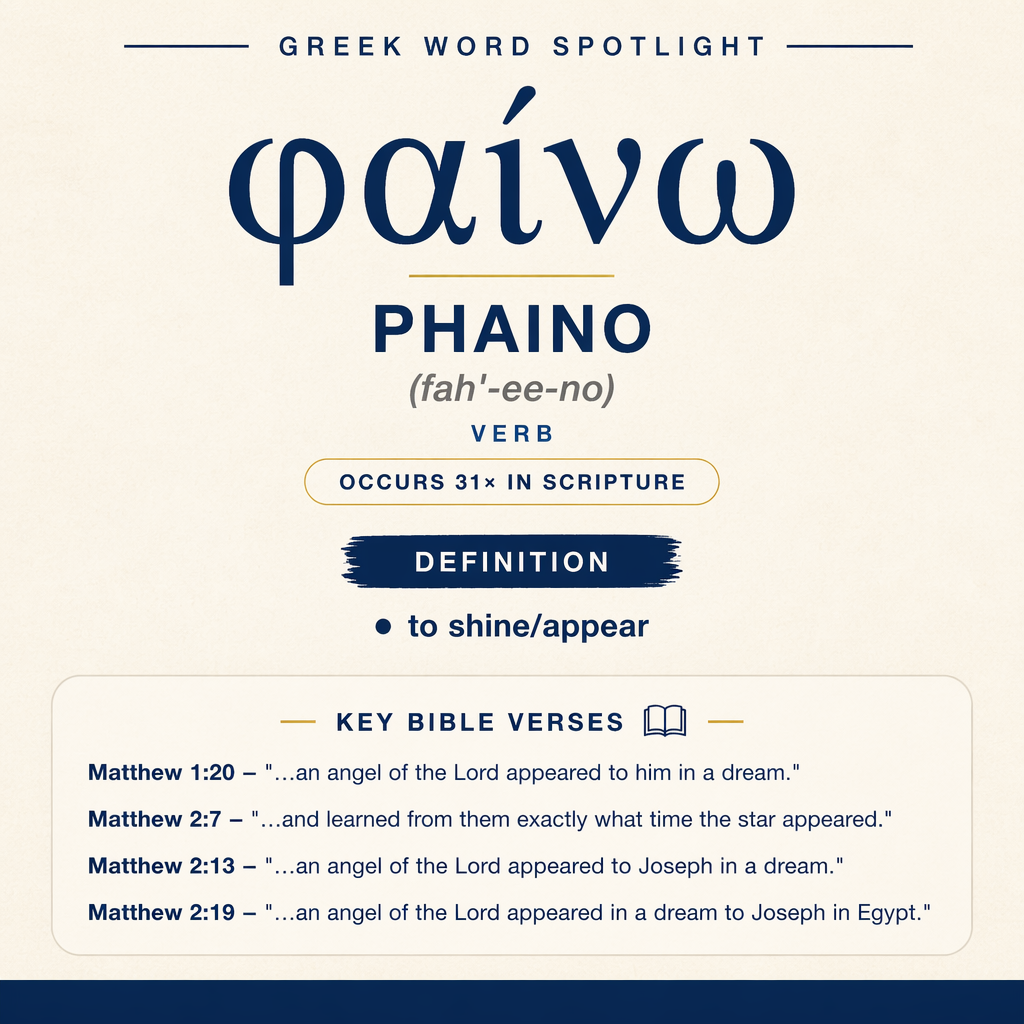
φαίνω means “to shine/appear” and occurs 31 times in Scripture, including Matthew 1:20; 2:7, 13, 19; 6:5, 16, 18; and 9:33.
Core Meaning
φαίνω means “to shine/appear.” In Matthew it describes things becoming visible or appearing.
Learn More →Matthew Examples
It is used of an angel of the Lord appearing to Joseph in a dream (Matthew 1:20; 2:13; 2:19). It is also used for the star that appeared (Matthew 2:7).
Learn More →Seen by Others
In Matthew 6:5, 6:16, and 6:18 it relates to being seen by people. In Matthew 9:33, the crowds say nothing like this has ever been seen.
Learn More →φαίνω describes shining or appearing, and in these passages it marks what comes into view—whether an angel in a dream, a star’s timing, weeds among wheat, outward religious display, or a flash of lightning seen across the sky. The word helps the reader track the moment something becomes visible or perceptible, sometimes with emphasis on outward appearance as distinct from inward reality.
Occurrences
Matthew 1:20 — But when he thought about these things, behold, an angel of the Lord appeared to him in a dream, saying, “Joseph, son of David, don’t be afraid to take to yourself Mary, your wife, for that which is conceived in her is of the Holy Spirit.
Here φαίνω frames a decisive turning point: Joseph is weighing his course, and then an angel comes into view within a dream. The verb highlights the transition from private deliberation (“he thought about these things”) to a revelatory appearance that redirects action through direct speech.
Matthew 2:7 — Then Herod secretly called the wise men, and learned from them exactly what time the star appeared.
In this scene the word anchors chronology. Herod’s question is not simply about the star’s existence but about the moment it came into view (“what time the star appeared”), turning an appearance in the sky into usable information for his plan.
Matthew 2:13 — Now when they had departed, behold, an angel of the Lord appeared to Joseph in a dream, saying, “Arise and take the young child and his mother, and flee into Egypt, and stay there until I tell you, for Herod will seek the young child to destroy him.”
Again φαίνω introduces an angelic appearance in a dream, but now it functions as an urgent warning. The appearance is tied to immediate direction (“Arise… flee… stay there”), so the verb carries the force of a sudden manifestation that demands swift obedience in response to danger.
Matthew 2:19 — But when Herod was dead, behold, an angel of the Lord appeared in a dream to Joseph in Egypt, saying,
The appearance here marks a change in circumstances (“when Herod was dead”) and signals that the period of hiding is over. φαίνω again cues the reader that guidance arrives by an angel coming into view in a dream, connecting external events with a revealed message.
Matthew 6:5 — “When you pray, you shall not be as the hypocrites, for they love to stand and pray in the synagogues and in the corners of the streets, that they may be seen by men. Most certainly, I tell you, they have received their reward.
In this instruction, φαίνω is bound to public visibility. The hypocrites choose locations designed for notice (“synagogues… corners of the streets”) so that their praying will appear to others; the verb points to prayer as performance, with being seen as the intended outcome.
Matthew 6:16 — “Moreover when you fast, don’t be like the hypocrites, with sad faces. For they disfigure their faces, that they may be seen by men to be fasting. Most certainly I tell you, they have received their reward.
Here the word governs an intentionally crafted appearance. The disfigured faces are not accidental but produced “that they may be seen,” so φαίνω exposes the strategy of making an inner practice outwardly evident, even through altered expression, to secure human recognition.

Matthew 6:18 — so that you are not seen by men to be fasting, but by your Father who is in secret, and your Father, who sees in secret, will reward you.
φαίνω continues the theme of visibility but reverses the audience. The instruction aims at removing fasting from public appearance (“not seen by men”), shifting attention to a hidden sphere where the Father “sees in secret.” The verb thus helps draw a line between public display and concealed devotion.
Matthew 9:33 — When the demon was cast out, the mute man spoke. The multitudes marveled, saying, “Nothing like this has ever been seen in Israel!”
In the crowd’s reaction, φαίνω expresses communal perception: the deliverance produces something that becomes observable and memorable. Their statement is framed in terms of what has come into view in their collective experience—an event so striking that it redefines what they consider previously visible “in Israel.”
Matthew 13:26 — But when the blade sprang up and produced fruit, then the darnel weeds appeared also.
In the agricultural picture, φαίνω marks delayed visibility. The weeds are present, but their appearance is tied to the crop’s development (“when the blade sprang up and produced fruit”), suggesting that certain realities become evident only at a later stage when growth reveals what had been hidden among the plants.
Matthew 23:27 — “Woe to you, scribes and Pharisees, hypocrites! For you are like whitened tombs, which outwardly appear beautiful, but inwardly are full of dead men’s bones, and of all uncleanness.
Here φαίνω is explicitly qualified by “outwardly,” placing the verb in the realm of surface impression. The comparison depends on a contrast: what appears beautiful on the outside versus what is contained within. φαίνω therefore serves the critique by naming the persuasive power of an exterior that looks attractive.
Matthew 23:28 — Even so you also outwardly appear righteous to men, but inwardly you are full of hypocrisy and iniquity.
The same outward/inward contrast is sharpened: the target is not merely beauty but righteousness “to men,” a social perception. φαίνω highlights that the righteousness in view is an appearance before observers, while the inner condition is described in opposing terms, making the verb central to the gap between seen reputation and unseen reality.
Matthew 24:27 — For as the lightning flashes from the east, and is seen even to the west, so will the coming of the Son of Man be.
In this saying, φαίνω draws on the reach of visible light. Lightning’s flash is characterized by being seen across distance (“from the east… even to the west”), and that observable scope is used as the comparison for the coming described. The verb emphasizes the unmistakable public character of what comes into view.

Sense and Usage
Across these passages φαίνω operates in two closely linked directions: (1) it marks the moment something becomes visible or perceptible, and (2) it can frame visibility as a matter of outward appearance before an audience. The dream-appearances (Matthew 1:20; 2:13; 2:19) present visibility within a visionary setting: the angel’s presence is introduced as something that comes into view and carries authoritative speech. In these scenes, appearing is not merely visual description; it functions as narrative signal that guidance has arrived and that the situation is being interpreted from beyond Joseph’s own reasoning.
The star (Matthew 2:7) shows φαίνω used for an appearance that can be timed and investigated. The verb supports an inquiry into the onset of visibility—when it became observable—so the appearance becomes a measurable event. In a different register, the crowd’s statement (Matthew 9:33) treats what has been “seen” as a category of communal memory, where the appearance of an unprecedented act shapes what people consider possible or known.
Several occurrences focus on human conduct shaped by the desire to be visible. In the instructions on prayer and fasting (Matthew 6:5; 6:16; 6:18), φαίνω is bound to social recognition: the hypocrites select public spaces and even alter their faces so their devotion will appear to others. The contrast with secrecy (“your Father who sees in secret”) makes visibility itself the contested issue: whether a practice is conducted for outward appearance or for an audience that is not part of the public gaze. In these contexts, φαίνω is less about light or radiance and more about appearing in the sense of being seen, noticed, and evaluated.
The parable-like statement about weeds (Matthew 13:26) uses φαίνω for the emergence of something previously concealed. The weeds “appeared also” only once the blade had grown and fruited, so the verb conveys disclosure over time: an appearance that happens when conditions make identification possible. Finally, the denunciations of hypocritical leadership (Matthew 23:27–28) place φαίνω at the heart of a moral contrast between outward appearance and inward condition. The verb helps describe the persuasive outer surface—beauty, righteousness as perceived “to men”—that can mask what is inside. The lightning comparison (Matthew 24:27) returns to overt visibility across the horizon, using what is seen at a distance to illustrate an appearance that is broadly evident and not confined to a private corner.
Imagery
These uses gather around a simple but potent image: what enters the field of sight shapes response. Angels appearing in dreams redirect travel and protect a child (Matthew 2:13) and signal shifts in danger (Matthew 2:19); a star’s appearance becomes a timestamp for a ruler’s calculations (Matthew 2:7); weeds appearing among wheat warn that hidden mixtures become visible with time (Matthew 13:26). At the same time, the word can expose the fragility of a life built on being seen—prayer on street corners (Matthew 6:5), fasting performed with “sad faces” (Matthew 6:16), righteousness that “outwardly” appears convincing (Matthew 23:28). In the climactic comparison, lightning seen from east to west (Matthew 24:27) supplies an image of appearance that cannot be contained or stage-managed, because it fills the skyline.
Sources: Lexical data from Strong’s Exhaustive Concordance and the Translators Brief Lexicon of Extended Strongs for Greek (STEPBible, CC BY). Occurrence data from the Translators Amalgamated Greek New Testament (STEPBible, CC BY). Scripture quotations from the World English Bible (public domain).