
Exploring the Meaning of Huperekchuno in Greek
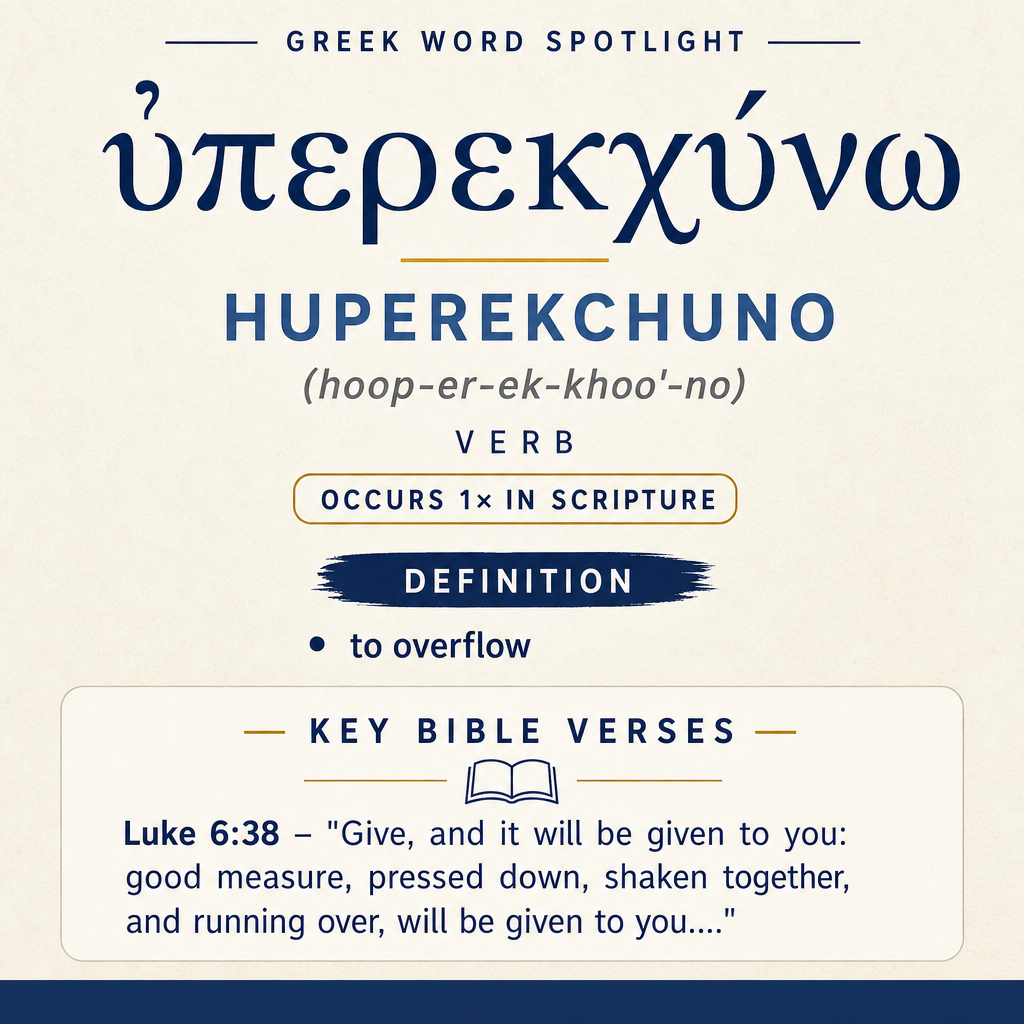
ὑπερεκχύνω means “to overflow” and appears once in Scripture, in Luke 6:38.
Scripture Occurrence
This word occurs one time in Scripture. Its sole occurrence is in Luke 6:38.
Learn More →Luke 6:38 Context
In Luke 6:38 it appears in the phrase “running over.” The verse describes giving that results in abundant return.
Learn More →ὑπερεκχύνω means “to overflow,” and it appears in the teaching scene of Luke 6:38. In that single context it serves as an image-word, describing abundance that goes beyond the container’s normal limit.
Root and Related Words
ὑπερεκχύνω is built from ὑπέρ (hyper), “above/for,” and ἐκχέω (ekcheō), “to pour out.” The combined shape of the word naturally fits a pouring image that rises past the top edge—language that matches the verse’s concrete picture of a vessel filled to excess.

Occurrences
“Give, and it will be given to you: good measure, pressed down, shaken together, and running over, will be given to you. For with the same measure you measure it will be measured back to you.” (Luke 6:38)
In Luke 6:38, ὑπερεκχύνω (“running over”) is the climax of a carefully stepped description of measured generosity: “good measure, pressed down, shaken together, and running over.” Each phrase adds another action a person might do when filling a container with grain or some other pourable commodity. “Pressed down” suggests compressing what is in the measure so that it holds more; “shaken together” suggests settling the contents so empty spaces close up. After those deliberate actions to maximize the amount, “running over” depicts a state beyond maximization: the contents now exceed the measure’s capacity and spill past its rim. The word therefore portrays excess not as vague abundance but as a visible, physical overflow that cannot be kept within the boundaries of the measuring vessel.
The surrounding statements show what this overflow is doing rhetorically. The verse begins with a direct exchange principle—“Give, and it will be given to you”—and then it intensifies the kind of giving envisioned: not minimal, not merely fair, but full to the point of spilling. The overflow functions as an image for the manner in which the return is described: what “will be given to you” is not simply a measured portion but one that has been prepared and then exceeds its limits. The phrase “will be given to you” is paired with this vivid measuring language, anchoring the picture in the act of receiving. Overflow is thus not only an attribute of the measure; it is the sensory way the verse communicates an exceeding kind of return.
The final sentence, “For with the same measure you measure it will be measured back to you,” frames the image as a principle of correspondence between one measure and another. Within that logic, “running over” takes on its force: it describes what the measured-back portion looks like when the giving side is pictured as full, settled, and beyond capacity. The word brings the scene to a point where the reader can imagine the boundary line of the measure and the surplus going past it. That surplus is what makes the picture memorable: the return is depicted not only as equivalent in measuring terms (“the same measure”) but as lavish in the concrete depiction of the filled container.
Sense and Usage
The sense “to overflow” in Luke 6:38 operates as a concrete, measurable image rather than an abstract label. The verse does not leave the concept at the level of “a lot” or “abundance”; it narrates the physical process of filling a measure in a way that presses the imagination into a tactile scene: compression, settling, and then spillover. In that sequence, overflow is the point at which addition becomes visible outside the container. It depicts excess that cannot be contained, excess that proves itself by surpassing a defined boundary.
Because the verse keeps repeating the vocabulary of “measure,” overflow here is tied to quantity and proportion. The reader is invited to think in terms of a standard vessel: a “good measure” that is filled properly, then filled even more carefully, until the contents surpass the measure’s edge. Overflow is therefore not random; it is the result of filling that has already reached fullness. In this context, the word’s force depends on the implied rim of the measuring container: overflow is what happens after fullness, and it is recognizable precisely because there is a clear limit being exceeded.
Within the give-and-receive framework of the verse, “running over” functions as an image of surplus in what is “given to you.” The passive phrasing—“will be given to you”—keeps attention on the gift received, while the measure-language describes its quality. Overflow supplies the sensory proof of abundance: what is given is not merely adequate to the measure; it spills, implying more than the measured capacity. The word thus serves as the final, strongest descriptor in the chain, leaving the scene with a picture of generosity that exceeds normal containment.
Imagery
The imagery of ὑπερεκχύνω in Luke 6:38 is domestic and practical: a container on the verge of being too full. “Pressed down” and “shaken together” make the scene almost audible and physical, and “running over” gives it motion, as the contents breach the rim. The result is a picture of overflow as a visible spill—an excess that is not hidden, not theoretical, but plainly seen as it goes beyond the measure.
Sources: Lexical data from Strong’s Exhaustive Concordance and the Translators Brief Lexicon of Extended Strongs for Greek (STEPBible, CC BY). Occurrence data from the Translators Amalgamated Greek New Testament (STEPBible, CC BY). Scripture quotations from the World English Bible (public domain).




