Exploring the Meaning of Huperekeina in Greek
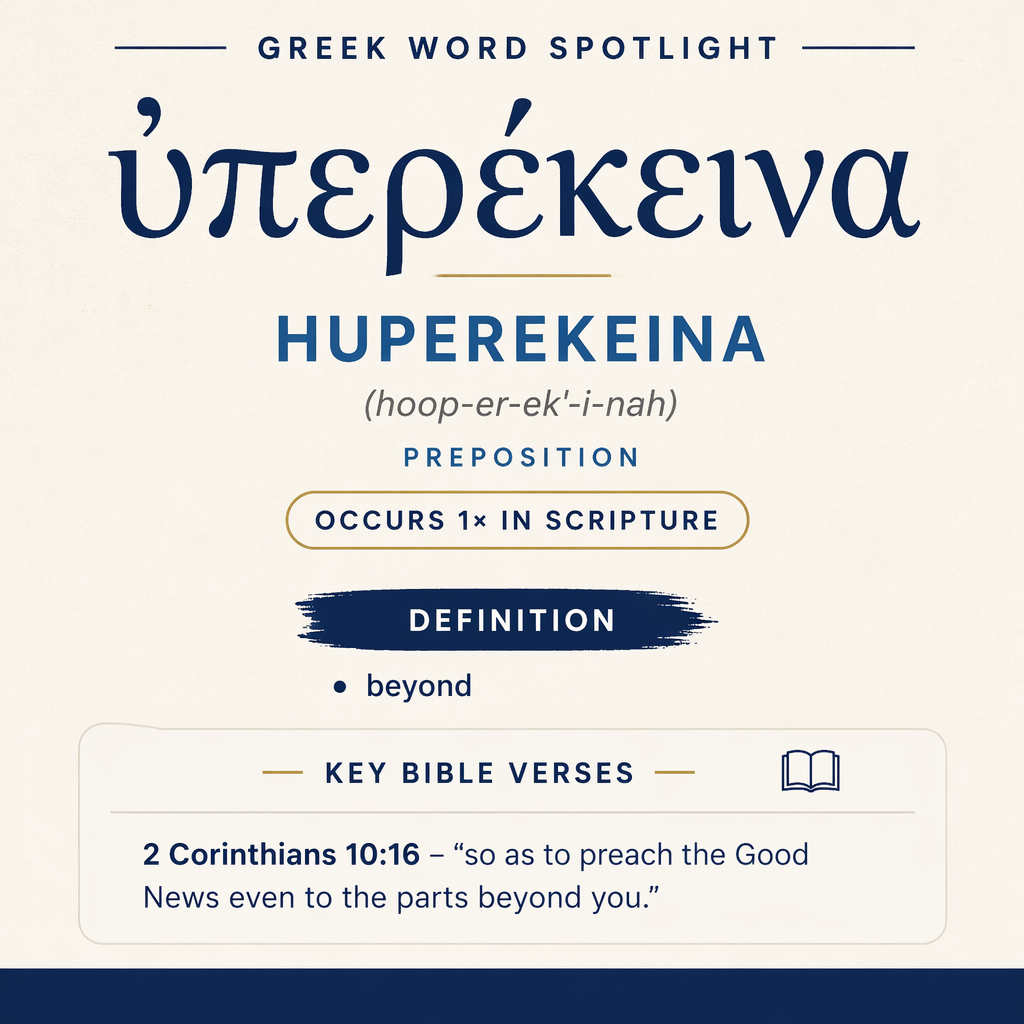
ὑπερέκεινα means “beyond” and appears once in Scripture, in 2 Corinthians 10:16.
Scripture Occurrence
This word occurs 1 time in Scripture. The occurrence is in 2 Corinthians 10:16.
Learn More →Verse Context
In 2 Corinthians 10:16, it refers to preaching the Good News to parts beyond the readers. The verse contrasts this with boasting in what someone else has already done.
Learn More →ὑπερέκεινα expresses the idea of being “beyond,” and it appears in Paul’s description of the direction and reach of gospel preaching. Its single New Testament occurrence places it in a sentence that contrasts forward-looking mission with boasting in another person’s work.
Root and Related Words
ὑπερέκεινα (Huperekeina) is connected with the preposition ὑπέρ (hyper), “above/for” (Strong’s G5228), and with ἐκεῖνος (ekeinos), “that” (Strong’s G1565). In combination, these related elements naturally suit a term that points away from what is immediate and toward what lies further on.

Occurrences
“so as to preach the Good News even to the parts beyond you, not to boast in what someone else has already done.” (2 Corinthians 10:16)
Here ὑπερέκεινα marks the intended extension of preaching: “even to the parts beyond you.” In the quoted line, Paul speaks of a purpose (“so as to preach the Good News”) and then specifies the scope of that purpose by adding a frontier: there are “parts” that lie “beyond” the audience addressed as “you.” The word therefore functions as a directional boundary-marker in Paul’s stated ministry aim, locating the next field of proclamation on the far side of the Corinthians’ present sphere.
The same sentence sets that outward reach beside an ethical constraint: “not to boast in what someone else has already done.” In this immediate context, “beyond” belongs to the logic of moving into space not already occupied by another’s completed labor. The contrast is not between two different messages, but between two kinds of ministerial posture described in the quotation—pressing onward to further regions versus taking credit for work already accomplished by someone else. ὑπερέκεινα, by naming what lies further, supports the forward motion implied in “preach… even to the parts beyond you” and aligns that motion with the refusal to boast over another person’s established accomplishments.
Sense and Usage
The definition “beyond” is spatial in its plain sense, and in 2 Corinthians 10:16 it is attached to “parts,” yielding a concrete-sounding phrase: “the parts beyond you.” The wording encourages the reader to picture a map-like progression—one region is addressed (“you”), and another region lies further out (“beyond”). Even though the verse does not describe terrain, cities, or roads, the term itself supplies a simple geographic logic: gospel preaching is conceived as extending past a current boundary.
At the same time, the sentence’s second clause (“not to boast in what someone else has already done”) gives “beyond” a practical force within ministerial conduct. “Beyond” does not merely indicate distance; it participates in a contrast of spheres of work. The implied line is between what is already completed by “someone else” and what lies ahead as a place to “preach the Good News.” Thus, within the single attestation, ὑπερέκεινα helps articulate a principle of moving forward rather than appropriating what is already established. The word contributes to the verse’s sense of expansion without altering the verse’s stated focus: preaching, scope, and the avoidance of boasting.
Because the expression is framed as “so as to preach… even to the parts beyond you,” “beyond” also carries an intensifying nuance in the flow of the sentence. The clause “even to the parts beyond you” adds an incremental reach to the stated aim—preaching is envisioned not only within the recipients’ vicinity but extending further than that. In this way the word serves Paul’s rhetoric of extension: it pushes the reader’s attention past the immediate audience toward additional places that are outside the present horizon of the conversation.
Imagery
The phrase “the parts beyond you” naturally evokes the image of a boundary and what lies past it: a nearer region in view and a farther region still to be reached. In 2 Corinthians 10:16 that imagery is kept deliberately spare, allowing “beyond” to do its work by suggesting open distance for proclamation while the sentence simultaneously rules out self-congratulation over “what someone else has already done.”
Sources: Lexical data from Strong’s Exhaustive Concordance and the Translators Brief Lexicon of Extended Strongs for Greek (STEPBible, CC BY). Occurrence data from the Translators Amalgamated Greek New Testament (STEPBible, CC BY). Scripture quotations from the World English Bible (public domain).