
Exploring the Meaning of Phago in Greek
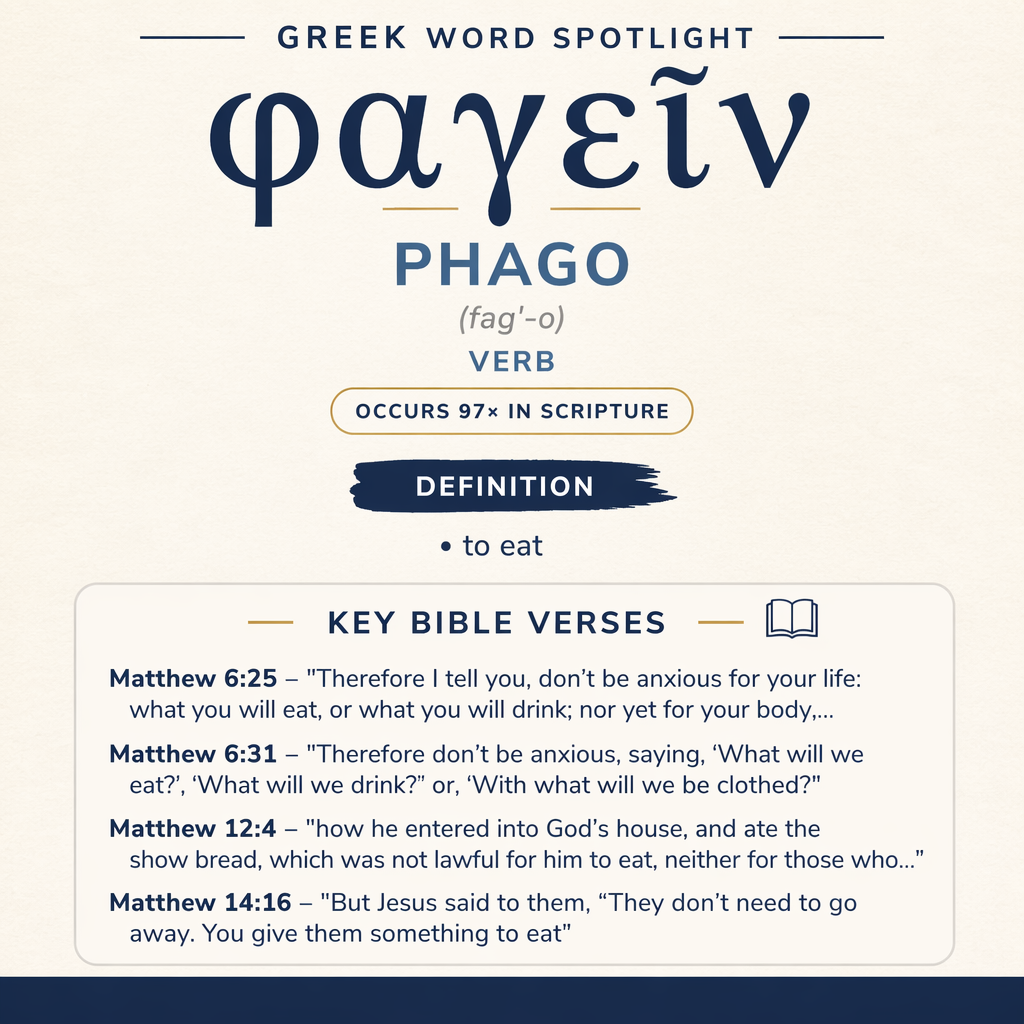
φαγεῖν (Phago) means “to eat” and occurs 97 times in Scripture, including in Matthew 6, 12, 14, and 15.
Core Meaning
φαγεῖν means “to eat.” It appears in contexts of ordinary meals and hunger.
Learn More →Matthew Contexts
In Matthew 6:25 and 6:31 it is used in questions about what to eat. In Matthew 12:4 it describes eating the show bread.
Learn More →Feeding Scenes
In Matthew 14:16–20 and 15:32–37 it describes crowds eating and being filled. These passages report food given and leftovers gathered.
Learn More →φαγεῖν expresses the ordinary act of eating and appears in sayings about daily concerns, narratives of miraculous feeding, disputes about what defiles, and scenes of hospitality and Passover preparation. Across these passages it can mark basic bodily need, shared meals, and the provision or lack of provision that reveals compassion or neglect.
Occurrences
“Therefore I tell you, don’t be anxious for your life: what you will eat, or what you will drink; nor yet for your body, what you will wear. Isn’t life more than food, and the body more than clothing?” (Matthew 6:25)
Here φαγεῖν is paired with drinking as one of the most basic daily necessities. The saying frames eating as a natural concern of “your life,” yet places it within a broader perspective: life is “more than food.” The verb thus functions as a concrete example of what anxiety fastens onto.
“Therefore don’t be anxious, saying, ‘What will we eat?’, ‘What will we drink?’ or, ‘With what will we be clothed?’” (Matthew 6:31)
φαγεῖν appears in a quoted question—“What will we eat?”—as the voice of worry. Eating is again grouped with drinking and clothing, emphasizing recurring human questions about provision. The form as a future-oriented concern (“will we”) highlights anticipation rather than the act itself.
“how he entered into God’s house, and ate the show bread, which was not lawful for him to eat, neither for those who were with him, but only for the priests?” (Matthew 12:4)
φαγεῖν is used twice to describe eating in a sacred setting: he “ate the show bread,” and the act is then evaluated as “not lawful … to eat” for him or his companions, reserved “only for the priests.” The verb here does more than describe consumption; it anchors a discussion of who may eat particular bread and under what conditions.
“But Jesus said to them, “They don’t need to go away. You give them something to eat.”” (Matthew 14:16)
In this instruction, φαγεῖν is the goal of practical care for a crowd: providing “something to eat.” The verb sets the immediate need in view and presses responsibility onto the disciples (“You give”), making eating the concrete outcome of compassionate action.
“They all ate, and were filled. They took up twelve baskets full of that which remained left over from the broken pieces.” (Matthew 14:20)
φαγεῖν narrates the shared result—“They all ate”—and the satisfaction that follows: “were filled.” Eating is pictured as abundant and communal, confirmed by the “twelve baskets” of leftovers. The verb thus marks not merely a meal but a provision so ample it produces remains to gather.
“These are the things which defile the man; but to eat with unwashed hands doesn’t defile the man.” (Matthew 15:20)
φαγεῖν is placed in a contested scenario: eating “with unwashed hands.” The verb itself remains ordinary, but the sentence uses it to distinguish physical practice at a meal from the deeper issue of what “defile[s] the man.” Eating becomes the everyday act around which the argument about defilement is clarified.
“Jesus summoned his disciples and said, “I have compassion on the multitude, because they continue with me now three days and have nothing to eat. I don’t want to send them away fasting, or they might faint on the way.”” (Matthew 15:32)
φαγεῖν appears in the negative—“have nothing to eat”—to describe deprivation after “three days.” The verb helps specify the nature of Jesus’ “compassion”: it addresses hunger and the risk of physical collapse (“they might faint on the way”). Eating is portrayed as necessary strength for the journey home.
“They all ate, and were filled. They took up seven baskets full of the broken pieces that were left over.” (Matthew 15:37)
As in the earlier feeding, φαγεῖν summarizes the crowd’s experience: “They all ate, and were filled.” The collection of “seven baskets” of leftovers again frames eating as the endpoint of overflowing provision. The verb ties the narrative to the tangible evidence of satisfaction and surplus.
“for I was hungry, and you gave me food to eat. I was thirsty, and you gave me drink. I was a stranger, and you took me in.” (Matthew 25:35)
φαγεῖν expresses a gift of sustenance given to the hungry: “food to eat.” Eating here is not self-supplied; it is enabled by another’s generosity. Alongside drink and shelter, the verb anchors a picture of responsive hospitality toward someone in need.
“for I was hungry, and you didn’t give me food to eat; I was thirsty, and you gave me no drink;” (Matthew 25:42)
φαγεῖν again occurs in relation to hunger, but now in failure: “you didn’t give me food to eat.” The verb spotlights omission—need remains unmet. The scene’s parallel structure (food/drink withheld) presents eating as a basic kindness that can be refused, exposing neglect.
“Now on the first day of unleavened bread, the disciples came to Jesus, saying to him, “Where do you want us to prepare for you to eat the Passover?”” (Matthew 26:17)
φαγεῖν is connected with preparation for a particular meal: “to eat the Passover.” The verb identifies the purpose of arranging a place and provisions, implying an ordered setting rather than spontaneous eating. It marks eating as an event requiring intentional readiness.
“As they were eating, Jesus took bread, gave thanks for it, and broke it. He gave to the disciples, and said, “Take, eat; this is my body.”” (Matthew 26:26)
φαγεῖν appears both as the ongoing action—“As they were eating”—and as a direct command: “Take, eat.” The verb sets the immediate table-scene: bread is taken, thanked for, broken, and distributed. In this moment eating is guided by speech and gesture, shaping how the disciples participate in the meal.

Sense and Usage
Across these passages φαγεῖν consistently denotes eating in the plain, bodily sense, yet its narrative and rhetorical roles vary. In Matthew 6:25 and 6:31 the verb is framed by anxious speech about necessities; eating functions as a representative concern of ordinary life, closely paired with drinking and contrasted with the larger value of “life” and the “body.” The questions “what you will eat” and “What will we eat?” show how the act can be pulled into the future as a worry about provision.
In Matthew 12:4 eating is evaluated with explicit boundaries: “not lawful … to eat” the “show bread” except for “the priests.” The verb remains literal but becomes a hinge for discussing rightful access. The repetition (“ate … not lawful … to eat”) emphasizes the act as the point at issue: who eats, what is eaten, and whether that eating is permitted in the setting described as “God’s house.”
In the feeding scenes (Matthew 14:16, 14:20; 15:32, 15:37) φαγεῖν moves from command, to need, to result. “You give them something to eat” presents eating as the measurable outcome of care; “have nothing to eat” names the problem; “They all ate, and were filled” narrates the resolution and the satisfaction that follows. The repeated note of leftovers (“twelve baskets” and “seven baskets”) places eating in a context of abundance: the act is completed, people are filled, and tangible remains are gathered. The verb therefore marks not only the act of eating but the completion of hunger in a crowd.
In Matthew 15:20 the focus shifts from provision to purity language: “to eat with unwashed hands.” Eating remains an ordinary activity, but it becomes the test case for what “defile[s] the man.” The verb’s concreteness helps the saying draw a line between physical eating practices and the deeper category of defilement mentioned in the same sentence.
In Matthew 25:35 and 25:42, φαγεῖν stands within a pair of mirrored statements about hunger and thirst. Eating is presented as something another person enables or refuses to enable: “you gave me food to eat” versus “you didn’t give me food to eat.” The verb thus functions in relational terms—eating as received sustenance—so that the presence or absence of food is interpreted through human response to need.
Finally, in Matthew 26:17 and 26:26, φαγεῖν belongs to a structured meal. The disciples ask where preparations should be made “to eat the Passover,” showing eating as the goal of deliberate arrangement on a particular day. Then “As they were eating” sets the immediate setting for bread being taken, thanked for, broken, and handed on; the imperative “Take, eat” directs participation. In these lines φαγεῖν is still literal eating, but it is embedded in a carefully narrated sequence of actions at the table.
Imagery in Context
The imagery tied to φαγεῖν in these passages is consistently concrete: food to be eaten, crowds with empty stomachs, baskets of broken pieces, hands at a meal, and a prepared setting for Passover. At one end, eating is the object of anxious questions; at the other, it is the outcome of compassion, hospitality, and shared table practice—either granted (“you gave me food to eat”) or withheld (“you didn’t give me food to eat”).
Sources: Lexical data from Strong’s Exhaustive Concordance and the Translators Brief Lexicon of Extended Strongs for Greek (STEPBible, CC BY). Occurrence data from the Translators Amalgamated Greek New Testament (STEPBible, CC BY). Scripture quotations from the World English Bible (public domain).





