
Exploring the Meaning of Phalek in Greek
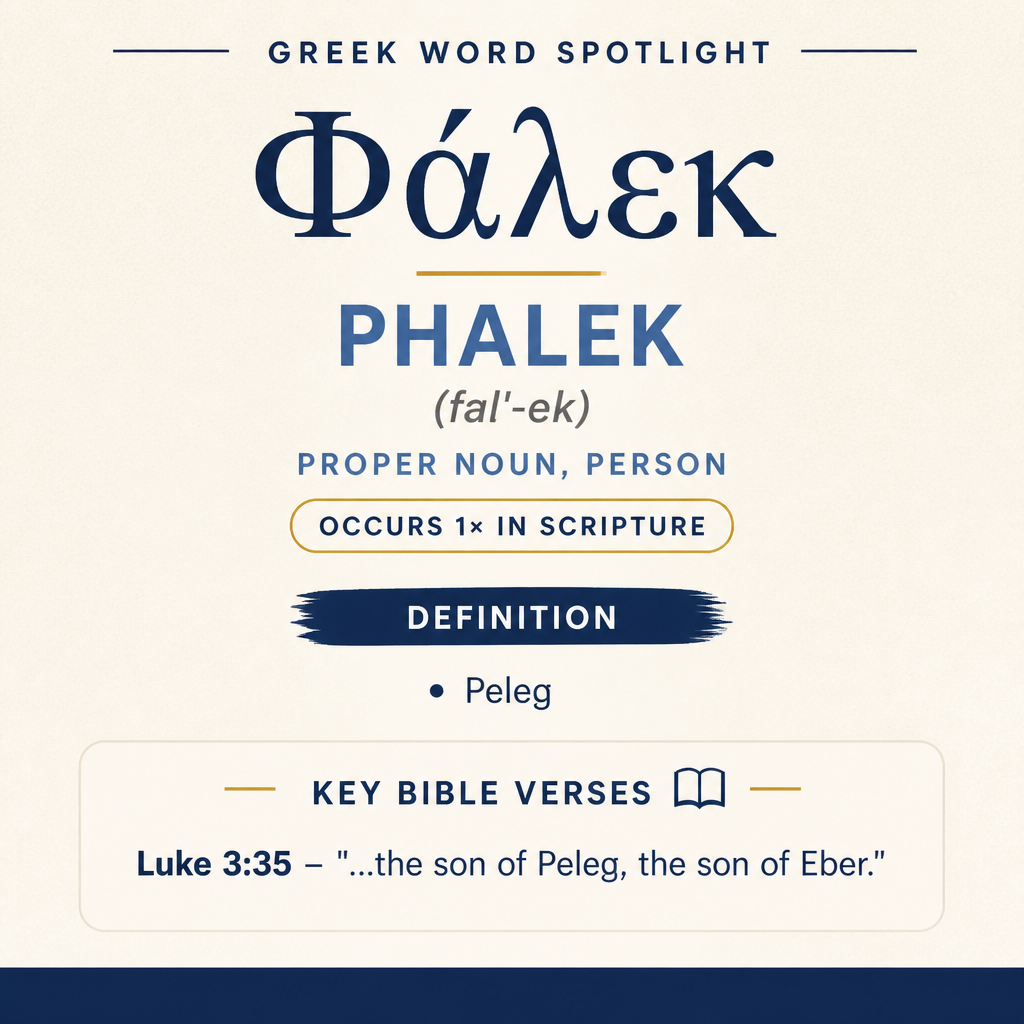
Φάλεκ means Peleg and appears once in Scripture, in Luke 3:35 within Jesus’ genealogy.
Luke Genealogy
In Luke 3:35, Φάλεκ appears in the lineage list: “the son of Peleg, the son of Eber.”
Learn More →Φάλεκ means “Peleg” and appears in a single New Testament genealogy where ancestral descent is traced through named generations. In that list, the name functions as a fixed point of lineage, linking earlier and later ancestors in an ordered chain.
Occurrences
“the son of Serug, the son of Reu, the son of Peleg, the son of Eber, the son of Shelah,” (Luke 3:35)
Here Φάλεκ appears as one link in a sequence of “the son of …” statements that connect individuals by direct descent. The verse places Peleg between Reu and Eber: he is presented as Reu’s son and as the father in the line leading to Eber. In this tightly structured wording, the name does not stand alone; it is defined by its relational placement within the chain. The repetition of the formula (“the son of”) gives each name the same grammatical and narrative weight, so Peleg is not highlighted for an action or speech, but for a precise position in the ancestry being recited.
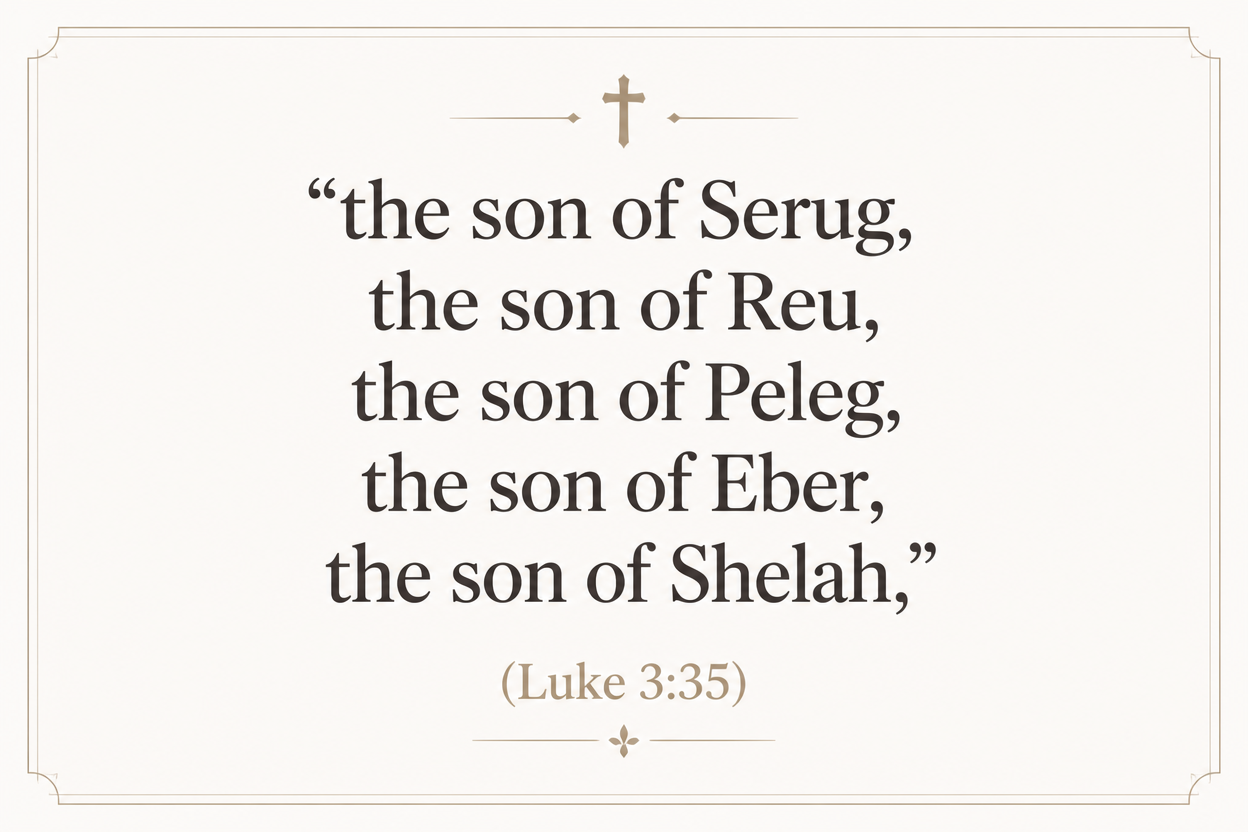
The immediate context within the quotation also shows how the genealogy is built from multiple adjacent links: “the son of Serug, the son of Reu” precedes Peleg, and “the son of Eber, the son of Shelah” follows. Peleg therefore functions as a hinge-point: the list moves through him as it passes from one cluster of forebears to another. The contribution of Φάλεκ in this verse is to identify a particular generational step and to maintain the continuity of the line as the sequence progresses name by name.

Sense and Usage
As a proper personal name, Φάλεκ (“Peleg”) serves chiefly to specify identity rather than to describe qualities, events, or roles beyond descent. In Luke 3:35, the sense of the word is exhausted in its reference: it points to the individual named Peleg, and that individual’s significance in the verse is genealogical—he is a named ancestor situated between two other named ancestors. The genealogy’s structure depends on the stability of such names: each one is an anchor that keeps the chain intelligible and prevents the “son of” pattern from becoming an abstract repetition. By supplying the distinctive identifier “Peleg,” the text marks one generation as distinct from those on either side, even though the phrasing treats each generation uniformly.
The wording also shows that the name’s usage is inherently connective. Because the verse frames Peleg with two relationships—descending from Reu and leading toward Eber—the name participates in both directions of the line at once. The term does not operate as a title, epithet, or descriptive label within the quoted line; it functions as a proper noun embedded in a relational formula. In a list where every item is another “son,” the presence of Φάλεκ is part of how the genealogy maps continuity across multiple generations: not through narrative detail, but through ordered succession.
Within this single occurrence, the semantic contribution is therefore pragmatic and referential. The name “Peleg” provides a concrete personal referent that allows the genealogy to proceed stepwise. The verse’s cadence—moving from Serug to Reu to Peleg to Eber to Shelah—illustrates how the text relies on proper names to build a linear framework of ancestry. Φάλεκ, in this setting, carries the ordinary force of a personal name in a genealogical register: it identifies one individual so that the line can be traced through him.
Genealogical Imagery
The imagery evoked by Luke 3:35 is that of a chain of descent made visible through successive naming. Peleg appears as one link in that chain, framed by the repeated phrase “the son of,” which turns the series of names into a verbal lineage—step after step, generation after generation—without pausing for narrative elaboration. In that restrained style, Φάλεκ contributes to the impression of continuity: the line does not leap across gaps, but advances through named ancestors, with Peleg occupying a definite place in the sequence.
Sources: Lexical data from Strong’s Exhaustive Concordance and the Translators Brief Lexicon of Extended Strongs for Greek (STEPBible, CC BY). Occurrence data from the Translators Amalgamated Greek New Testament (STEPBible, CC BY). Scripture quotations from the World English Bible (public domain).





