Exploring the Meaning of Huponoia in Greek
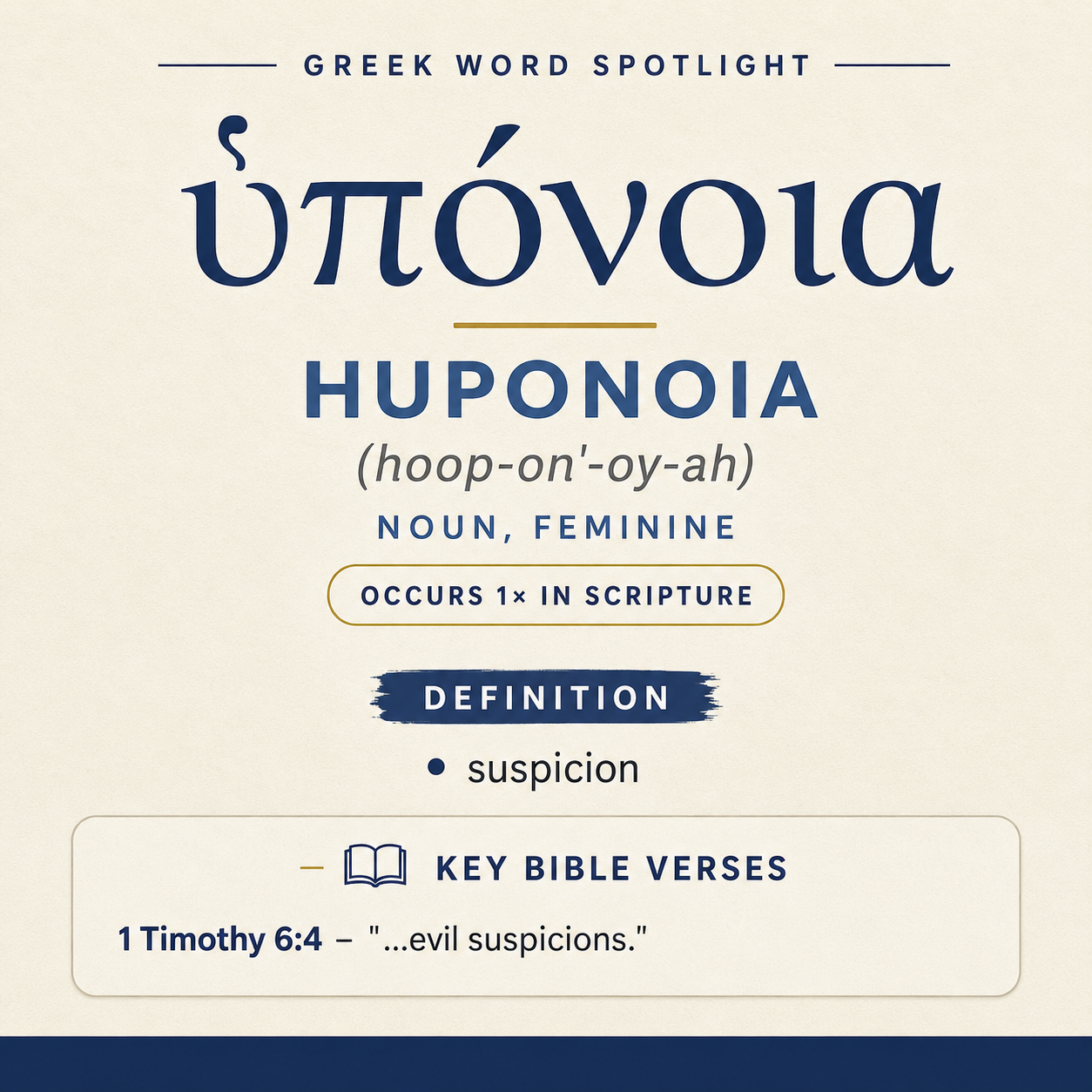
ὑπόνοια means “suspicion” and appears once in Scripture, in 1 Timothy 6:4.
Scripture Occurrence
This word occurs 1 time in Scripture. Its occurrence is in 1 Timothy 6:4.
Learn More →Verse Context
In 1 Timothy 6:4, it appears in a warning about obsession with arguments and disputes. The verse links such conflicts with envy and strife.
Learn More →ὑπόνοια means “suspicion,” and it appears in the New Testament in Paul’s description of the social fallout produced by unhealthy teaching and quarrels. Its single occurrence is found in 1 Timothy 6:4, where it stands among a cluster of relational and moral evils that grow out of contentious speech.
Root and Related Words
ὑπόνοια (Huponoia) is related to the verb ὑπονοέω (hyponoeō), “to suppose” (Strong’s G5282). The relationship signals a conceptual link between an inward act of supposing and the resulting posture of suspicion expressed as a settled disposition toward others.

Occurrences
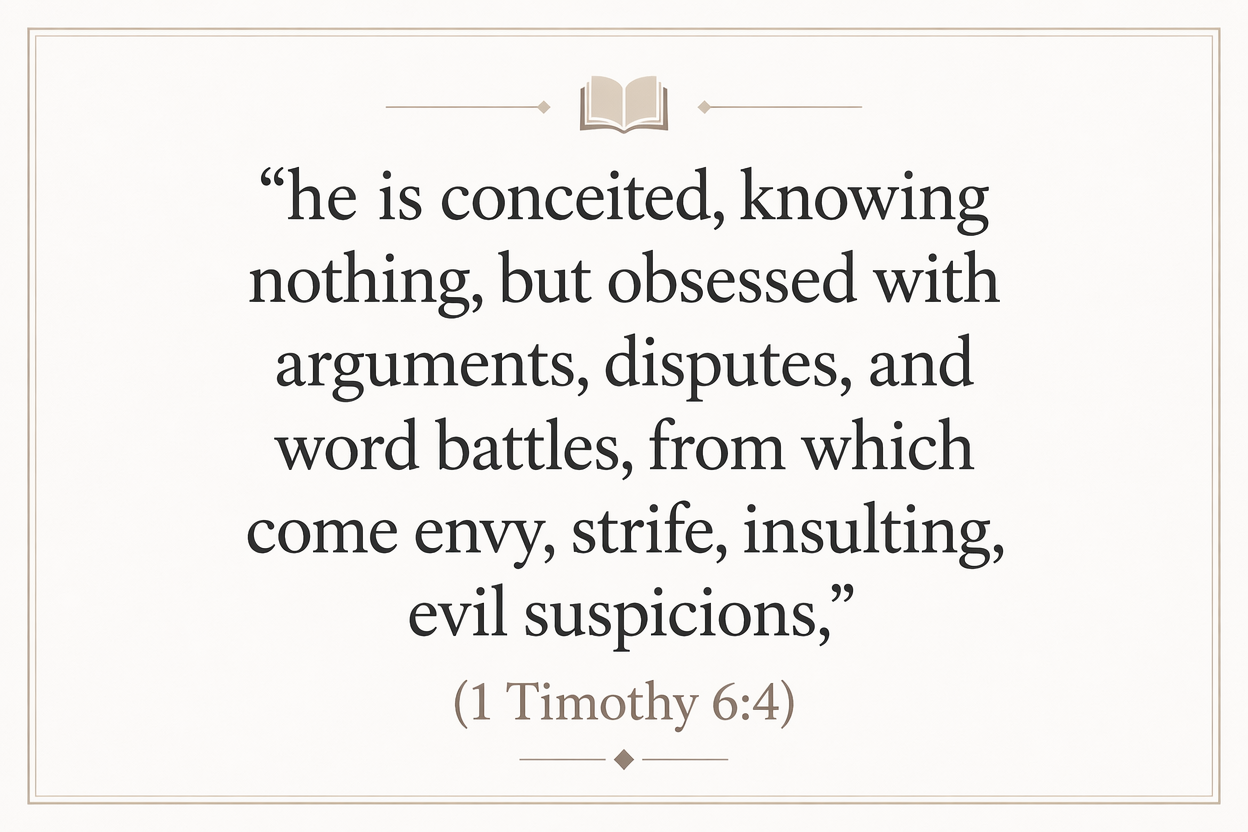
“he is conceited, knowing nothing, but obsessed with arguments, disputes, and word battles, from which come envy, strife, insulting, evil suspicions,” (1 Timothy 6:4)
In this sentence, ὑπόνοια is not introduced as a private moment of doubt but as an outcome—one item in a chain of effects that “come” from a particular kind of obsession. The person in view is described in a stack of characterizations (“conceited,” “knowing nothing,” “obsessed”) that portray a mind and manner bent toward contention. That inner posture expresses itself socially through “arguments, disputes, and word battles,” and Paul presents ὑπόνοια as one of the concrete results those verbal conflicts generate.
The noun is placed at the end of a list: “envy, strife, insulting, evil suspicions.” This positioning gives it the feel of a culminating symptom within the same diseased environment. Envy and strife point to rivalry and fracture; insulting points to speech that injures; and ὑπόνοια names the corrosive attitude of suspicion that thrives where people are trained to hear the worst and read hostile intent. The verse frames suspicion as “evil,” which in the logic of the sentence marks it as morally blameworthy rather than merely cautious. It is therefore not commended as discernment but condemned as one of the relational poisons produced by contentious talk.
Because the suspicions are said to arise “from” obsession with disputes, the noun also functions diagnostically. It identifies a predictable social atmosphere around certain kinds of teaching and argumentation: when discussion becomes a battleground, trust collapses and suspicion fills the space. In this way ὑπόνοια contributes to the verse’s portrait of how destructive patterns of words reshape a community’s emotional and moral climate.
Sense and Usage
Within its New Testament setting, “suspicion” is shown as more than an isolated thought; it is a relational stance that spreads in a community shaped by quarrelsome speech. In 1 Timothy 6:4, suspicion is pluralized (“suspicions”) and connected to a broader web of sins, which suggests repeated, multiplying instances rather than a single, fleeting concern. The plural form fits Paul’s depiction of an environment where accusations and dark readings of motives become common currency.
The immediate collocation of ὑπόνοια with “insulting” is especially revealing for how suspicion behaves. Suspicion often remains unspoken, but here it stands next to overt verbal harm, implying that it does not stay hidden; it tends to surface as insinuation, contempt, or hostile interpretation. The verse does not isolate suspicion as a psychological struggle to be managed internally; it treats it as a social pollutant with public consequences, emerging from “word battles” and feeding back into them.
At the same time, Paul’s line of thought ties suspicion to distorted knowing: the person is “conceited, knowing nothing,” yet “obsessed with arguments.” Suspicion in this frame is not a mark of penetrating insight; it is compatible with ignorance and pride. It is the kind of “supposing” that pretends to know what others mean or intend, but it grows out of conceit and conflict rather than understanding. Thus ὑπόνοια names suspicion as a moral and communal problem—an attitude that thrives where prideful contention replaces humility and careful thought.
The adjective “evil” also clarifies the kind of suspicion in view. The term is not used for reasonable caution or prudent reserve, but for suspicions that corrupt relationships. “Evil suspicions” presuppose a readiness to suspect wrongdoing, ulterior motives, or malice; they do not wait for clarity but interpret in a way that harms. In Paul’s sequence, suspicion belongs with envy and strife as a driver of disunity: where people envy, they resent; where they strive, they compete; where they insult, they wound; and where they suspect, they distrust. The noun therefore functions as a name for distrustful conjecture that destabilizes fellowship.
Because the verse links suspicion to “arguments, disputes, and word battles,” ὑπόνοια also carries a rhetorical setting. Words are the soil in which it grows: not simply talk, but talk framed as combat. The noun fits the dynamics of dispute, where each statement is heard as a strategy, each question as a trap, and each disagreement as a threat. In such a setting, suspicion becomes habitual—a way of listening and responding. Paul’s phrasing suggests that suspicion is not an accidental byproduct but a characteristic fruit of that kind of discourse.
Imagery
1 Timothy 6:4 paints suspicion as something that “comes” out of a cycle of verbal conflict, like a noxious byproduct of continual friction. The imagery of “word battles” evokes a scene where language is weaponized; within that scene, ὑπόνοια names the dark cloud that hangs over relationships when every exchange is contested and every motive is questioned.
Sources: Lexical data from Strong’s Exhaustive Concordance and the Translators Brief Lexicon of Extended Strongs for Greek (STEPBible, CC BY). Occurrence data from the Translators Amalgamated Greek New Testament (STEPBible, CC BY). Scripture quotations from the World English Bible (public domain).