
Exploring the Meaning of Hupomone in Greek
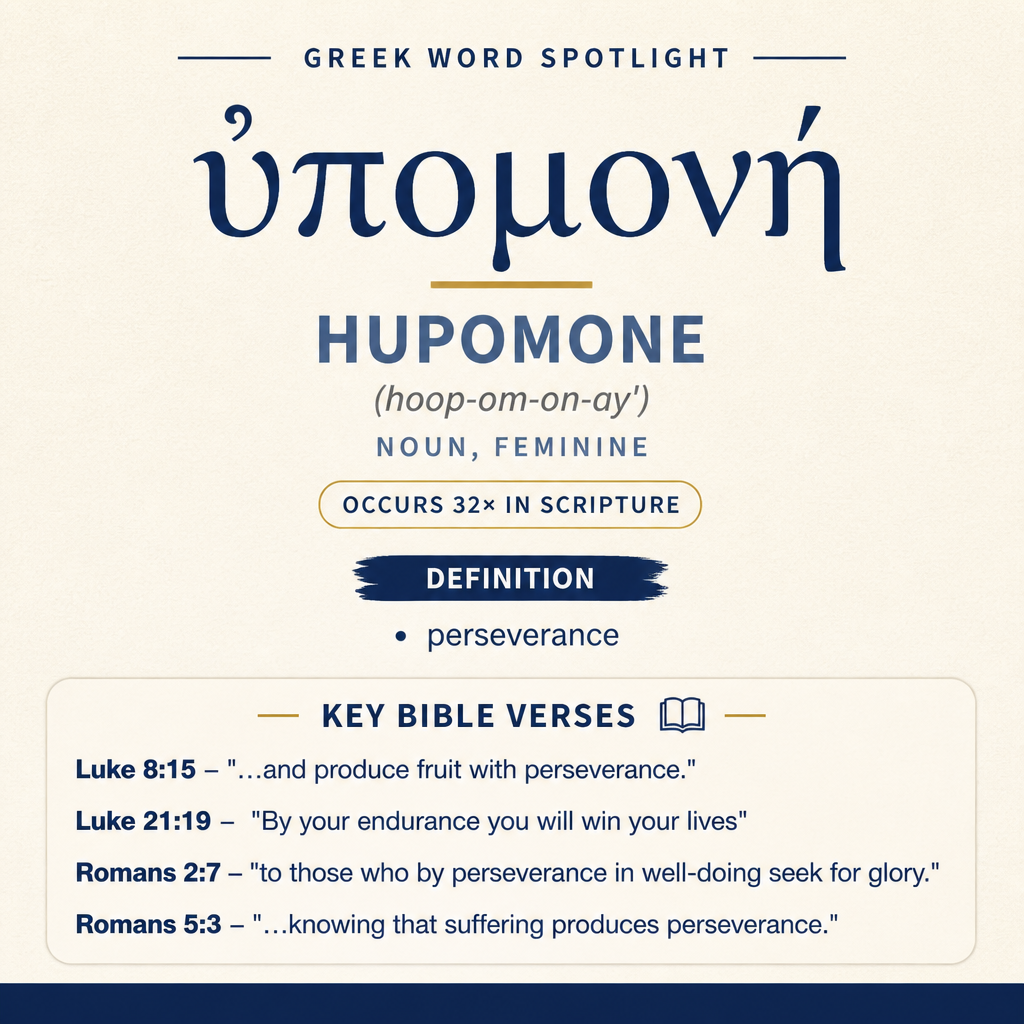
ὑπομονή means “perseverance” and occurs 32 times in Scripture, including Luke 8:15; 21:19 and Romans 2:7; 5:3–4; 8:25; 15:4–5.
Core Meaning
ὑπομονή is defined as “perseverance.” In Luke 21:19 it is linked with winning your lives through endurance.
Learn More →Romans Usage
In Romans 2:7, perseverance in well-doing is associated with seeking eternal life. Romans 5:3–4 connects suffering, perseverance, proven character, and hope.
Learn More →Learning & Hope
Romans 8:25 connects hope with waiting in patience. Romans 15:4–5 speaks of perseverance and encouragement for learning and unity in Christ.
Learn More →ὑπομονή denotes perseverance, the steady continuance that holds its course over time. In the passages where it appears here, it is repeatedly set in contexts of hearing and keeping the word, suffering and affliction, waiting in hope, and the shared life of the church.
Occurrences
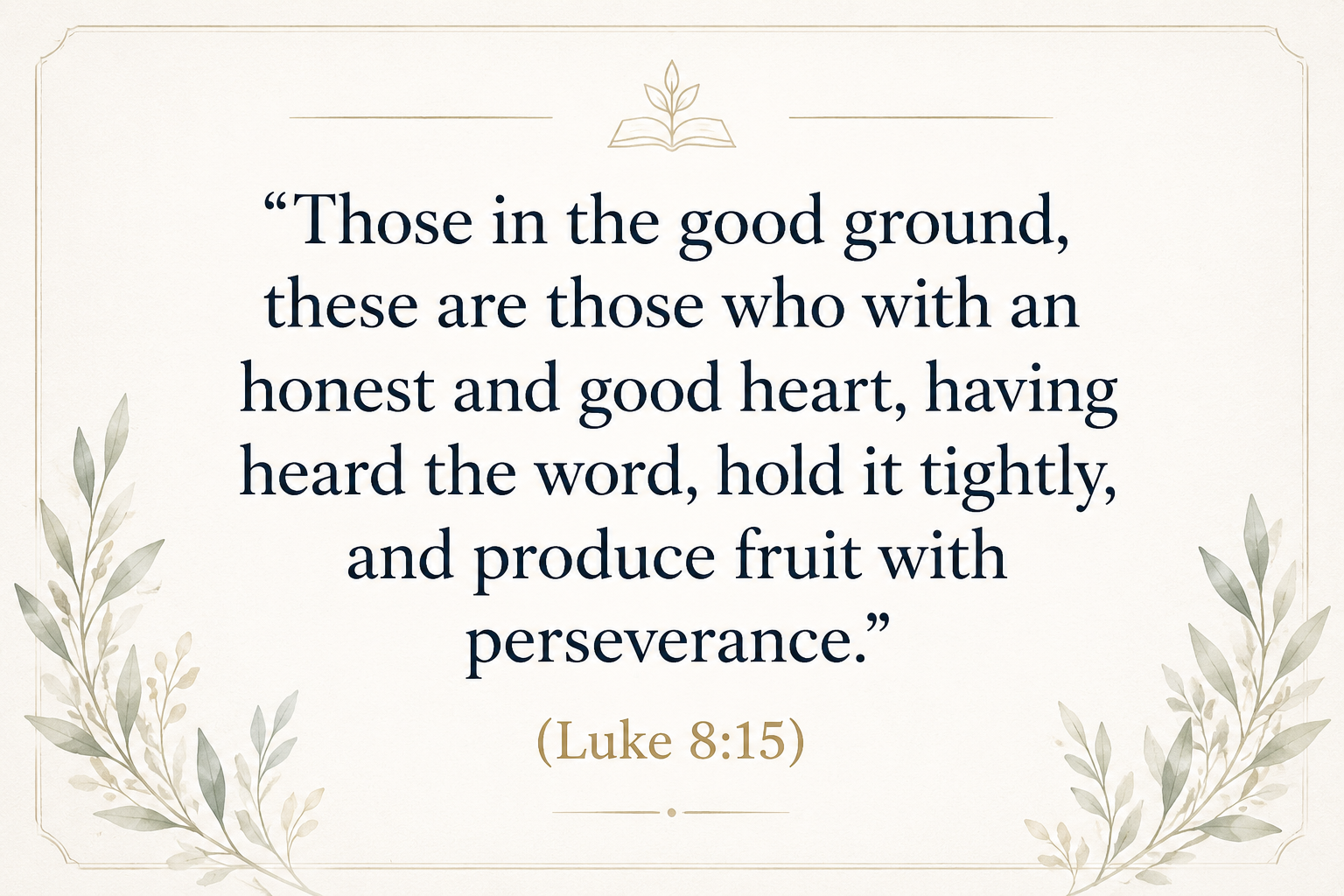
“Those in the good ground, these are those who with an honest and good heart, having heard the word, hold it tightly, and produce fruit with perseverance.” (Luke 8:15)
Perseverance is the manner in which lasting fruitfulness comes about. The verse ties it to a sequence: hearing “the word,” holding it “tightly,” and then producing “fruit.” ὑπομονή names the sustained staying-with that keeps the word held fast long enough for fruit to emerge; it is not momentary enthusiasm but the continuing persistence that carries obedience forward.
“By your endurance you will win your lives.” (Luke 21:19)
Here ὑπομονή stands as the decisive factor for “winning” one’s life. The statement is terse and direct: the outcome (“you will win your lives”) is linked to the means (“By your endurance”). Perseverance is presented as what enables faithful continuance when circumstances press toward loss rather than gain.
“to those who by perseverance in well-doing seek for glory, honor, and incorruptibility, eternal life;” (Romans 2:7)
Perseverance is attached to “well-doing” and to an ongoing seeking: “seek for glory, honor, and incorruptibility.” The verse depicts a sustained pattern, not an isolated deed. ὑπομονή frames well-doing as something maintained over time, a continuing course in which the seeking remains active and directed.
“Not only this, but we also rejoice in our sufferings, knowing that suffering produces perseverance;” (Romans 5:3)
In this chain, perseverance is explicitly presented as an effect: “suffering produces perseverance.” The verse also shows the knowing that undergirds rejoicing—rejoicing is linked to recognizing what suffering brings about. ὑπομονή is the formed capacity to continue under pressure, arising from the experience of sufferings rather than from ease.
“and perseverance, proven character; and proven character, hope:” (Romans 5:4)
Perseverance is the pivotal middle term in a progression: it leads into “proven character,” and that in turn into “hope.” ὑπομονή is not merely survival; it is productive. Within the sequence, it is the kind of continuing steadfastness that shapes a person into something “proven,” and this proven quality becomes fertile ground for hope.
“But if we hope for that which we don’t see, we wait for it with patience.” (Romans 8:25)
Here perseverance appears in the posture of waiting: hope concerns “that which we don’t see,” and the appropriate response is to “wait for it with patience.” ὑπομονή gives waiting a moral and spiritual texture—it is not passive delay but steady, sustained expectation that holds its place even without visible fulfillment.
“For whatever things were written before were written for our learning, that through perseverance and through encouragement of the Scriptures we might have hope.” (Romans 15:4)
Perseverance is paired with “encouragement of the Scriptures,” and together they serve a purpose: “that … we might have hope.” The verse sets ὑπομονή within a learning process shaped by what “were written before.” Perseverance is not isolated grit; it is a quality nourished alongside scriptural encouragement so that hope is sustained rather than extinguished.
“Now the God of perseverance and of encouragement grant you to be of the same mind with one another according to Christ Jesus,” (Romans 15:5)
ὑπομονή is attributed to God in a genitive description: “the God of perseverance and of encouragement.” In the immediate aim of the prayer, this divine perseverance is connected to communal unity—being “of the same mind with one another.” Perseverance is thus not only an individual trait but part of the divine support that enables a community to remain aligned “with one another” in a Christ-shaped way.
“But if we are afflicted, it is for your comfort and salvation. If we are comforted, it is for your comfort, which produces in you the patient enduring of the same sufferings which we also suffer.” (2 Corinthians 1:6)
Perseverance is described as “the patient enduring” that is produced in believers through comfort, specifically in relation to “the same sufferings.” The verse holds together affliction, comfort, and a resulting endurance that is shared: “which we also suffer.” ὑπομονή here is communal and sympathetic—an endurance formed as the church learns to bear sufferings that are not unique to one group but experienced together.
“but in everything commending ourselves, as servants of God, in great endurance, in afflictions, in hardships, in distresses,” (2 Corinthians 6:4)
Perseverance is the first quality in a list that situates ministry under strain: “in great endurance, in afflictions, in hardships, in distresses.” ὑπομονή functions as the overarching frame in which those pressures are borne. It is not presented as a private virtue but as part of how “servants of God” commend themselves—visible, tested steadiness amid concrete difficulties.
“Truly the signs of an apostle were worked among you in all perseverance, in signs and wonders and mighty works.” (2 Corinthians 12:12)
Perseverance is placed alongside extraordinary attestations: “signs and wonders and mighty works.” Yet it is introduced with comprehensiveness: “in all perseverance.” ὑπομονή is treated as integral to apostolic ministry, not as an optional background feature. The verse implies that persevering continuance is itself part of what was “worked among you,” marking the manner in which ministry was carried out and sustained.
“strengthened with all power, according to the might of his glory, for all endurance and perseverance with joy,” (Colossians 1:11)
Perseverance is the intended outcome of divine strengthening: “strengthened with all power … for all endurance and perseverance with joy.” The pairing of “endurance and perseverance” and the addition “with joy” place ὑπομονή within spiritual empowerment rather than mere temperament. The verse presents perseverance as something enabled “according to the might of his glory,” and as compatible with joy rather than only grim survival.

Sense and Usage
Across these passages, perseverance appears as sustained continuance under conditions that would naturally erode resolve: the slow work of fruit-bearing (Luke 8:15), the pressure implied by the need to “win your lives” (Luke 21:19), and the long-term pursuit of well-doing and seeking (Romans 2:7). It is repeatedly oriented toward an end that is not immediately in hand—fruit that takes time, life that must be “won,” and realities sought or hoped for rather than possessed.
Paul’s sequences in Romans give ὑπομονή a distinctive role: it can be produced (“suffering produces perseverance,” Romans 5:3), and it can itself be productive (“perseverance, proven character; and proven character, hope,” Romans 5:4). In that framing, perseverance is both outcome and instrument—formed by adversity and then functioning as a conduit toward tested character and hope. Romans 8:25 tightens this to the realm of unseen fulfillment: hope for what is not seen calls for waiting marked by patient steadiness. This makes perseverance a kind of disciplined temporality: it governs how faith lives between promise and sight.
Romans 15:4–5 roots perseverance in Scripture and in God’s own character. The Scriptures foster learning whose fruit is hope “through perseverance and through encouragement,” and God is invoked as “the God of perseverance and of encouragement” to grant unity of mind. Perseverance, then, is not merely the individual’s inner reserve; it is sustained by what is written and by the God who gives both perseverance and encouragement for communal life. The virtue is social in its effects—serving the aim of being “of the same mind with one another.”
In 2 Corinthians, perseverance is placed in the lived realities of ministry. It is produced in the afflicted community through comfort that teaches them to endure “the same sufferings” (2 Corinthians 1:6). It is also an explicit mark by which servants of God commend themselves amid “afflictions, … hardships, … distresses” (2 Corinthians 6:4). Finally, it stands alongside “signs and wonders and mighty works” as part of the apostolic pattern “worked among you” (2 Corinthians 12:12), showing that sustained steadfastness belongs with conspicuous power as a feature of authenticated ministry.
Colossians 1:11 adds the note of empowerment and affect: perseverance is something believers are strengthened for, and it is meant to be carried “with joy.” This keeps the word from being reduced to stubbornness. In these verses, perseverance is consistently relational—linked to the word heard and held, to the Scriptures that encourage, to God who grants unity, to shared sufferings, and to a community that learns endurance together.
Imagery
The dominant imagery around ὑπομονή in these passages is agricultural growth and long waiting. Fruit is produced over time by holding the word tightly (Luke 8:15), and hope waits for what is unseen with patient steadiness (Romans 8:25). Alongside this are the images of pressure—sufferings, afflictions, hardships, distresses—within which perseverance is not crushed but formed and displayed (Romans 5:3; 2 Corinthians 6:4). The word thus carries the feel of sustained weight-bearing: a continuing firmness that lasts long enough for fruit, character, hope, unity, and joy to take shape.
Sources: Lexical data from Strong’s Exhaustive Concordance and the Translators Brief Lexicon of Extended Strongs for Greek (STEPBible, CC BY). Occurrence data from the Translators Amalgamated Greek New Testament (STEPBible, CC BY). Scripture quotations from the World English Bible (public domain).





