
Exploring the Meaning of Hudor in Greek
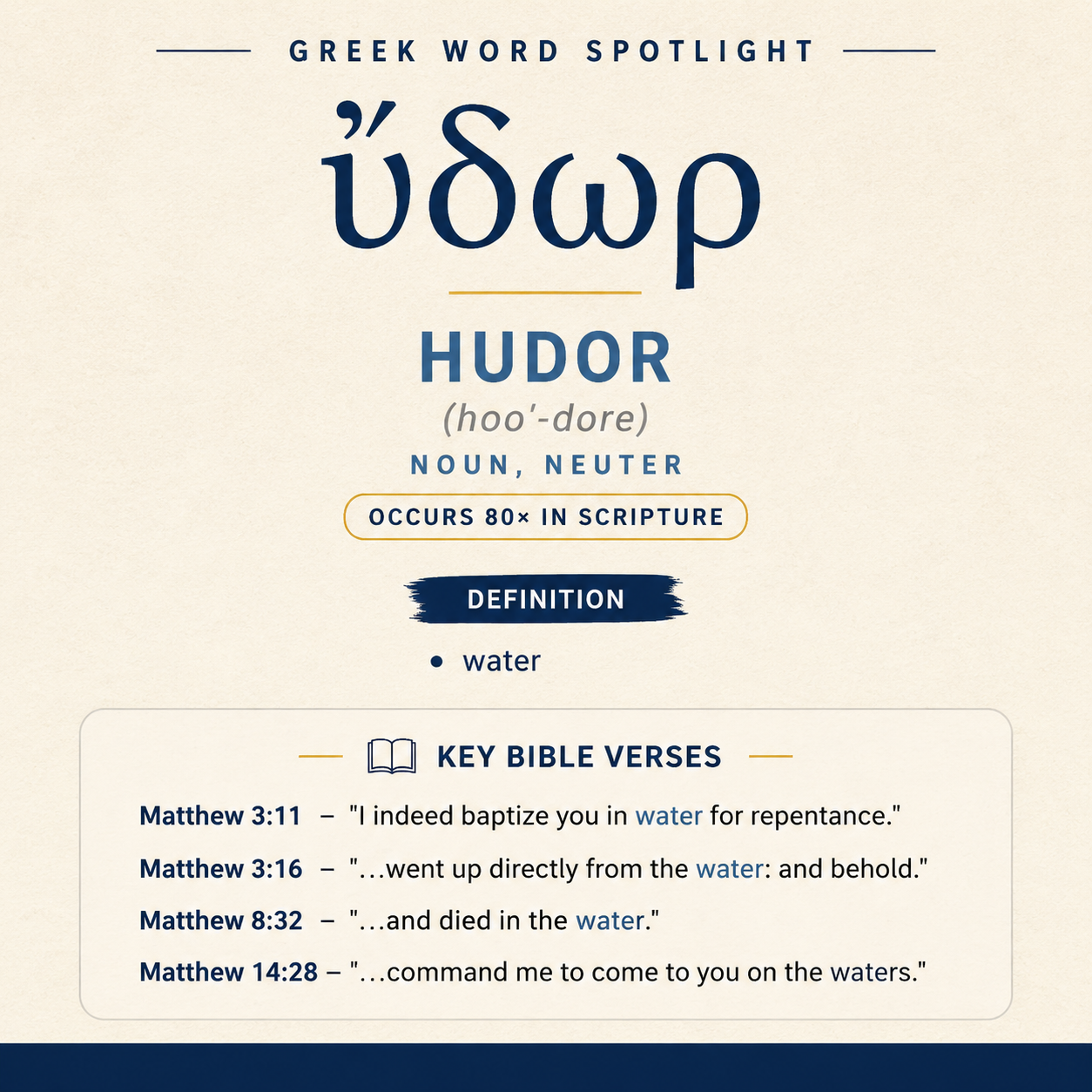
ὕδωρ (Hudor) means “water” in Greek and occurs 80 times in Scripture, including passages in Matthew about baptism, waters, and washing.
Matthew Examples
In Matthew 3:11 and 3:16 it appears in baptism “in water” and coming up from the water. In Matthew 27:24 it is used when Pilate took water and washed his hands.
Learn More →ὕδωρ names “water,” appearing in scenes of baptism, sea-crossing, danger, ritual handwashing, and simple refreshment. In these passages it can be a medium that surrounds, receives, and even threatens, as well as a basic necessity offered in hospitality.
Occurrences
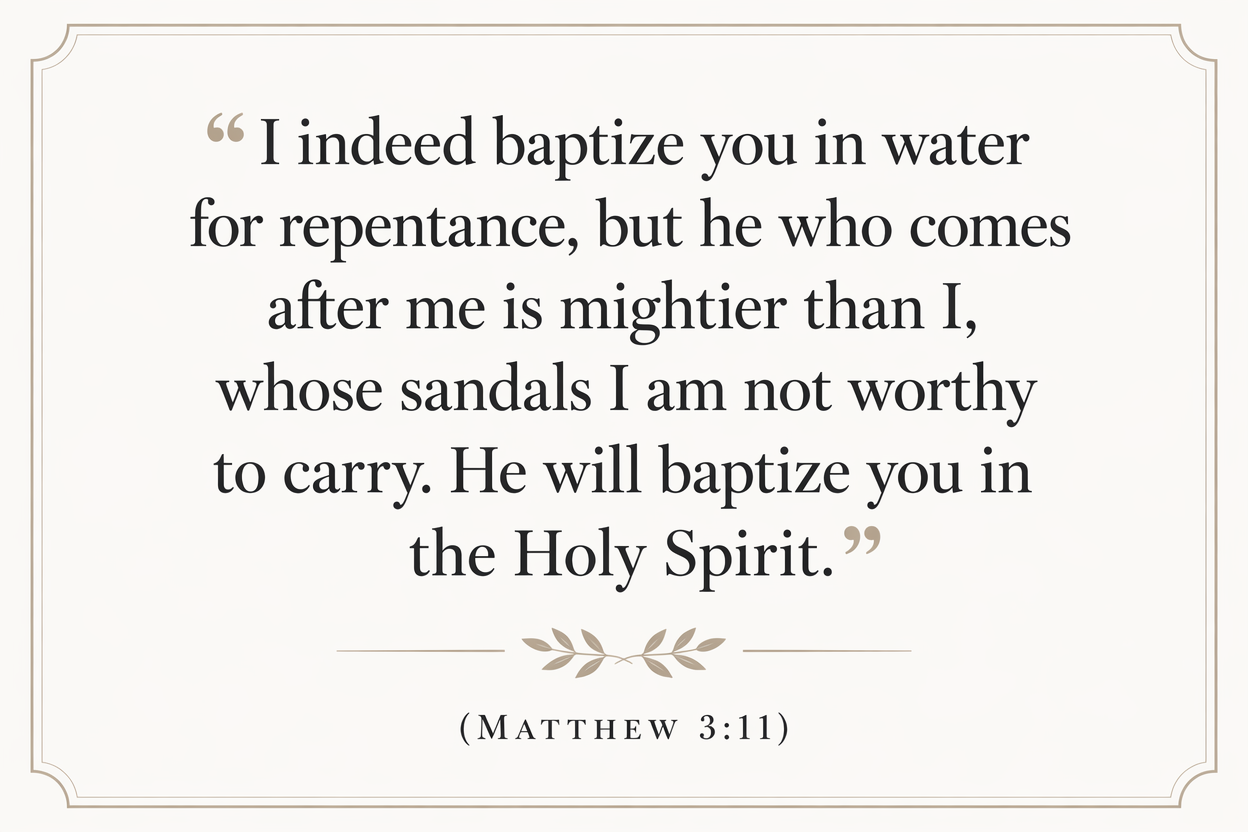
“I indeed baptize you in water for repentance, but he who comes after me is mightier than I, whose sandals I am not worthy to carry. He will baptize you in the Holy Spirit.” (Matthew 3:11)
Here ὕδωρ marks the element in which John’s baptism takes place. The line contrasts two baptisms by distinguishing their respective spheres: one in water “for repentance,” and another in “the Holy Spirit,” so that water functions as the concrete, physical medium of the first rite.
“Jesus, when he was baptized, went up directly from the water: and behold, the heavens were opened to him. He saw the Spirit of God descending as a dove, and coming on him.” (Matthew 3:16)
Water is the setting from which Jesus emerges after baptism—“went up directly from the water.” The narrative uses that movement to frame what follows: the opened heavens and the Spirit’s descent, with the water serving as the immediate, visible environment of the baptismal act.
“He said to them, “Go!” They came out, and went into the herd of pigs: and behold, the whole herd of pigs rushed down the cliff into the sea, and died in the water.” (Matthew 8:32)
ὕδωρ here identifies the lethal medium in which the animals perish. Though the motion is “into the sea,” the death is described as occurring “in the water,” focusing attention on water as the engulfing element that ends their life when the herd plunges down the cliff.
“Peter answered him and said, “Lord, if it is you, command me to come to you on the waters.”” (Matthew 14:28)
In Peter’s request, “the waters” presents the expanse separating him from Jesus as a surface he cannot ordinarily traverse. The plural form matches the scene’s breadth and movement, portraying water as the wide, unstable environment upon which Peter asks to walk.
“He said, “Come!” Peter stepped down from the boat, and walked on the waters to come to Jesus.” (Matthew 14:29)
Water again functions as the improbable pathway: Peter “stepped down from the boat” and “walked on the waters.” The wording makes the water the immediate ground beneath his feet, highlighting the abnormality of walking where one would normally sink.
““Lord, have mercy on my son, for he is epileptic, and suffers grievously; for he often falls into the fire, and often into the water.” (Matthew 17:15)
Here water appears as one of two recurring hazards—paired with fire—into which the boy “often falls.” The phrase sets water within a pattern of repeated danger, presenting it not as cleansing or life-giving but as a threatening environment in the course of the affliction.
“So when Pilate saw that nothing was being gained, but rather that a disturbance was starting, he took water, and washed his hands before the multitude, saying, “I am innocent of the blood of this righteous person. You see to it.”” (Matthew 27:24)
In this public gesture, water is the substance Pilate “took” for handwashing “before the multitude.” Water functions as the practical means for the visible act; the washing is staged as a response to the rising “disturbance,” and the water enables the outward performance accompanying his spoken claim of innocence.
“The rest said, “Let him be. Let’s see whether Elijah comes to save him.”” (Matthew 27:49)
This verse is part of the crucifixion scene’s spoken exchange. In the flow of the narrative, the attention is on the crowd’s decision to wait and watch, setting the surrounding actions and reactions in which water can be used as an immediate, tangible object within the scene’s tense observance.
“I baptized you in water, but he will baptize you in the Holy Spirit.” (Mark 1:8)
As in Matthew 3:11, water identifies the element of John’s baptism. The contrast again depends on naming water as the medium of one baptism over against “the Holy Spirit” as the medium of another, so water locates the first act firmly in the realm of the physical.
“Immediately coming up from the water, he saw the heavens parting, and the Spirit descending on him like a dove.” (Mark 1:10)
Water is the source from which Jesus “coming up” marks the completion of the baptismal action. The verse uses this movement as the pivot point into the vision of the heavens parting and the Spirit descending, with water remaining the concrete context at the moment the divine sign appears.
“Often it has cast him both into the fire and into the water to destroy him. But if you can do anything, have compassion on us, and help us.”” (Mark 9:22)
Water again stands alongside fire as an instrument of harm: the boy is cast “into the water to destroy him.” The wording emphasizes intent and outcome—destruction—so that water is portrayed as a place where life is threatened, not merely discomforted.
“For whoever will give you a cup of water to drink in my name, because you are Christ’s, most certainly I tell you, he will in no way lose his reward.” (Mark 9:41)
Here water is measured and offered—“a cup of water to drink”—shifting from danger and vastness to everyday need. Water becomes the substance of a small, concrete kindness, and its simplicity underscores the accessibility of the act: a basic drink given “in my name.”
Sense and Usage
Across these passages, ὕδωρ consistently denotes water, but the scenes show how that single referent can serve very different narrative functions. In baptism (Matthew 3:11, 3:16; Mark 1:8, 1:10), water is the element that surrounds the baptized person and from which one emerges. The repeated phrase “from the water” anchors the rite in a visible, bodily action: going down into a tangible medium and then coming up out of it. Within those accounts, water also provides the grounded contrast that allows a second baptism to be described without confusion: water names an ordinary, material element, set alongside “the Holy Spirit” as a distinct sphere.
In the sea episodes, water’s scale and force come into view. In Matthew 14:28–29 “the waters” stretch between boat and Jesus, and the narrative focuses on the impossibility of using water as a walkway. Water is not described here in terms of depth or waves; it is simply the environment that, in normal experience, cannot bear a human step. In Matthew 8:32, water functions as the engulfing element associated with death: the pigs “died in the water.” The line draws the eye to what finally holds them—water becomes the place in which their descent ends.
In the affliction accounts (Matthew 17:15; Mark 9:22), water appears as a recurring peril, coordinated with fire. The repeated “often” language gives water a grim regularity: it is one of the predictable destinations into which the boy falls or is cast. Water is not neutral scenery in these lines; it is part of the destructive pattern that elicits the plea for mercy and help.
Matthew 27:24 uses water as a tool for an immediate, observable action. The verse stresses that Pilate “took water” and washed “before the multitude,” making the substance itself part of the public staging. Water enables the handwashing, and because the action is performed in front of others, water serves as the practical means of a gesture intended to be seen as well as done.
Mark 9:41 narrows water down to a “cup,” presenting it as a basic provision for thirst. In this setting, water is neither vast nor dangerous but simple and portable. The phrase “to drink” keeps the reference concrete and bodily, and the verse frames the gift of water as a recognizable act of care within discipleship.
Imagery
These texts place water at the intersection of ordinary life and moments of crisis or revelation. It can be the immediate environment of baptism from which one rises into an opened-heavens scene (Matthew 3:16; Mark 1:10), the threatening element that can “destroy” (Mark 9:22), the overwhelming medium in which creatures “died” (Matthew 8:32), and the plain refreshment contained in “a cup of water” (Mark 9:41). Even when the narratives use water for public action, as in Pilate’s handwashing (Matthew 27:24), it remains a tangible substance whose visibility supports what is being enacted before others.
Sources: Lexical data from Strong’s Exhaustive Concordance and the Translators Brief Lexicon of Extended Strongs for Greek (STEPBible, CC BY). Occurrence data from the Translators Amalgamated Greek New Testament (STEPBible, CC BY). Scripture quotations from the World English Bible (public domain).





